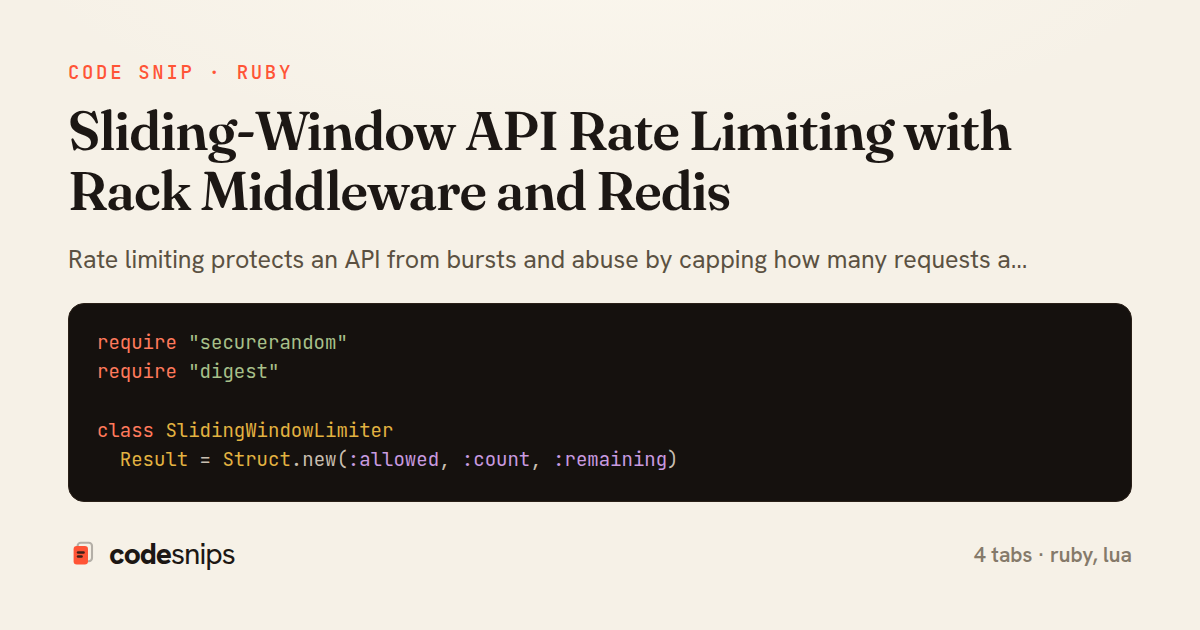
require "securerandom"
require "digest"

class SlidingWindowLimiter
  Result = Struct.new(:allowed, :count, :remaining)

  def initialize(redis:, limit:, window_ms:)
    @redis = redis
    @limit = limit
    @window_ms = window_ms
    @script = File.read(File.expand_path("rate_limit.lua", __dir__))
    @sha = Digest::SHA1.hexdigest(@script)
  end

  def allow?(client_key)
    now_ms = redis_time_ms
    member = "#{now_ms}-#{SecureRandom.hex(4)}"
    allowed, count = eval_script(client_key, now_ms, member)
    Result.new(allowed == 1, count, [@limit - count, 0].max)
  end

  private

  def eval_script(key, now_ms, member)
    args = [now_ms, @window_ms, @limit, member]
    @redis.evalsha(@sha, keys: ["ratelimit:#{key}"], argv: args)
  rescue Redis::CommandError => e
    raise unless e.message.include?("NOSCRIPT")
    @redis.eval(@script, keys: ["ratelimit:#{key}"], argv: args)
  end

  def redis_time_ms
    secs, micros = @redis.time
    (secs * 1000) + (micros / 1000)
  end
end
local key      = KEYS[1]
local now      = tonumber(ARGV[1])
local window   = tonumber(ARGV[2])
local limit    = tonumber(ARGV[3])
local member   = ARGV[4]

-- Drop everything older than the trailing window.
redis.call('ZREMRANGEBYSCORE', key, 0, now - window)

local count = redis.call('ZCARD', key)

if count < limit then
  redis.call('ZADD', key, now, member)
  redis.call('PEXPIRE', key, window)
  return { 1, count + 1 }
end

redis.call('PEXPIRE', key, window)
return { 0, count }
require "json"

class RackThrottle
  def initialize(app, limiter:, logger: nil)
    @app = app
    @limiter = limiter
    @logger = logger
  end

  def call(env)
    key = client_key(env)
    result = @limiter.allow?(key)

    unless result.allowed
      return too_many_requests(result)
    end

    status, headers, body = @app.call(env)
    headers["X-RateLimit-Limit"] = @limiter.instance_variable_get(:@limit).to_s
    headers["X-RateLimit-Remaining"] = result.remaining.to_s
    [status, headers, body]
  rescue => e
    @logger&.error("rate limiter failed, failing open: #{e.class}: #{e.message}")
    @app.call(env)
  end

  private

  def client_key(env)
    token = env["HTTP_AUTHORIZATION"].to_s[/Bearer\s+(.+)/, 1]
    token || Rack::Request.new(env).ip
  end

  def too_many_requests(result)
    body = JSON.dump(error: "rate_limit_exceeded", retry_after: 1)
    headers = {
      "Content-Type" => "application/json",
      "Retry-After" => "1",
      "X-RateLimit-Remaining" => "0"
    }
    [429, headers, [body]]
  end
end
require "redis"
require "logger"
require_relative "sliding_window_limiter"
require_relative "rack_throttle"
require_relative "app"

redis = Redis.new(url: ENV.fetch("REDIS_URL", "redis://localhost:6379/0"))

limiter = SlidingWindowLimiter.new(
  redis: redis,
  limit: 100,
  window_ms: 60_000
)

use RackThrottle, limiter: limiter, logger: Logger.new($stdout)

run API::Application.new
Rate limiting protects an API from bursts and abuse by capping how many requests a client may make in a rolling time span. This snippet implements a sliding-window limiter as Rack middleware backed by Redis, using a sorted set per client so the window slides continuously rather than resetting on fixed boundaries. Fixed-window counters are simpler but suffer from the boundary problem: a client can send a full quota at the end of one window and another full quota at the start of the next, briefly doubling the intended rate. A sliding window avoids that by scoring every request with its timestamp and only counting those inside the trailing window.
The SlidingWindowLimiter file holds the core algorithm. Each client gets a Redis sorted set keyed by identity; request timestamps (in milliseconds) are the members and the scores. On every call, #allow? removes entries older than now - window with ZREMRANGEBYSCORE, counts the survivors with ZCARD, and, if under the limit, adds the new timestamp and sets a TTL so idle keys expire. Running these steps individually would be racy under concurrency, so they are executed atomically inside a Lua script via EVALSHA. The script returns both the current count and the allowance decision, which lets the middleware emit accurate X-RateLimit-Remaining headers without a second round trip.
The Lua body lives in rate_limit.lua. Because Redis runs the whole script as a single atomic operation, no other client can interleave between the prune, the count, and the insert. KEYS[1] is the client bucket; the ARGV carry the current time, window size, limit, and a unique member value (timestamp plus a random suffix) so two requests landing in the same millisecond do not collide in the sorted set. The script returns {allowed, count}, and it only writes the new member when the request is actually permitted, keeping rejected requests from inflating the window.
The RackThrottle middleware wires this into a Rack app. #call derives a client key — an API token when present, otherwise the remote IP — and consults the limiter. When the request is allowed it forwards to the next app in the stack and decorates the response with X-RateLimit-Limit and X-RateLimit-Remaining. When the limit is exceeded it short-circuits with a 429 Too Many Requests JSON body and a Retry-After header, never touching the downstream app. Fail-open behavior is deliberate: if Redis raises, #call logs and lets the request through, since a limiter outage should not become a full outage.
The config.ru file shows the assembly, inserting the middleware ahead of the application with a shared Redis pool and per-route policy. Trade-offs worth noting: sorted sets cost memory proportional to requests-in-window per client, so very high limits should prefer approximate counters; and clock skew across app servers is avoided by using Redis TIME as the authority rather than each host's clock.
Related snips
class Money
  include Comparable

  attr_reader :amount, :currency

  def initialize(amount, currency = 'USD')
Value objects for domain modeling
payload = {
  sub: user.id,
  iss: 'https://auth.example.com',
  aud: 'codesnips-api',
  exp: 15.minutes.from_now.to_i,
  iat: Time.now.to_i,
JWT issuance and verification without common footguns
module Api
  module V1
    class UsersController < BaseController
      def show
        user = User.includes(:profile).find(params[:id])
ETags for conditional requests and caching
require "csv"

class PeopleCsvStream
  include Enumerable

  HEADERS = %w[id full_name email signed_up_at plan].freeze
Resilient CSV Export as a Streamed Response
type User {
    id: ID!
    name: String!
    email: String!
    posts: [Post!]!
    createdAt: String!
GraphQL API with Spring Boot
// Creating a Promise
const myPromise = new Promise((resolve, reject) => {
  const success = true;

  setTimeout(() => {
    if (success) {
Promises and async/await patterns for asynchronous JavaScript
Share this code
Here's the card — post it anywhere.