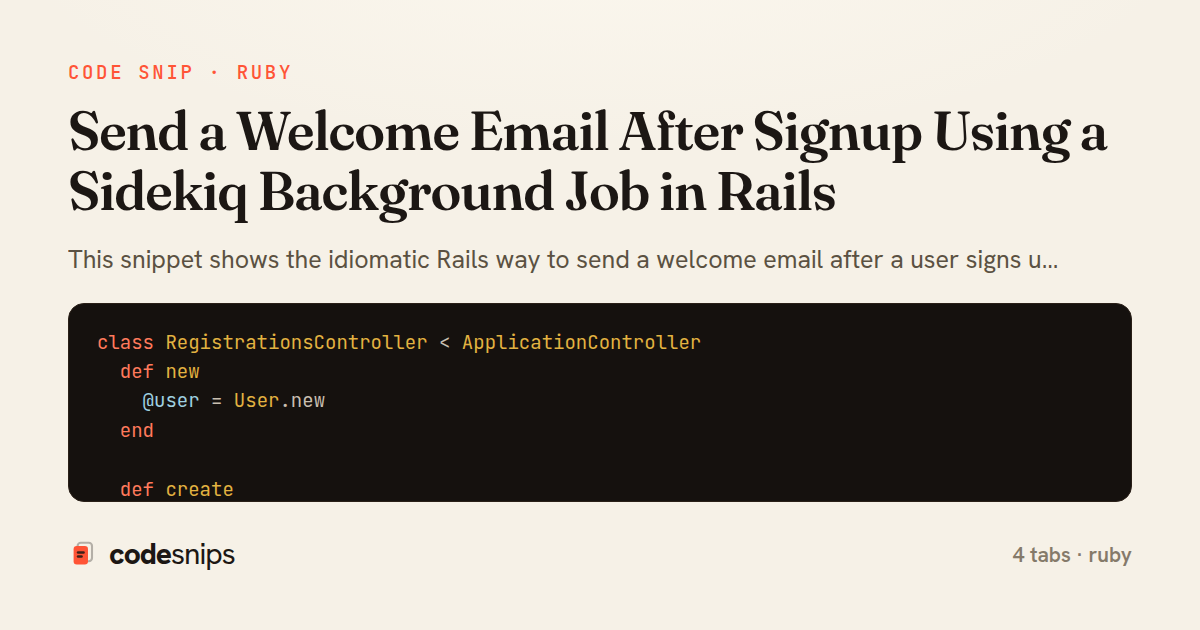
class RegistrationsController < ApplicationController
  def new
    @user = User.new
  end

  def create
    @user = User.new(user_params)

    if @user.save
      session[:user_id] = @user.id
      redirect_to dashboard_path, notice: "Welcome aboard! Check your inbox."
    else
      render :new, status: :unprocessable_entity
    end
  end

  private

  def user_params
    params.require(:user).permit(:email, :name, :password, :password_confirmation)
  end
end
class User < ApplicationRecord
  has_secure_password

  validates :email, presence: true, uniqueness: { case_sensitive: false }
  validates :name, presence: true

  after_commit :enqueue_welcome_email, on: :create

  def welcome_email_sent?
    welcome_email_sent_at.present?
  end

  private

  def enqueue_welcome_email
    WelcomeEmailJob.perform_later(id)
  end
end
class WelcomeEmailJob < ApplicationJob
  queue_as :mailers

  retry_on Net::OpenTimeout, wait: :polynomially_longer, attempts: 5
  discard_on ActiveJob::DeserializationError

  def perform(user_id)
    user = User.find_by(id: user_id)
    return if user.nil?
    return if user.welcome_email_sent?

    UserMailer.with(user: user).welcome.deliver_now

    user.touch(:welcome_email_sent_at)
  end
end
class UserMailer < ApplicationMailer
  default from: "hello@example.com"

  def welcome
    @user = params[:user]
    @dashboard_url = dashboard_url

    mail(
      to: @user.email,
      subject: "Welcome to Acme, #{@user.name}!"
    )
  end
end
This snippet shows the idiomatic Rails way to send a welcome email after a user signs up without blocking the HTTP request. Sending email inline during a signup request couples the response time to an external SMTP provider, and any slowness or outage in that provider makes signup itself feel slow or fail. Moving delivery to a background job decouples the two: the controller returns quickly and the email is delivered by a worker process, with automatic retries if the provider is temporarily down.
In RegistrationsController, the create action builds and saves a User inside save_and_notify. The important detail is that the email is not enqueued from the controller directly. Instead the model owns that responsibility via an after_commit callback, so the job is only scheduled once the database transaction has actually committed. This avoids a classic race: if the job were enqueued inside the transaction (for example from after_create), a fast worker could pick up the job and query for a User row that has not yet been committed, producing a spurious RecordNotFound.
In User model, enqueue_welcome_email calls WelcomeEmailJob.perform_later(id). Passing the primary key rather than the whole object is deliberate: ActiveJob serializes arguments, and GlobalID would work, but a bare integer id keeps the payload tiny and forces the job to reload fresh state at execution time. The model also exposes welcome_email_sent? backed by a welcome_email_sent_at timestamp column, which is the foundation for idempotency.
In WelcomeEmailJob, the job is a plain ApplicationJob on the mailers queue. It uses find_by rather than find so a deleted user simply returns early instead of raising and burning retries. The return if user.welcome_email_sent? guard makes the job idempotent: Sidekiq guarantees at-least-once execution, meaning a job can run more than once after a crash or a retry, so the code must tolerate duplicate invocations. Delivery uses deliver_now because the job is already asynchronous — calling deliver_later here would pointlessly enqueue a second job. After a successful send, touch(:welcome_email_sent_at) records the fact so subsequent runs short-circuit.
The trade-off worth understanding is the ordering of the guard and the send. If the process dies between deliver_now and touch, the same email could be sent twice; if the timestamp were set first, a crash could drop the email entirely. This implementation favors delivery over strict exactly-once, which is the usual choice for welcome emails where a rare duplicate is harmless but a missing email is not. For stricter guarantees a developer would introduce a provider-level idempotency key.
This pattern generalizes to almost any post-signup side effect — provisioning, analytics, syncing to a CRM — where the work should happen reliably but need not happen synchronously. Keeping the enqueue in after_commit and the idempotency guard in the job are the two habits that make it robust in production.
Related snips
class CommentsController < ApplicationController
  before_action :set_post

  def create
    @comment = @post.comments.build(comment_params)
System test: asserting Turbo Stream responses
class Money
  include Comparable

  attr_reader :amount, :currency

  def initialize(amount, currency = 'USD')
Value objects for domain modeling
class Post < ApplicationRecord
  belongs_to :author, class_name: 'User'
  has_many :comments, dependent: :destroy

  scope :published, -> { where.not(published_at: nil).where('published_at <= ?', Time.current) }
  scope :draft, -> { where(published_at: nil) }
ActiveRecord scopes for reusable query logic
module Api
  module V1
    class UsersController < BaseController
      def show
        user = User.includes(:profile).find(params[:id])
ETags for conditional requests and caching
class PostsController < ApplicationController
  def index
    @posts = Post.includes(:author)
                 .order(created_at: :desc)
                 .page(params[:page])
                 .per(10)
Turbo Frames: infinite scroll with lazy-loading frame
package dbutil

import (
  "context"

  "github.com/jackc/pgconn"
Retry Postgres serialization failures with bounded attempts
Share this code
Here's the card — post it anywhere.