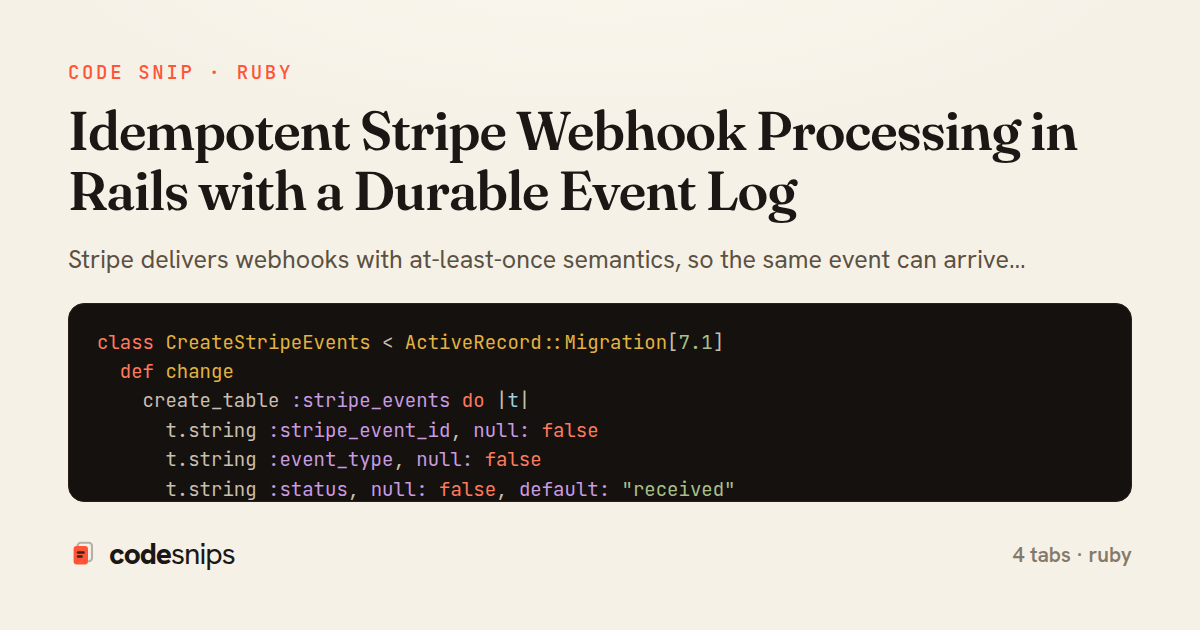
class CreateStripeEvents < ActiveRecord::Migration[7.1]
  def change
    create_table :stripe_events do |t|
      t.string :stripe_event_id, null: false
      t.string :event_type, null: false
      t.string :status, null: false, default: "received"
      t.jsonb :payload, null: false, default: {}
      t.text :last_error
      t.datetime :processed_at
      t.timestamps
    end

    add_index :stripe_events, :stripe_event_id, unique: true
    add_index :stripe_events, :status
  end
end
class StripeEvent < ApplicationRecord
  STATUSES = %w[received processed failed].freeze

  validates :stripe_event_id, presence: true, uniqueness: true
  validates :status, inclusion: { in: STATUSES }

  def self.record!(event)
    create!(
      stripe_event_id: event.id,
      event_type: event.type,
      payload: event.as_json
    )
  rescue ActiveRecord::RecordNotUnique
    find_by!(stripe_event_id: event.id)
  end

  def processed?
    status == "processed"
  end

  def mark_processed!
    update!(status: "processed", processed_at: Time.current, last_error: nil)
  end

  def mark_failed!(error)
    update!(status: "failed", last_error: error.message)
  end

  def payload_object
    Stripe::Event.construct_from(payload)
  end
end
class WebhooksController < ActionController::API
  def stripe
    payload = request.body.read
    signature = request.env["HTTP_STRIPE_SIGNATURE"]

    event = Stripe::Webhook.construct_event(
      payload,
      signature,
      Rails.application.credentials.stripe[:webhook_secret]
    )

    record = StripeEvent.record!(event)
    StripeEventJob.perform_later(record.id) unless record.processed?

    head :ok
  rescue JSON::ParserError, Stripe::SignatureVerificationError => e
    Rails.logger.warn("Rejected Stripe webhook: #{e.message}")
    head :bad_request
  end
end
class StripeEventJob < ApplicationJob
  queue_as :webhooks

  def perform(stripe_event_id)
    record = StripeEvent.find(stripe_event_id)
    return if record.processed?

    event = record.payload_object

    ActiveRecord::Base.transaction do
      handle(event)
      record.mark_processed!
    end
  rescue => e
    record&.mark_failed!(e)
    raise
  end

  private

  def handle(event)
    case event.type
    when "checkout.session.completed"
      fulfill_checkout(event.data.object)
    when "invoice.payment_failed"
      flag_past_due(event.data.object)
    else
      Rails.logger.info("Ignoring unhandled Stripe event #{event.type}")
    end
  end

  def fulfill_checkout(session)
    order = Order.find_by!(checkout_session_id: session.id)
    order.fulfill! unless order.fulfilled?
  end

  def flag_past_due(invoice)
    Subscription.find_by(stripe_id: invoice.subscription)&.mark_past_due!
  end
end
Stripe delivers webhooks with at-least-once semantics, so the same event can arrive more than once, out of order, and sometimes while an earlier delivery is still in flight. Naively handling events inline means a duplicate delivery can double-fulfill an order or credit an account twice. This snippet shows the durable-log pattern that makes processing exactly-once in effect even though delivery is at-least-once.
The create_stripe_events migration defines the table that anchors the whole approach. The stripe_event_id column carries a unique index, which turns idempotency into a database invariant rather than an application check: a duplicate insert simply fails. A status column tracks the lifecycle (received, processed, failed), and payload stores the raw JSON so processing can be retried or replayed without re-fetching from Stripe.
StripeEvent model wraps that table. record! uses create and rescues ActiveRecord::RecordNotUnique, returning the existing row when the event id has already been seen. This is the crucial move — the unique index does the deduplication, and the rescue converts the race into a normal return value. mark_processed! and mark_failed! advance the state machine, and the payload_object helper rebuilds a typed Stripe::Event for downstream code.
WebhooksController is intentionally thin. It verifies the signature with Stripe::Webhook.construct_event, which both authenticates the payload and guards against replayed bodies. Verification failures return 400 so Stripe stops retrying a malformed request. On success it calls record! and enqueues StripeEventJob, then responds 200 immediately — the endpoint acknowledges receipt fast and defers real work, so a slow handler never causes Stripe to time out and retry.
StripeEventJob does the actual fulfillment. It short-circuits if the event is already processed, wraps the handler in a transaction, and dispatches on event.type. Business methods like fulfill_checkout must themselves be idempotent, since a job can be retried after a partial failure. The combination of a unique index, an explicit status, and asynchronous processing yields a system that tolerates duplicates, retries, and crashes without corrupting payment state — the standard shape for any at-least-once integration, not just Stripe.
Related snips
class CommentsController < ApplicationController
  before_action :set_post

  def create
    @comment = @post.comments.build(comment_params)
System test: asserting Turbo Stream responses
class Post < ApplicationRecord
  belongs_to :author, class_name: 'User'
  has_many :comments, dependent: :destroy

  scope :published, -> { where.not(published_at: nil).where('published_at <= ?', Time.current) }
  scope :draft, -> { where(published_at: nil) }
ActiveRecord scopes for reusable query logic
timestamp = request.headers.fetch('X-Signature-Timestamp')
signature = request.headers.fetch('X-Signature')
payload = request.raw_post

data = "#{timestamp}.#{payload}"
expected = OpenSSL::HMAC.hexdigest('SHA256', ENV.fetch('WEBHOOK_SECRET'), data)
HMAC signed API requests for webhook and partner integrity
export interface RetryOptions {
  retries: number;
  baseMs: number;
  maxMs: number;
  signal?: AbortSignal;
  onRetry?: (attempt: number, delay: number, err: unknown) => void;
Exponential backoff with jitter for retries
module Api
  module V1
    class UsersController < BaseController
      def show
        user = User.includes(:profile).find(params[:id])
ETags for conditional requests and caching
class PostsController < ApplicationController
  def index
    @posts = Post.includes(:author)
                 .order(created_at: :desc)
                 .page(params[:page])
                 .per(10)
Turbo Frames: infinite scroll with lazy-loading frame
Share this code
Here's the card — post it anywhere.