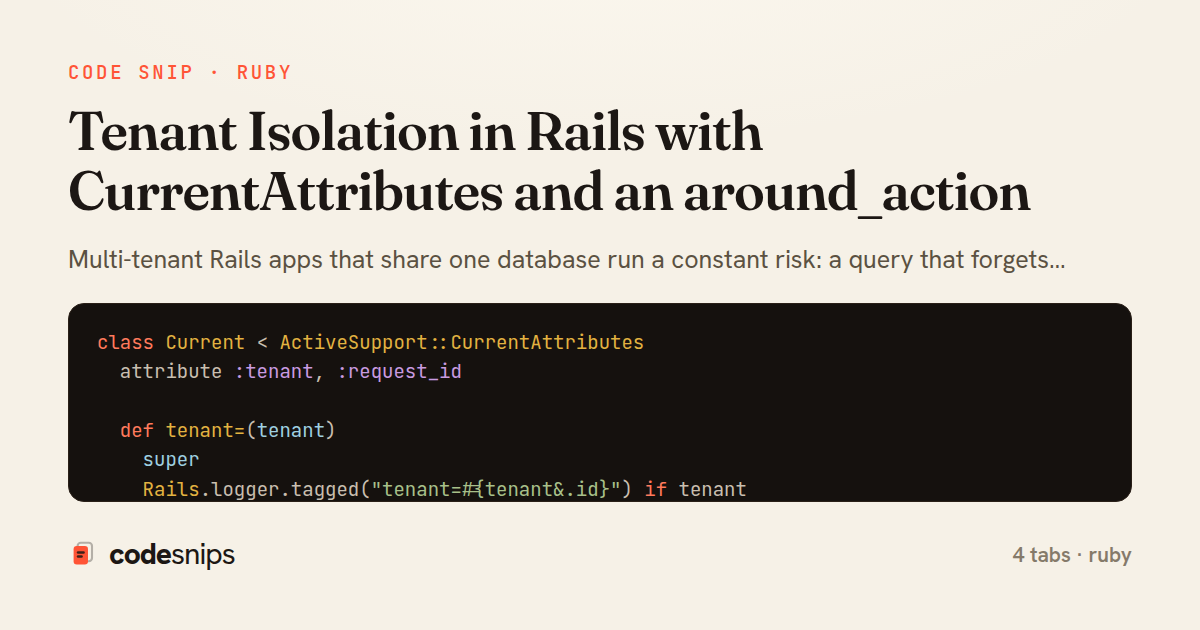
class Current < ActiveSupport::CurrentAttributes
  attribute :tenant, :request_id

  def tenant=(tenant)
    super
    Rails.logger.tagged("tenant=#{tenant&.id}") if tenant
  end

  def tenant_id
    tenant&.id
  end

  def tenant!
    tenant || raise(Tenant::NotResolved, "No tenant is set for the current request")
  end
end
class ApplicationController < ActionController::Base
  class Tenant
    NotResolved = Class.new(StandardError)
  end

  before_action :authenticate_user!
  around_action :with_tenant

  rescue_from Tenant::NotResolved do
    head :not_found
  end

  private

  def with_tenant
    set_tenant
    yield
  ensure
    Current.reset
  end

  def set_tenant
    Current.request_id = request.request_id
    Current.tenant = current_user&.tenant
    Current.tenant! # raises Tenant::NotResolved when nil
  end
end
module TenantScoped
  extend ActiveSupport::Concern

  included do
    belongs_to :tenant

    default_scope do
      if Current.tenant_id
        where(tenant_id: Current.tenant_id)
      else
        all
      end
    end

    before_validation :assign_current_tenant, on: :create
  end

  class_methods do
    def unscoped_across_tenants
      unscoped { yield }
    end
  end

  private

  def assign_current_tenant
    self.tenant_id ||= Current.tenant_id
  end
end
class Invoice < ApplicationRecord
  include TenantScoped

  has_many :line_items, dependent: :destroy

  validates :number, presence: true, uniqueness: { scope: :tenant_id }

  scope :overdue, -> { where("due_on < ?", Date.current).where(paid_at: nil) }

  def self.monthly_totals_all_tenants
    unscoped_across_tenants do
      group(:tenant_id).group_by_month(:issued_on).sum(:amount_cents)
    end
  end
end
Multi-tenant Rails apps that share one database run a constant risk: a query that forgets to filter by tenant leaks one customer's data into another's response. This snippet centralizes that filtering so individual controllers and models never have to remember it, using ActiveSupport::CurrentAttributes to hold the active tenant for the duration of a request and a default_scope to bind every query to it.
In Current the tenant lives in a request-scoped attribute. CurrentAttributes is per-thread and, critically, is reset automatically between requests by Rails' executor, so a tenant set on one request can never bleed into the next even under a threaded server like Puma. The tenant= writer also mirrors the id into ActiveSupport::Notifications tags, which makes the tenant show up in structured logs for free.
ApplicationController resolves the tenant from the authenticated user and wraps the whole action in an around_action. Using around_action rather than before_action matters: the ensure block guarantees Current.reset runs even when the action raises, so a failure mid-request cannot leave a stale tenant set for the next unit of work on that thread. set_tenant raises Tenant::NotResolved when no tenant can be determined, turning a silent data-leak bug into a loud 404.
TenantScoped is a concern mixed into every tenant-owned model. Its default_scope reads Current.tenant_id so ordinary finds like Invoice.find(id) are automatically constrained. A before_validation stamps tenant_id on new records so writes can't be misattributed. The unscoped_across_tenants helper is the deliberate escape hatch for admin tools and background jobs, forcing that dangerous operation to be explicit and greppable.
The trade-offs are real: default_scope is famously sticky and can surprise developers who expect unscoped to behave a certain way, and background jobs must set Current.tenant themselves since they run outside the request cycle. But for request-driven code the pattern removes an entire class of authorization mistakes by making the safe path the default one. Reaching for this approach makes sense once tenant checks start appearing copy-pasted across many controllers.
Related snips
class CommentsController < ApplicationController
  before_action :set_post

  def create
    @comment = @post.comments.build(comment_params)
System test: asserting Turbo Stream responses
class Post < ApplicationRecord
  belongs_to :author, class_name: 'User'
  has_many :comments, dependent: :destroy

  scope :published, -> { where.not(published_at: nil).where('published_at <= ?', Time.current) }
  scope :draft, -> { where(published_at: nil) }
ActiveRecord scopes for reusable query logic
payload = {
  sub: user.id,
  iss: 'https://auth.example.com',
  aud: 'codesnips-api',
  exp: 15.minutes.from_now.to_i,
  iat: Time.now.to_i,
JWT issuance and verification without common footguns
module Api
  module V1
    class UsersController < BaseController
      def show
        user = User.includes(:profile).find(params[:id])
ETags for conditional requests and caching
class PostsController < ApplicationController
  def index
    @posts = Post.includes(:author)
                 .order(created_at: :desc)
                 .page(params[:page])
                 .per(10)
Turbo Frames: infinite scroll with lazy-loading frame
package dbutil

import (
  "context"

  "github.com/jackc/pgconn"
Retry Postgres serialization failures with bounded attempts
Share this code
Here's the card — post it anywhere.