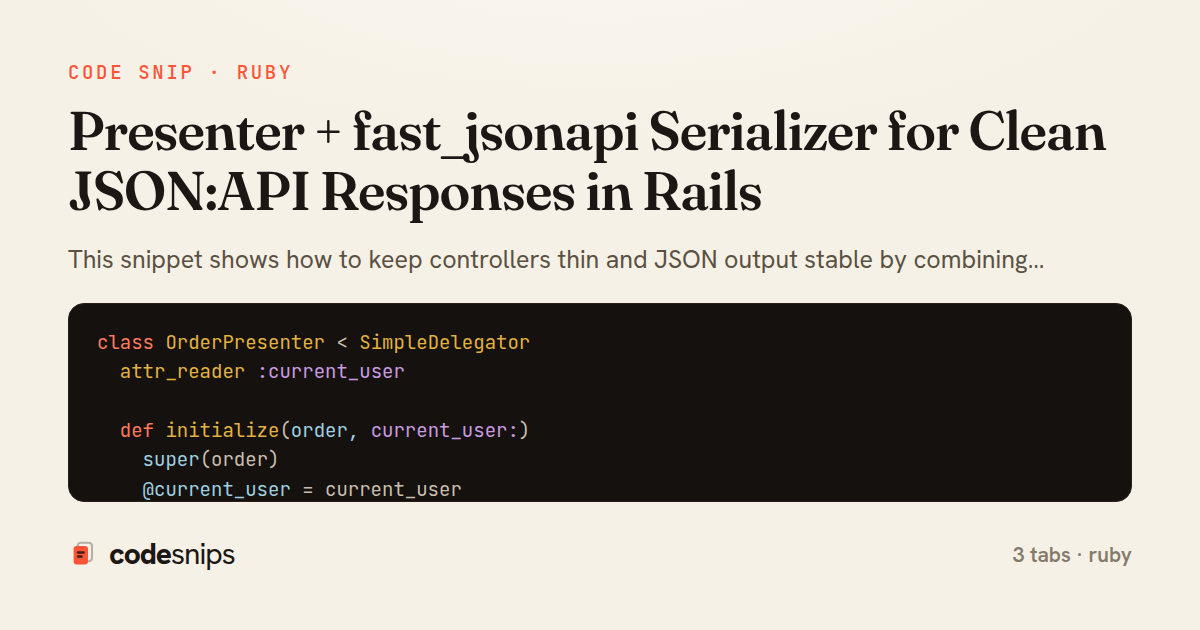
class OrderPresenter < SimpleDelegator
  attr_reader :current_user

  def initialize(order, current_user:)
    super(order)
    @current_user = current_user
  end

  def self.wrap(orders, current_user:)
    orders.map { |o| new(o, current_user: current_user) }
  end

  def order
    __getobj__
  end

  def status_label
    status.to_s.humanize
  end

  def total_formatted
    format("$%.2f", total_cents / 100.0)
  end

  def can_cancel?
    return false if current_user.nil?
    pending? && (current_user.admin? || current_user.id == customer_id)
  end
end
class OrderSerializer
  include JSONAPI::Serializer

  set_type :order
  set_id :id

  attributes :number, :status_label, :total_formatted, :placed_at

  attribute :cancelable do |presenter|
    presenter.can_cancel?
  end

  attribute :total do |presenter|
    presenter.total_cents
  end

  belongs_to :customer

  has_many :line_items, serializer: LineItemSerializer
end
module Api
  module V1
    class OrdersController < Api::BaseController
      def index
        orders = current_user.visible_orders
                             .includes(:customer, :line_items)
                             .page(params[:page])

        render json: OrderSerializer.new(
          present(orders),
          include: requested_includes,
          meta: { total: orders.total_count }
        ).serializable_hash
      end

      def show
        order = current_user.visible_orders.find(params[:id])

        render json: OrderSerializer.new(
          present(order),
          include: requested_includes
        ).serializable_hash
      end

      private

      def present(records)
        if records.respond_to?(:map)
          OrderPresenter.wrap(records, current_user: current_user)
        else
          OrderPresenter.new(records, current_user: current_user)
        end
      end

      def requested_includes
        (params[:include] || "").split(",").map(&:strip).reject(&:empty?)
      end
    end
  end
end
This snippet shows how to keep controllers thin and JSON output stable by combining two complementary patterns: a presenter (view model) that computes derived, request-aware fields, and a fast_jsonapi-style serializer that shapes the wire format. The two live at different layers — the presenter owns what a record looks like for a given viewer, and the serializer owns how that gets encoded into a JSON:API document — so neither leaks concerns into the controller.
In OrderPresenter, an ActiveRecord Order is wrapped in a plain Ruby object built with SimpleDelegator. Delegating means the presenter transparently exposes the model's own attributes while adding presentation-only methods like status_label, total_formatted, and can_cancel?. It also carries the current_user so authorization-sensitive fields (can_cancel?) can depend on the viewer without the model reaching into request state. This is the key trade-off of the presenter pattern: a little indirection buys a place to put formatting and policy logic that would otherwise pollute models or views.
In OrderSerializer, the JSONAPI::Serializer DSL declares the resource type, its attributes, and relationships. Because the serializer is fed presenter instances, attribute :status_label and attribute :total resolve against presenter methods rather than raw columns, so the JSON:API contract stays decoupled from the database schema. The belongs_to :customer line emits a proper relationship object with resource linkage, which clients can use with include.
In Api::V1::OrdersController, the index and show actions wrap records via a private present helper before serialization. Passing params: { current_user: current_user } threads request context into the serializer so it can conditionally include fields, and include: lets callers request compound documents. Wrapping collections happens in memory, so for large result sets pagination (via page) matters to avoid instantiating thousands of presenters.
The payoff is a stable, testable boundary: the serializer is a pure function of presenters, presenters are cheap to unit test without HTTP, and the controller does almost nothing. When output needs to change, edits stay local — formatting in the presenter, structure in the serializer — instead of rippling through views or model callbacks.
Related snips
class CommentsController < ApplicationController
  before_action :set_post

  def create
    @comment = @post.comments.build(comment_params)
System test: asserting Turbo Stream responses
class Post < ApplicationRecord
  belongs_to :author, class_name: 'User'
  has_many :comments, dependent: :destroy

  scope :published, -> { where.not(published_at: nil).where('published_at <= ?', Time.current) }
  scope :draft, -> { where(published_at: nil) }
ActiveRecord scopes for reusable query logic
payload = {
  sub: user.id,
  iss: 'https://auth.example.com',
  aud: 'codesnips-api',
  exp: 15.minutes.from_now.to_i,
  iat: Time.now.to_i,
JWT issuance and verification without common footguns
export interface RetryOptions {
  retries: number;
  baseMs: number;
  maxMs: number;
  signal?: AbortSignal;
  onRetry?: (attempt: number, delay: number, err: unknown) => void;
Exponential backoff with jitter for retries
module Api
  module V1
    class UsersController < BaseController
      def show
        user = User.includes(:profile).find(params[:id])
ETags for conditional requests and caching
class PostsController < ApplicationController
  def index
    @posts = Post.includes(:author)
                 .order(created_at: :desc)
                 .page(params[:page])
                 .per(10)
Turbo Frames: infinite scroll with lazy-loading frame
Share this code
Here's the card — post it anywhere.