class User < ApplicationRecord
  normalizes :phone, with: ->(value) { PhoneNormalizer.call(value) }, apply_to_nil: false

  validates :phone,
            presence: true,
            uniqueness: { case_sensitive: false },
            format: {
              with: /\A\+[1-9]\d{6,14}\z/,
              message: "is not a valid phone number"
            }

  def self.find_by_phone(input)
    normalized = PhoneNormalizer.call(input)
    return nil if normalized.blank?

    find_by(phone: normalized)
  end
end
class PhoneNormalizer
  DEFAULT_REGION = "US".freeze

  def self.call(raw, region: DEFAULT_REGION)
    new(raw, region).normalize
  end

  def initialize(raw, region)
    @raw = raw
    @region = region
  end

  def normalize
    return if @raw.blank?

    parsed = Phonelib.parse(@raw, @region)
    return unless parsed.valid?

    parsed.e164
  end
end
class UserSerializer < ActiveModel::Serializer
  attributes :id, :name, :phone, :phone_display

  def phone_display
    return if object.phone.blank?

    Phonelib.parse(object.phone).national
  end
end
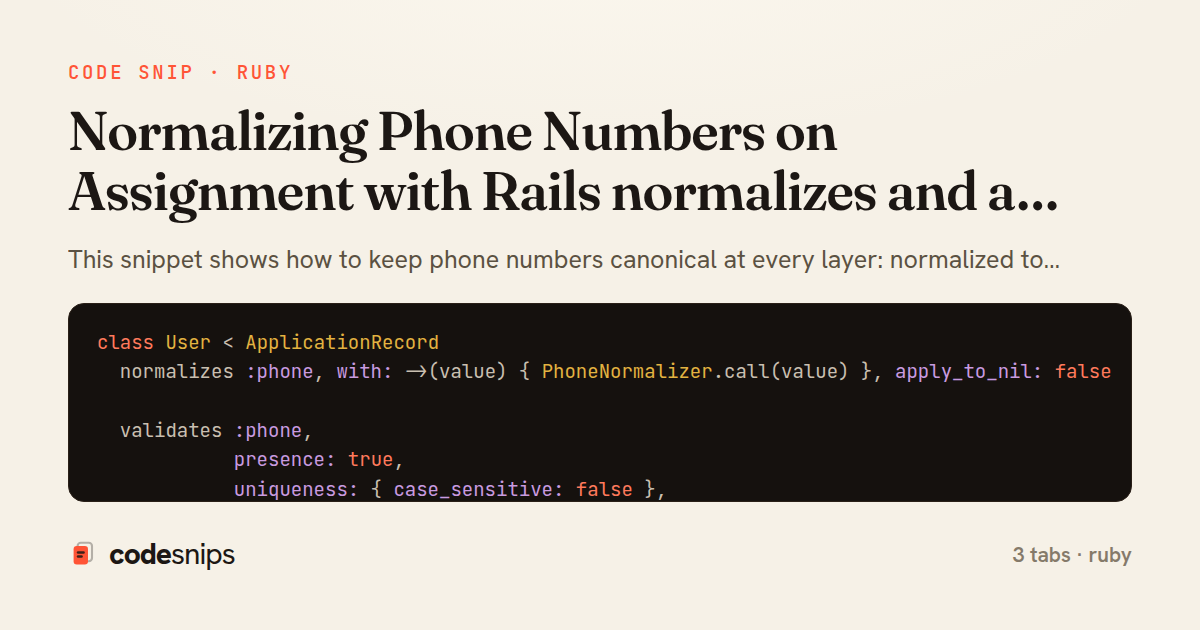
This snippet shows how to keep phone numbers canonical at every layer: normalized to E.164 on write with ActiveRecord's normalizes, validated against that canonical form, and rendered back in a human-friendly way through a dedicated serializer. Storing one canonical representation per number avoids the classic bug where +1 (415) 555-0100 and 4155550100 are treated as different values, which breaks uniqueness checks, deduplication, and lookups.
In User model, normalizes :phone runs a normalization block whenever the attribute is assigned — not just on save — so reads after assignment already reflect the cleaned value. The block delegates to PhoneNormalizer.call, which strips formatting and coerces to E.164 using a configurable default region. Because normalization happens before validation, the format validation and the unique index both operate on the canonical string. with: -> keeps the transform pure and testable, and apply_to_nil: false leaves blank phones untouched so optional numbers stay nil rather than becoming an empty string.
PhoneNormalizer is a small PORO wrapping the phonelib gem. It returns nil for junk input rather than raising, which lets the model treat an unparseable number as a validation failure instead of an exception. Centralizing the parsing here means both the model and any importer or API endpoint share exactly one definition of "valid." The trade-off is that E.164 discards the original formatting a user typed, so display formatting must be reconstructed on the way out.
That reconstruction lives in UserSerializer, an ActiveModel::Serializer. It exposes the raw canonical phone for machine consumers and a derived phone_display in the caller's national format, again delegating to phonelib so formatting logic is not duplicated in views. Serializers are the right seam for this because presentation should not leak into the persisted value.
The main pitfall is region ambiguity: a bare 5551234 has no country, so the default region matters and should reflect the application's user base or be captured explicitly. Another is that normalizes only fires on the setter, so bulk update_all writes bypass it — those paths must normalize manually. Reach for this pattern whenever a value has a single canonical form but many valid textual inputs.
Related snips
class CommentsController < ApplicationController
  before_action :set_post

  def create
    @comment = @post.comments.build(comment_params)
System test: asserting Turbo Stream responses
class Post < ApplicationRecord
  belongs_to :author, class_name: 'User'
  has_many :comments, dependent: :destroy

  scope :published, -> { where.not(published_at: nil).where('published_at <= ?', Time.current) }
  scope :draft, -> { where(published_at: nil) }
ActiveRecord scopes for reusable query logic
module Api
  module V1
    class UsersController < BaseController
      def show
        user = User.includes(:profile).find(params[:id])
ETags for conditional requests and caching
class PostsController < ApplicationController
  def index
    @posts = Post.includes(:author)
                 .order(created_at: :desc)
                 .page(params[:page])
                 .per(10)
Turbo Frames: infinite scroll with lazy-loading frame
package dbutil

import (
  "context"

  "github.com/jackc/pgconn"
Retry Postgres serialization failures with bounded attempts
require "csv"

class PeopleCsvStream
  include Enumerable

  HEADERS = %w[id full_name email signed_up_at plan].freeze
Resilient CSV Export as a Streamed Response
Share this code
Here's the card — post it anywhere.