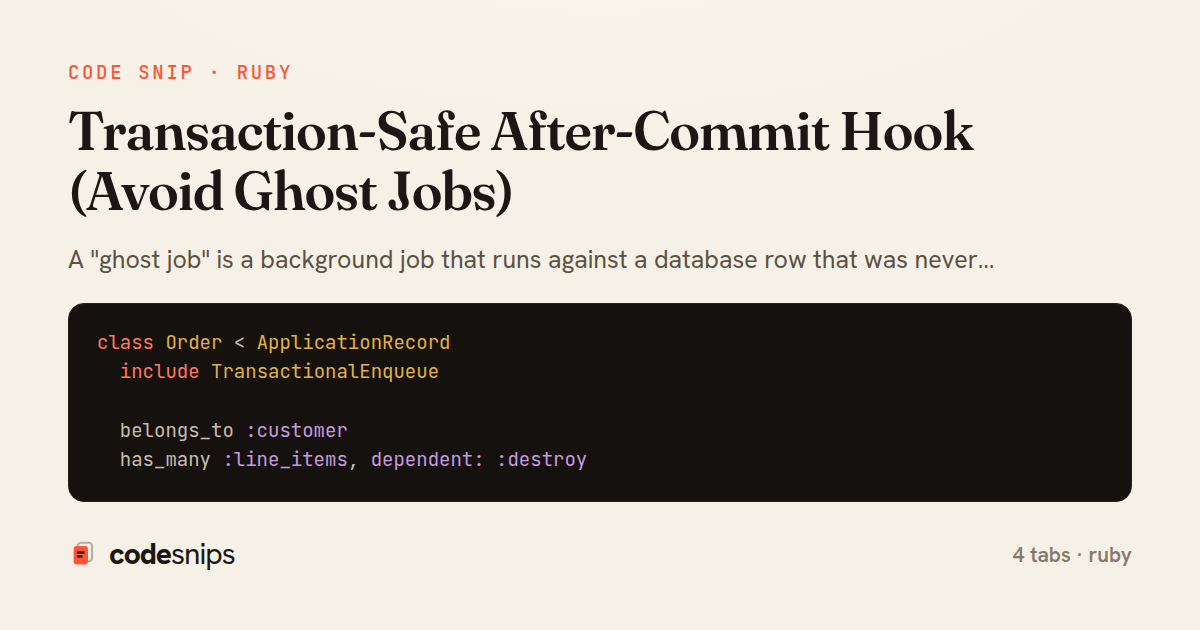
class Order < ApplicationRecord
  include TransactionalEnqueue

  belongs_to :customer
  has_many :line_items, dependent: :destroy

  enum status: { pending: 0, fulfilling: 1, fulfilled: 2, failed: 3 }

  validates :reference, presence: true, uniqueness: true

  after_commit :enqueue_fulfillment, on: :create

  private

  def enqueue_fulfillment
    # Runs only after the creating transaction has committed for real.
    perform_after_commit do
      FulfillmentJob.perform_later(id)
    end
  end
end
module TransactionalEnqueue
  extend ActiveSupport::Concern

  def perform_after_commit(&block)
    connection = self.class.connection
    transaction = connection.current_transaction

    if transaction_pending?(connection, transaction)
      register_after_commit(transaction, &block)
    else
      yield
    end
  end

  private

  def transaction_pending?(connection, transaction)
    connection.transaction_open? && transaction.joinable?
  end

  def register_after_commit(transaction, &block)
    callback = AfterCommitCallback.new(block)
    transaction.add_record(callback)
  end

  class AfterCommitCallback
    def initialize(block)
      @block = block
      @committed = false
    end

    def has_transactional_callbacks?
      true
    end

    def committed!(should_run_callbacks: true)
      return if @committed

      @committed = true
      @block.call if should_run_callbacks
    end

    def rolledback!(force_restore_state: false, should_run_callbacks: true)
      # Deliberately no-op: the enqueue is dropped so no ghost job survives.
    end

    def before_committed!(*)
    end

    def add_to_transaction(*)
    end
  end
end
class FulfillmentJob < ApplicationJob
  queue_as :fulfillment

  retry_on Redis::ConnectionError, wait: :polynomially_longer, attempts: 5
  discard_on ActiveJob::DeserializationError

  def perform(order_id)
    order = Order.find_by(id: order_id)
    return if order.nil?          # transaction rolled back or row purged
    return if order.fulfilled?    # idempotent against retries and races

    order.with_lock do
      return if order.fulfilled?

      order.update!(status: :fulfilling)
      FulfillmentService.new(order).ship!
      order.update!(status: :fulfilled, fulfilled_at: Time.current)
    end
  rescue FulfillmentService::PermanentError => e
    order&.update(status: :failed, failure_reason: e.message)
  end
end
class OrdersController < ApplicationController
  def create
    order = nil

    ActiveRecord::Base.transaction do
      order = Order.create!(order_params.merge(status: :pending))
      InventoryReservation.reserve!(order) # raises on insufficient stock
    end

    render json: { id: order.id, status: order.status }, status: :created
  rescue InventoryReservation::OutOfStock => e
    # Transaction rolled back: no Order row, and crucially no FulfillmentJob.
    render json: { error: e.message }, status: :unprocessable_entity
  end

  private

  def order_params
    params.require(:order).permit(:customer_id, :reference, line_items_attributes: %i[sku quantity])
  end
end
A "ghost job" is a background job that runs against a database row that was never actually committed, or that reads stale data because the enqueue fired inside a transaction that later rolled back. When jobs are enqueued from an after_save or after_create callback, the record only exists in the uncommitted transaction; a fast worker can dequeue and look up the row before COMMIT lands, or the enqueue survives even though the transaction rolls back. This snippet shows the idiomatic Rails fix built around after_commit plus a helper that defers work until the surrounding transaction has truly committed.
In Order model, the enqueue is moved out of after_save and into after_commit on: :create. The enqueue_fulfillment method calls perform_after_commit, a small concern method that guarantees the block runs only when no open transaction remains. Passing id (not the object) to the job matters: after_commit runs after the row is durable, but the worker still re-fetches the row so it never trusts an in-memory copy.
The TransactionalEnqueue concern centralizes the logic. It inspects self.class.connection.transaction_open? (and whether that transaction is a real one via current_transaction.joinable?) to decide whether to run immediately or register a completion callback with add_transaction_record style tracking. When still inside a transaction it uses connection.add_transaction_record and an after_commit callback on the connection's current transaction, so the block fires exactly once on commit and is silently dropped on rollback.
FulfillmentJob is deliberately defensive: it re-loads the Order by id and returns early if the record is missing or already processed, giving idempotency against retries and any residual races. The find_by guard turns a would-be crash into a no-op, which is the correct behavior for a job whose triggering transaction may have been rolled back before delivery.
OrdersController wraps creation and inventory reservation in a single ActiveRecord::Base.transaction. Because the job is only enqueued on commit, a failed reservation rolls everything back with zero ghost jobs. The main trade-off is a slightly later enqueue and reliance on Rails' connection-level transaction bookkeeping, which is stable but framework-internal. This pattern is the standard answer whenever a job must never observe uncommitted or rolled-back state.
Related snips
class CommentsController < ApplicationController
  before_action :set_post

  def create
    @comment = @post.comments.build(comment_params)
System test: asserting Turbo Stream responses
class Post < ApplicationRecord
  belongs_to :author, class_name: 'User'
  has_many :comments, dependent: :destroy

  scope :published, -> { where.not(published_at: nil).where('published_at <= ?', Time.current) }
  scope :draft, -> { where(published_at: nil) }
ActiveRecord scopes for reusable query logic
export interface RetryOptions {
  retries: number;
  baseMs: number;
  maxMs: number;
  signal?: AbortSignal;
  onRetry?: (attempt: number, delay: number, err: unknown) => void;
Exponential backoff with jitter for retries
module Api
  module V1
    class UsersController < BaseController
      def show
        user = User.includes(:profile).find(params[:id])
ETags for conditional requests and caching
class PostsController < ApplicationController
  def index
    @posts = Post.includes(:author)
                 .order(created_at: :desc)
                 .page(params[:page])
                 .per(10)
Turbo Frames: infinite scroll with lazy-loading frame
package dbutil

import (
  "context"

  "github.com/jackc/pgconn"
Retry Postgres serialization failures with bounded attempts
Share this code
Here's the card — post it anywhere.