class AddSoftDeleteToUsers < ActiveRecord::Migration[7.1]
  def change
    add_column :users, :deleted_at, :datetime

    add_index :users, :deleted_at, where: "deleted_at IS NULL", name: "index_users_on_live"

    # Uniqueness should only apply to live rows so a soft-deleted
    # user does not block re-registering the same email.
    remove_index :users, :email if index_exists?(:users, :email)
    add_index :users, :email,
              unique: true,
              where: "deleted_at IS NULL",
              name: "index_users_on_email_live"
  end
end
module SoftDeletable
  extend ActiveSupport::Concern

  included do
    default_scope { where(deleted_at: nil) }

    scope :with_deleted, -> { unscope(where: :deleted_at) }
    scope :only_deleted, -> { unscope(where: :deleted_at).where.not(deleted_at: nil) }
  end

  def soft_delete
    return true if deleted?
    update_columns(deleted_at: Time.current)
  end

  def restore
    return true unless deleted?
    update_columns(deleted_at: nil)
  end

  def deleted?
    deleted_at.present?
  end
end
class UsersController < ApplicationController
  before_action :set_user, only: :destroy
  before_action :set_deleted_user, only: :restore

  def destroy
    @user.soft_delete
    redirect_to users_path,
                notice: "User archived.",
                flash: { undo_id: @user.id }
  end

  def restore
    @user.restore
    redirect_to user_path(@user), notice: "User restored."
  end

  private

  def set_user
    @user = User.find(params[:id])
  end

  # default_scope hides soft-deleted rows, so restore must look
  # them up explicitly through only_deleted.
  def set_deleted_user
    @user = User.only_deleted.find(params[:id])
  end
end
This snippet shows a compact soft-delete implementation for Rails that avoids pulling in a full gem, keeping the behavior explicit and easy to reason about. Soft deletion means rows are never physically removed; instead a deleted_at timestamp marks them as gone, so records can be audited, undeleted, or referenced by historical data. The three tabs walk through the schema, a reusable concern, and the controller that drives the delete/restore flow.
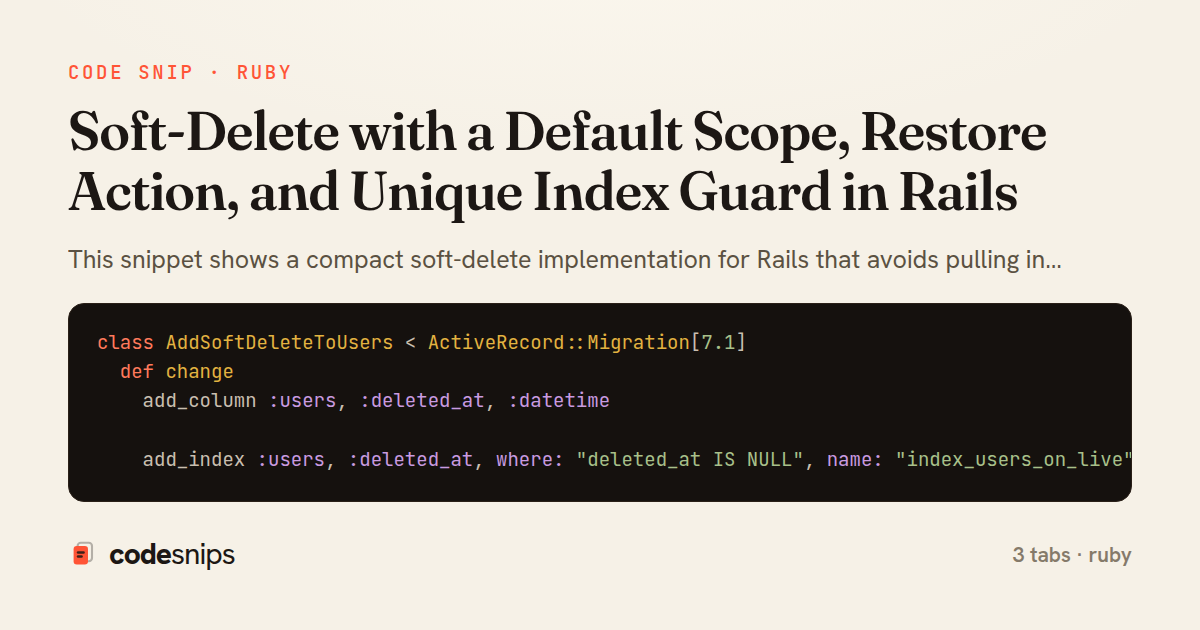
The add soft-delete migration tab adds a nullable deleted_at timestamp and a partial index. The index is filtered with where: 'deleted_at IS NULL', which is important for two reasons: queries that scope to live rows hit a small, focused index, and any composite unique index on live data (like a unique email) only applies to non-deleted rows, so a soft-deleted user does not block re-registering the same email. The migration also demonstrates a Postgres partial unique index via add_index with both unique: true and a where clause.
The SoftDeletable concern centralizes the behavior. default_scope filters out deleted rows automatically for every query, which is convenient but a known footgun — it silently affects associations, find, and counts. To recover deleted rows the concern exposes unscoped-based scopes: with_deleted and only_deleted. The instance methods soft_delete and restore flip deleted_at using update_columns so they skip validations and callbacks and never re-trigger the destroy chain. deleted? is a simple predicate on the column.
A key trade-off is that default_scope interacts badly with Model.find when a row is soft-deleted, since it will raise RecordNotFound. That is why the UsersController restore path deliberately queries User.only_deleted in set_deleted_user rather than the default finder. In UsersController, destroy calls soft_delete instead of destroy, returning the record so the UI can offer an undo. restore finds the hidden record and clears its deleted_at. This pattern fits domains needing recoverable deletes and audit trails; the main pitfalls are default_scope leaking into unexpected queries and needing partial indexes to keep uniqueness correct.
Related snips
class CommentsController < ApplicationController
  before_action :set_post

  def create
    @comment = @post.comments.build(comment_params)
System test: asserting Turbo Stream responses
class Post < ApplicationRecord
  belongs_to :author, class_name: 'User'
  has_many :comments, dependent: :destroy

  scope :published, -> { where.not(published_at: nil).where('published_at <= ?', Time.current) }
  scope :draft, -> { where(published_at: nil) }
ActiveRecord scopes for reusable query logic
module Api
  module V1
    class UsersController < BaseController
      def show
        user = User.includes(:profile).find(params[:id])
ETags for conditional requests and caching
class PostsController < ApplicationController
  def index
    @posts = Post.includes(:author)
                 .order(created_at: :desc)
                 .page(params[:page])
                 .per(10)
Turbo Frames: infinite scroll with lazy-loading frame
package dbutil

import (
  "context"

  "github.com/jackc/pgconn"
Retry Postgres serialization failures with bounded attempts
require "csv"

class PeopleCsvStream
  include Enumerable

  HEADERS = %w[id full_name email signed_up_at plan].freeze
Resilient CSV Export as a Streamed Response
Share this code
Here's the card — post it anywhere.