class Document < ApplicationRecord
  belongs_to :owner, class_name: "User"
  has_many :visibilities, class_name: "DocumentVisibility", dependent: :delete_all

  scope :public_documents, -> { where(is_public: true) }

  scope :visible_to, ->(actor) do
    DocumentVisibilityQuery.new(self, actor).relation
  end

  def grant_to(subject)
    visibilities.create!(subject: subject)
  end
end

class DocumentVisibility < ApplicationRecord
  belongs_to :document
  belongs_to :subject, polymorphic: true
end
class DocumentVisibilityQuery
  def initialize(scope, actor)
    @scope = scope
    @actor = actor
  end

  def relation
    @scope.where(public_condition.or(owner_condition).or(shared_condition))  end

  private

  def docs
    Document.arel_table
  end

  def vis
    DocumentVisibility.arel_table
  end

  def public_condition
    docs[:is_public].eq(true)
  end

  def owner_condition
    docs[:owner_id].eq(@actor.id)
  end

  def shared_condition
    principals = principal_pairs
    return docs[:id].eq(nil) if principals.empty?

    matches = principals.map do |type, id|
      vis[:subject_type].eq(type).and(vis[:subject_id].eq(id))
    end.reduce(:or)

    subquery = Arel::SelectManager.new
    subquery.from(vis)
    subquery.project(Arel.sql("1"))
    subquery.where(vis[:document_id].eq(docs[:id]).and(matches))

    Arel::Nodes::Exists.new(subquery)
  end

  def principal_pairs
    pairs = [["User", @actor.id]]
    Array(@actor.try(:team_ids)).each { |tid| pairs << ["Team", tid] }
    pairs
  end
end
class DocumentsController < ApplicationController
  before_action :authenticate_user!

  def index
    @documents = Document
      .visible_to(current_user)
      .merge(search_scope)
      .order(updated_at: :desc)
      .page(params[:page])

    render :index
  end

  def show
    @document = Document.visible_to(current_user).find(params[:id])
    render :show
  rescue ActiveRecord::RecordNotFound
    head :not_found
  end

  private

  def search_scope
    return Document.all if params[:q].blank?

    Document.where("title ILIKE ?", "%#{params[:q]}%")
  end
end
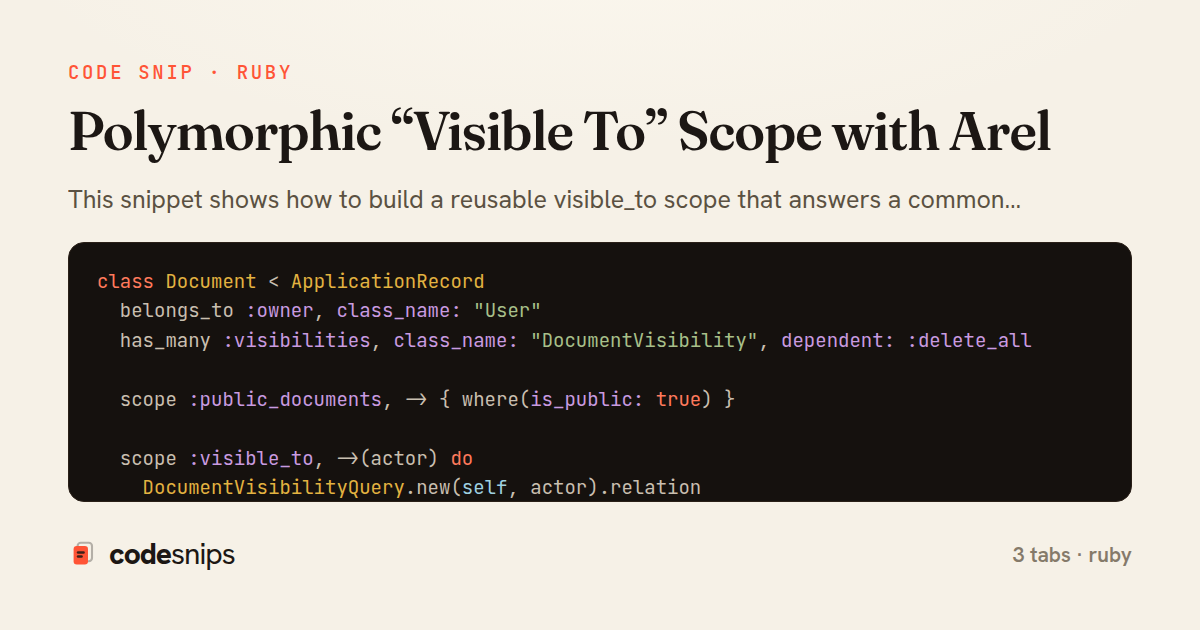
This snippet shows how to build a reusable visible_to scope that answers a common authorization question — "which records is this actor allowed to see?" — when visibility can come from several different sources at once. Rather than filtering in Ruby after loading rows, the logic is pushed down into a single SQL query composed with Arel, so pagination, counting, and further chaining all stay correct and efficient.
The Document model defines the domain: a document can be public, owned directly by a user, or shared through a polymorphic visibilities association whose subject is either a User or a Team. The visible_to scope delegates to a query object so the model stays thin, and it accepts any actor that can describe its own visibility principals via team_ids.
The interesting work lives in DocumentVisibilityQuery. It builds three independent Arel predicates against the documents and document_visibilities tables: public_condition matches anything flagged public, owner_condition matches the actor's own rows, and shared_condition matches a polymorphic grant using both subject_type and subject_id. Building the EXISTS subquery with Arel::SelectManager keeps the correlation (vis[:document_id].eq(docs[:id])) explicit and avoids an accidental cartesian join. Combining the pieces with or produces one predicate, which is handed to ActiveRecord via where(condition) — so the caller still gets a normal, chainable ActiveRecord::Relation.
Using Arel here rather than string interpolation matters: table and column references go through arel_table, values are bound as parameters, and the subject_type/subject_id pair is matched together, which is exactly the trap that makes naive polymorphic queries leak rows across types. The EXISTS form also short-circuits per document and plays well with a composite index on (subject_type, subject_id, document_id).
The DocumentsController shows the payoff at the call site. Document.visible_to(current_user) is used as an ordinary scope, then merged with search and pagination without any special casing, and the same scope is reused to authorize a single show lookup so the read path can never diverge from the list path. The trade-off is that Arel is verbose and version-sensitive; the benefit is one authoritative, index-friendly definition of visibility that is impossible to bypass by loading first and filtering later.
Related snips
class CommentsController < ApplicationController
  before_action :set_post

  def create
    @comment = @post.comments.build(comment_params)
System test: asserting Turbo Stream responses
class Post < ApplicationRecord
  belongs_to :author, class_name: 'User'
  has_many :comments, dependent: :destroy

  scope :published, -> { where.not(published_at: nil).where('published_at <= ?', Time.current) }
  scope :draft, -> { where(published_at: nil) }
ActiveRecord scopes for reusable query logic
module Api
  module V1
    class UsersController < BaseController
      def show
        user = User.includes(:profile).find(params[:id])
ETags for conditional requests and caching
class PostsController < ApplicationController
  def index
    @posts = Post.includes(:author)
                 .order(created_at: :desc)
                 .page(params[:page])
                 .per(10)
Turbo Frames: infinite scroll with lazy-loading frame
package dbutil

import (
  "context"

  "github.com/jackc/pgconn"
Retry Postgres serialization failures with bounded attempts
require "csv"

class PeopleCsvStream
  include Enumerable

  HEADERS = %w[id full_name email signed_up_at plan].freeze
Resilient CSV Export as a Streamed Response
Share this code
Here's the card — post it anywhere.