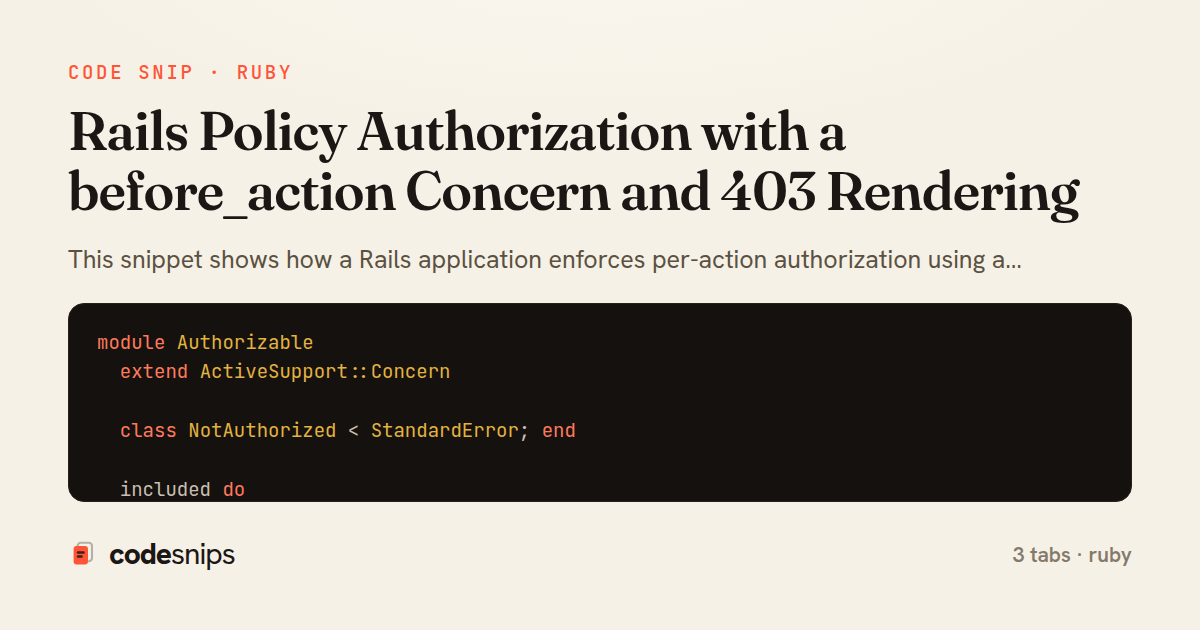
module Authorizable
  extend ActiveSupport::Concern

  class NotAuthorized < StandardError; end

  included do
    rescue_from NotAuthorized, with: :render_forbidden
  end

  private

  def authorize!(record, action: action_name, user: current_user)
    policy = policy_for(record, user)
    permission = "#{action}?"

    unless policy.respond_to?(permission)
      raise NotAuthorized, "#{policy.class} has no rule for #{permission}"
    end

    raise NotAuthorized unless policy.public_send(permission)
    record
  end

  def policy_for(record, user)
    klass = "#{record.class.name}Policy".constantize
    klass.new(user, record)
  end

  def render_forbidden
    respond_to do |format|
      format.html { render file: Rails.root.join("public/403.html"), status: :forbidden, layout: false }
      format.json { render json: { error: "forbidden" }, status: :forbidden }
    end
  end
end
class ArticlePolicy
  attr_reader :user, :article

  def initialize(user, article)
    @user = user
    @article = article
  end

  def show?
    article.published? || owner? || admin?
  end

  def create?
    user.present?
  end

  def update?
    owner? || admin?
  end

  def destroy?
    owner? || admin?
  end

  private

  def owner?
    user.present? && article.author_id == user.id
  end

  def admin?
    user.present? && user.admin?
  end
end
class ArticlesController < ApplicationController
  include Authorizable

  before_action :require_login, only: %i[create update destroy]
  before_action :set_article, only: %i[show update destroy]

  def show
    authorize!(@article)
    render json: @article
  end

  def create
    authorize!(Article.new(author: current_user))
    @article = current_user.articles.create!(article_params)
    render json: @article, status: :created
  end

  def update
    authorize!(@article)
    @article.update!(article_params)
    render json: @article
  end

  def destroy
    authorize!(@article)
    @article.destroy!
    head :no_content
  end

  private

  def set_article
    @article = Article.find(params[:id])
  end

  def article_params
    params.require(:article).permit(:title, :body, :published)
  end
end
This snippet shows how a Rails application enforces per-action authorization using a small policy object wired into controllers through a before_action concern that renders a proper 403 Forbidden when access is denied. The pattern keeps controllers thin: each action declares what it needs authorized, and the mechanics of resolving a policy, calling it, and handling failure live in one reusable place.
In Authorizable concern, the authorize! helper is the heart of the design. It looks up a policy class by convention (ArticlePolicy for an Article), instantiates it with current_user and the record, and calls a predicate named after the current action (show?, update?, and so on). When the predicate returns false it raises NotAuthorized, a dedicated error class, rather than rendering inline. A rescue_from NotAuthorized handler centralizes the response so every denial produces the same 403 regardless of which action failed. Resolving the action name from action_name means callers usually just write authorize!(@article) without repeating the permission name.
Raising and rescuing is deliberate: it lets a single before_action short-circuit the request before the action body runs, and it keeps the failure path out of every individual method. The render_forbidden handler responds to both HTML and JSON, so API and browser clients each get an appropriate 403. Returning a machine-readable error code in the JSON branch is friendlier to frontend clients than a bare status.
ArticlePolicy holds the actual rules as plain predicate methods. Because it is an ordinary Ruby object with no framework coupling, the logic — owners can edit and destroy, anyone can read published articles — is trivial to unit test in isolation and to reason about. admin? short-circuits several checks, a common escape hatch.
In ArticlesController, before_action :require_login and a per-action authorize! call combine to guard mutating endpoints. The trade-off of convention-based lookup is that it depends on consistent naming; when a policy or predicate is missing it fails loudly, which is preferable to silently allowing access. This approach suits apps that have outgrown scattered if current_user checks but do not need a full gem.
Related snips
class CommentsController < ApplicationController
  before_action :set_post

  def create
    @comment = @post.comments.build(comment_params)
System test: asserting Turbo Stream responses
class Post < ApplicationRecord
  belongs_to :author, class_name: 'User'
  has_many :comments, dependent: :destroy

  scope :published, -> { where.not(published_at: nil).where('published_at <= ?', Time.current) }
  scope :draft, -> { where(published_at: nil) }
ActiveRecord scopes for reusable query logic
payload = {
  sub: user.id,
  iss: 'https://auth.example.com',
  aud: 'codesnips-api',
  exp: 15.minutes.from_now.to_i,
  iat: Time.now.to_i,
JWT issuance and verification without common footguns
module Api
  module V1
    class UsersController < BaseController
      def show
        user = User.includes(:profile).find(params[:id])
ETags for conditional requests and caching
class PostsController < ApplicationController
  def index
    @posts = Post.includes(:author)
                 .order(created_at: :desc)
                 .page(params[:page])
                 .per(10)
Turbo Frames: infinite scroll with lazy-loading frame
require "csv"

class PeopleCsvStream
  include Enumerable

  HEADERS = %w[id full_name email signed_up_at plan].freeze
Resilient CSV Export as a Streamed Response
Share this code
Here's the card — post it anywhere.