import { randomBytes } from 'crypto';
import { Request, Response, NextFunction } from 'express';

interface CspOptions {
  reportOnly?: boolean;
  reportUri?: string;
}

function buildPolicy(nonce: string, reportUri?: string): string {
  const directives = [
    "default-src 'self'",
    `script-src 'self' 'nonce-${nonce}' 'strict-dynamic'`,
    "style-src 'self' 'unsafe-inline'",
    "img-src 'self' data:",
    "connect-src 'self'",
    "object-src 'none'",
    "base-uri 'self'",
    "frame-ancestors 'none'",
    "form-action 'self'",
    'upgrade-insecure-requests',
  ];
  if (reportUri) directives.push(`report-uri ${reportUri}`);
  return directives.join('; ');
}

export function cspMiddleware(options: CspOptions = {}) {
  const header = options.reportOnly
    ? 'Content-Security-Policy-Report-Only'
    : 'Content-Security-Policy';

  return (req: Request, res: Response, next: NextFunction): void => {
    const nonce = randomBytes(16).toString('base64');
    res.locals.cspNonce = nonce;
    res.setHeader(header, buildPolicy(nonce, options.reportUri));
    next();
  };
}
import { Request, Response } from 'express';

interface CspReport {
  'document-uri'?: string;
  'violated-directive'?: string;
  'blocked-uri'?: string;
  'original-policy'?: string;
}

const NOISE = ['about', 'chrome-extension', 'moz-extension', 'safari-extension'];

function isNoise(blockedUri: string | undefined): boolean {
  if (!blockedUri) return false;
  return NOISE.some((prefix) => blockedUri.startsWith(prefix));
}

export function cspReportHandler(req: Request, res: Response): void {
  const report: CspReport = (req.body && req.body['csp-report']) || {};
  const blocked = report['blocked-uri'];

  if (!isNoise(blocked)) {
    console.warn('[csp] violation', {
      documentUri: report['document-uri'],
      directive: report['violated-directive'],
      blockedUri: blocked,
    });
  }

  // Browsers ignore the body; 204 avoids a redundant round trip.
  res.status(204).end();
}
import express from 'express';
import { cspMiddleware } from './csp';
import { cspReportHandler } from './report';

const app = express();
const REPORT_URI = '/__csp-report';

app.use(
  cspMiddleware({
    reportOnly: process.env.CSP_ENFORCE !== 'true',
    reportUri: REPORT_URI,
  })
);

app.post(
  REPORT_URI,
  express.json({ type: ['application/csp-report', 'application/json'] }),
  cspReportHandler
);

app.get('/', (req, res) => {
  const nonce = res.locals.cspNonce as string;
  res.type('html').send(`<!doctype html>
<html>
  <head><title>Dashboard</title></head>
  <body>
    <div id="root"></div>
    <script nonce="${nonce}" src="/assets/app.js"></script>
    <script nonce="${nonce}">window.__BOOT__ = true;</script>
  </body>
</html>`);
});

app.listen(3000, () => console.log('listening on :3000'));
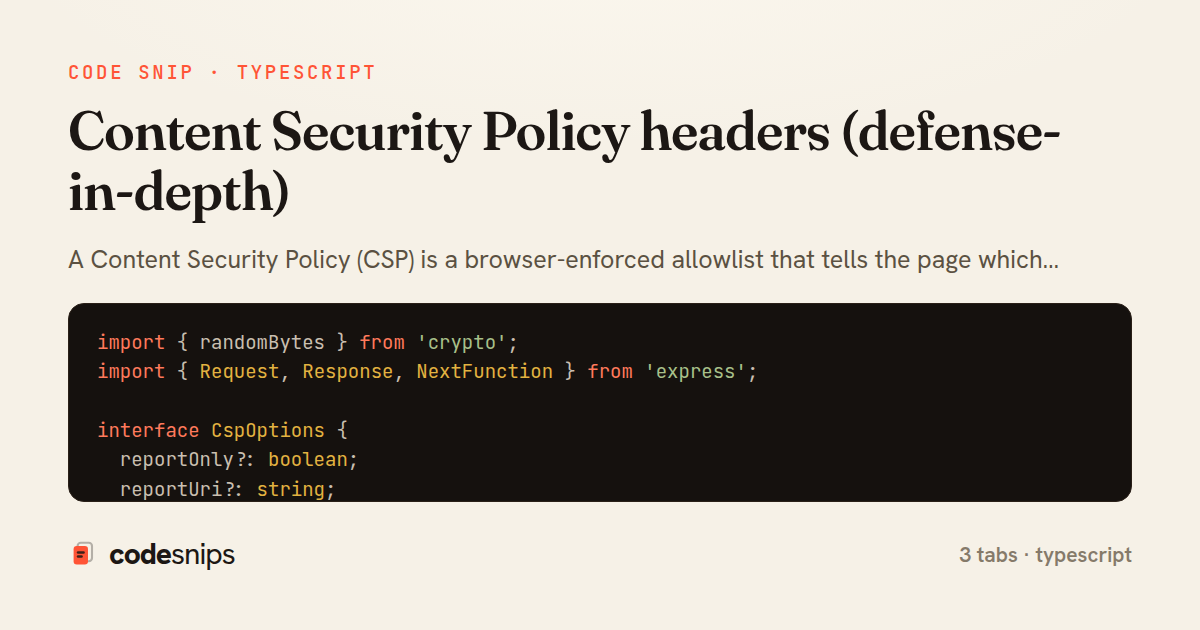
A Content Security Policy (CSP) is a browser-enforced allowlist that tells the page which sources of script, style, images, and connections are trusted. It is a defense-in-depth control: even if an attacker manages to inject markup through an XSS hole, a strict policy stops the injected <script> from executing because it lacks the correct origin or nonce. This snippet builds a nonce-based CSP for an Express app so that inline scripts the server actually emits are permitted while any injected inline script is rejected.
In csp.ts, cspMiddleware generates a fresh 128-bit random nonce per request with randomBytes(16), base64-encodes it, and stashes it on res.locals.cspNonce so templates can read it. The policy string is assembled from buildPolicy, which pins default-src to 'self', allows scripts only from 'self' plus the request nonce, and adds hardening directives like object-src 'none', base-uri 'self', and frame-ancestors 'none' to block plugin execution, base-tag hijacking, and clickjacking. The 'strict-dynamic' token lets a nonced loader script pull in further scripts without needing every URL enumerated, which keeps the policy maintainable as bundles change.
The key trade-off is enforce-versus-observe. Shipping a broken policy can break a live site, so csp.ts supports a reportOnly flag that switches the header name to Content-Security-Policy-Report-Only. In that mode the browser reports violations to the report-uri endpoint but does not block anything, which is the safe way to roll a policy out and tune it against real traffic before enforcing.
In report.ts, cspReportHandler accepts the application/csp-report beacon the browser POSTs on each violation, normalizes the payload, and logs the blocked URI and violated directive. Filtering noisy blocked-uri values such as browser-extension origins keeps the signal clean.
In app.ts, the middleware is mounted before the routes and the JSON body parser is scoped to the report route with a matching content type. res.locals.cspNonce flows into the rendered template's inline script tags. Pitfalls to watch: nonces must never be reused across responses, unsafe-inline is ignored by browsers whenever a nonce is present, and any third-party widget needs an explicit source entry or it will silently fail under enforcement.
Related snips
payload = {
  sub: user.id,
  iss: 'https://auth.example.com',
  aud: 'codesnips-api',
  exp: 15.minutes.from_now.to_i,
  iat: Time.now.to_i,
JWT issuance and verification without common footguns
#!/usr/bin/env bash
set -euo pipefail

export VAULT_ADDR="https://vault.internal:8200"
export VAULT_TOKEN="${VAULT_TOKEN:?missing VAULT_TOKEN}"
Secrets management with environment isolation and Vault
import { randomBytes, createHash } from "crypto";
import jwt from "jsonwebtoken";
import { RefreshTokenStore } from "./store";

const ACCESS_SECRET = process.env.ACCESS_SECRET!;
const ACCESS_TTL = "15m";
JWT access + refresh token rotation (conceptual)
package files

import (
  "context"
  "time"
Presigned S3 upload URLs (AWS SDK v2)
<%# private stream: turbo signs the serialized record name %>
<%= turbo_stream_from current_user %>

<section class="notifications">
  <h1>Notifications</h1>
Turbo Streams + authorization: signed per-user stream name
package api

import (
  "io"
  "net/http"
  "os"
Safe multipart uploads using temp files (bounded memory)
Share this code
Here's the card — post it anywhere.