require "sinatra/base"
require "rack/utils"

class AdminApp < Sinatra::Base
  before do
    protected!
  end

  get "/" do
    "Admin dashboard"
  end

  get "/metrics" do
    content_type :json
    { queued: 12, failed: 0 }.to_json
  end

  post "/flush" do
    status 202
    "flush scheduled"
  end

  helpers do
    def protected!
      return if authorized?
      request_auth!
    end

    def request_auth!
      headers["WWW-Authenticate"] = %(Basic realm="Admin Area")
      halt 401, "Not authorized\n"
    end

    def authorized?
      @auth ||= Rack::Auth::Basic::Request.new(request.env)
      return false unless @auth.provided? && @auth.basic? && @auth.credentials

      user, pass = @auth.credentials
      Rack::Utils.secure_compare(user, ENV.fetch("ADMIN_USER")) &&
        Rack::Utils.secure_compare(pass, ENV.fetch("ADMIN_PASSWORD"))
    end
  end
end
require "rack"
require "./main_app"
require "./admin_app"

map "/" do
  run MainApp
end

map "/admin" do
  run AdminApp
end
require "rack/test"
require "rspec"
require "./admin_app"

RSpec.describe AdminApp do
  include Rack::Test::Methods

  def app
    AdminApp
  end

  before do
    ENV["ADMIN_USER"] = "ops"
    ENV["ADMIN_PASSWORD"] = "s3cret"
  end

  it "challenges requests without credentials" do
    get "/"
    expect(last_response.status).to eq(401)
    expect(last_response.headers["WWW-Authenticate"]).to include("Basic")
  end

  it "rejects wrong credentials" do
    authorize "ops", "wrong"
    get "/metrics"
    expect(last_response.status).to eq(401)
  end

  it "allows valid credentials" do
    authorize "ops", "s3cret"
    get "/"
    expect(last_response.status).to eq(200)
    expect(last_response.body).to eq("Admin dashboard")
  end
end
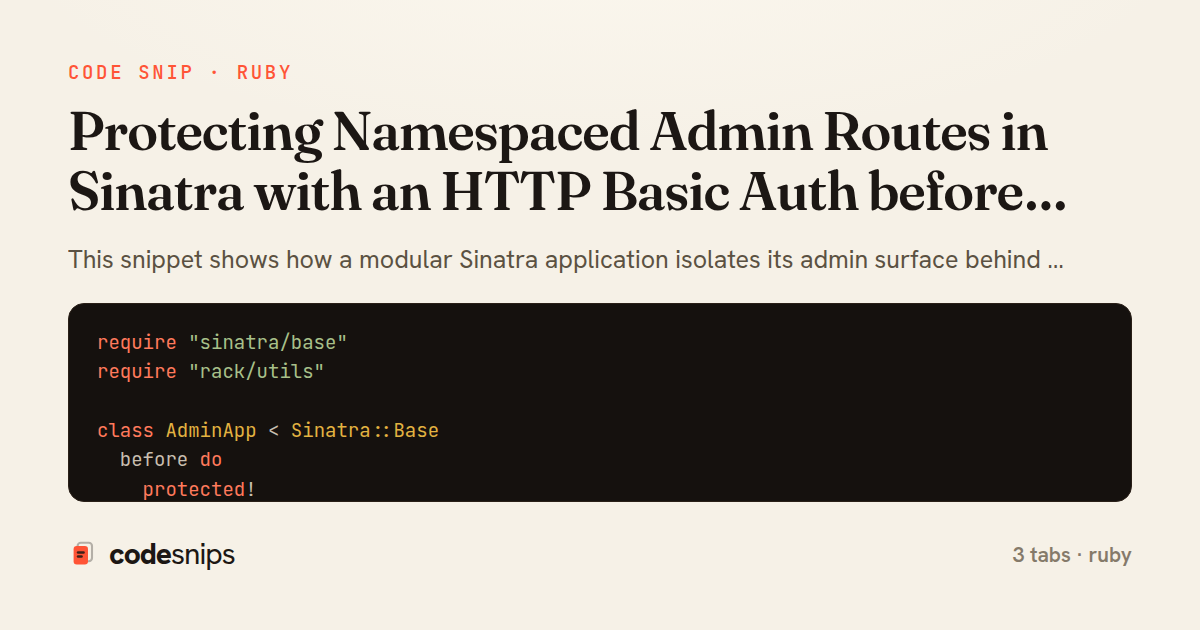
This snippet shows how a modular Sinatra application isolates its admin surface behind a single HTTP Basic auth gate rather than sprinkling authentication checks into every handler. The core idea is that a before filter combined with a shared route prefix lets one block guard an entire namespace, so new admin endpoints inherit protection automatically.
In AdminApp, all routes live under /admin because the whole Sinatra::Base subclass is mounted at that path in config.ru. The before filter runs ahead of every matching request and delegates to protected!, which either passes through or halts. protected! checks a memoized Rack::Auth::Basic::Request wrapper around env; when credentials are missing or wrong it calls halt 401, immediately short-circuiting the request so no route body ever executes. The WWW-Authenticate header set in request_auth! is what makes a browser show the native login dialog, and returning status 401 is what tells the client to retry with credentials.
The credential comparison in authorized? is deliberately written with Rack::Utils.secure_compare instead of ==. A naive string comparison returns early on the first differing byte, leaking timing information an attacker can exploit to guess a secret character by character; the constant-time compare closes that side channel. Expected values are pulled from ENV so secrets stay out of source control, with fetch raising loudly if they are unset rather than silently allowing an empty password.
In config.ru, the public MainApp and the guarded AdminApp are composed with Rack::URLMap via map, giving a clean separation where only the /admin mount carries the auth filter. This keeps the public app completely free of auth concerns.
The pattern's trade-off is that Basic auth sends credentials on every request and offers no logout or session semantics, so it suits internal dashboards and CI-only tooling behind TLS, not consumer login. The Rack::Test example in admin_auth_spec.rb verifies both the 401 challenge and a successful authenticated request using the authorize helper, documenting the contract the filter enforces.
Related snips
payload = {
  sub: user.id,
  iss: 'https://auth.example.com',
  aud: 'codesnips-api',
  exp: 15.minutes.from_now.to_i,
  iat: Time.now.to_i,
JWT issuance and verification without common footguns
require "csv"

class PeopleCsvStream
  include Enumerable

  HEADERS = %w[id full_name email signed_up_at plan].freeze
Resilient CSV Export as a Streamed Response
from django.urls import path
from . import views

app_name = 'blog'

urlpatterns = [
Django URL namespacing and reverse lookups
#!/usr/bin/env bash
set -euo pipefail

export VAULT_ADDR="https://vault.internal:8200"
export VAULT_TOKEN="${VAULT_TOKEN:?missing VAULT_TOKEN}"
Secrets management with environment isolation and Vault
import { randomBytes, createHash } from "crypto";
import jwt from "jsonwebtoken";
import { RefreshTokenStore } from "./store";

const ACCESS_SECRET = process.env.ACCESS_SECRET!;
const ACCESS_TTL = "15m";
JWT access + refresh token rotation (conceptual)
package files

import (
  "context"
  "time"
Presigned S3 upload URLs (AWS SDK v2)
Share this code
Here's the card — post it anywhere.