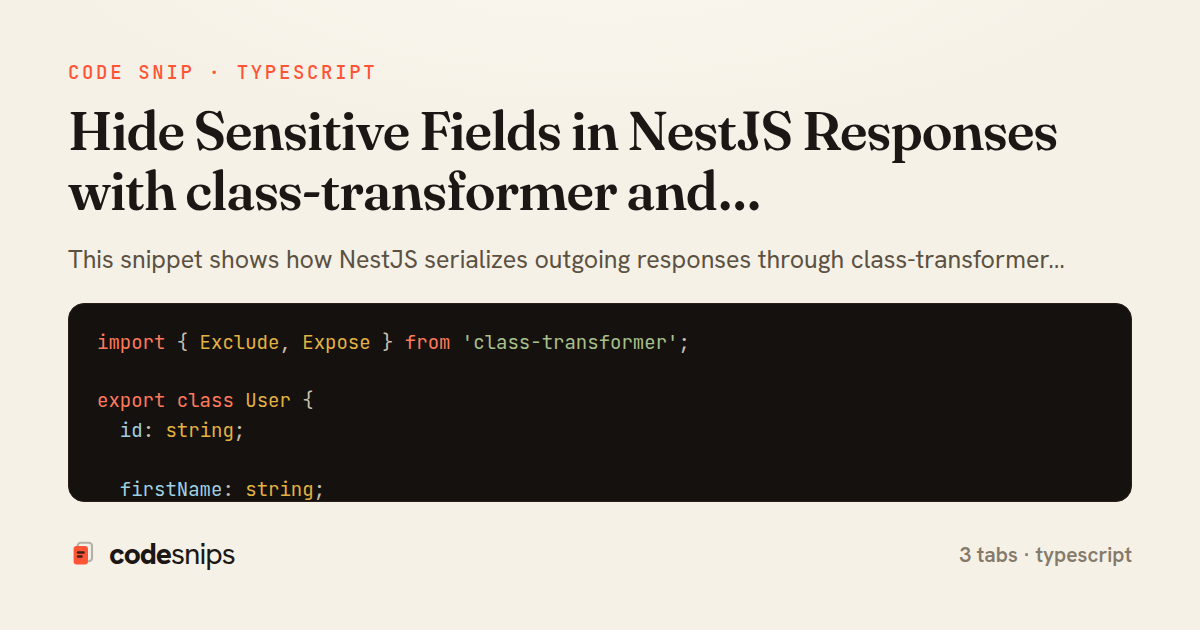
import { Exclude, Expose } from 'class-transformer';

export class User {
  id: string;

  firstName: string;

  lastName: string;

  @Expose({ groups: ['admin'] })
  email: string;

  @Exclude()
  password: string;

  @Exclude()
  twoFactorSecret: string | null;

  createdAt: Date;

  constructor(partial: Partial<User>) {
    Object.assign(this, partial);
  }

  @Expose()
  get fullName(): string {
    return `${this.firstName} ${this.lastName}`.trim();
  }
}
import {
  ClassSerializerInterceptor,
  Controller,
  Get,
  NotFoundException,
  Param,
  SerializeOptions,
  UseInterceptors,
} from '@nestjs/common';
import { UsersService } from './users.service';
import { User } from './user.entity';

@Controller('users')
@UseInterceptors(ClassSerializerInterceptor)
export class UsersController {
  constructor(private readonly usersService: UsersService) {}

  @Get(':id')
  async findOne(@Param('id') id: string): Promise<User> {
    const user = await this.usersService.findById(id);
    if (!user) {
      throw new NotFoundException(`User ${id} not found`);
    }
    return new User(user);
  }

  @Get(':id/admin')
  @SerializeOptions({ groups: ['admin'] })
  async findForAdmin(@Param('id') id: string): Promise<User> {
    const user = await this.usersService.findById(id);
    if (!user) {
      throw new NotFoundException(`User ${id} not found`);
    }
    return new User(user);
  }
}
import { NestFactory, Reflector } from '@nestjs/core';
import { ClassSerializerInterceptor, ValidationPipe } from '@nestjs/common';
import { AppModule } from './app.module';

async function bootstrap() {
  const app = await NestFactory.create(AppModule);

  app.useGlobalPipes(
    new ValidationPipe({
      transform: true,
      whitelist: true,
      forbidNonWhitelisted: true,
    }),
  );

  app.useGlobalInterceptors(
    new ClassSerializerInterceptor(app.get(Reflector), {
      excludeExtraneousValues: false,
      enableImplicitConversion: true,
    }),
  );

  await app.listen(3000);
}

bootstrap();
This snippet shows how NestJS serializes outgoing responses through class-transformer, using decorators to strip sensitive data before it leaves the controller. The core idea is that a controller should return a class instance (an entity), and a ClassSerializerInterceptor transforms that instance into a plain object right before the response is written, honoring @Exclude() and @Expose() metadata along the way. This keeps field-hiding declarative and centralized instead of scattering delete user.password calls across handlers.
In user.entity.ts, the User class annotates persistence-only fields like password and twoFactorSecret with @Exclude(), so they never appear in serialized output regardless of which endpoint returns the object. email is wrapped with @Expose({ groups: ['admin'] }), meaning it is only emitted when the serialization context requests the admin group — a common pattern for showing more data to privileged callers. The fullName getter uses @Expose() to add a computed field that has no database column, demonstrating that serialization operates on the runtime instance, not the schema.
Because class-transformer only excludes fields it knows about, the entity constructor uses Object.assign so plain rows from the ORM become real User instances that carry the decorator metadata. Returning a bare object would bypass the interceptor entirely, which is the most common pitfall.
In users.controller.ts, @UseInterceptors(ClassSerializerInterceptor) activates serialization for the controller, and @SerializeOptions({ groups: ['admin'] }) on findForAdmin passes the group into the transform so admin routes see email while the public findOne route does not. The @Get() handlers simply return User instances and let the interceptor do the hiding.
In main.ts, app.useGlobalInterceptors wires the interceptor app-wide using the DI Reflector, and the global ValidationPipe with transform: true and whitelist: true ensures inbound DTOs are also class instances with unknown properties dropped. A key trade-off: excludeExtraneousValues is deliberately not enabled here, so only decorated fields are hidden; teams wanting an allow-list model would flip that on and @Expose() everything intended to ship. This approach is worth reaching for whenever the same entity is returned by many endpoints and consistent, auditable field-hiding matters more than per-handler control.
Related snips
payload = {
  sub: user.id,
  iss: 'https://auth.example.com',
  aud: 'codesnips-api',
  exp: 15.minutes.from_now.to_i,
  iat: Time.now.to_i,
JWT issuance and verification without common footguns
#!/usr/bin/env bash
set -euo pipefail

export VAULT_ADDR="https://vault.internal:8200"
export VAULT_TOKEN="${VAULT_TOKEN:?missing VAULT_TOKEN}"
Secrets management with environment isolation and Vault
import { randomBytes, createHash } from "crypto";
import jwt from "jsonwebtoken";
import { RefreshTokenStore } from "./store";

const ACCESS_SECRET = process.env.ACCESS_SECRET!;
const ACCESS_TTL = "15m";
JWT access + refresh token rotation (conceptual)
package files

import (
  "context"
  "time"
Presigned S3 upload URLs (AWS SDK v2)
<%# private stream: turbo signs the serialized record name %>
<%= turbo_stream_from current_user %>

<section class="notifications">
  <h1>Notifications</h1>
Turbo Streams + authorization: signed per-user stream name
package api

import (
  "io"
  "net/http"
  "os"
Safe multipart uploads using temp files (bounded memory)
Share this code
Here's the card — post it anywhere.