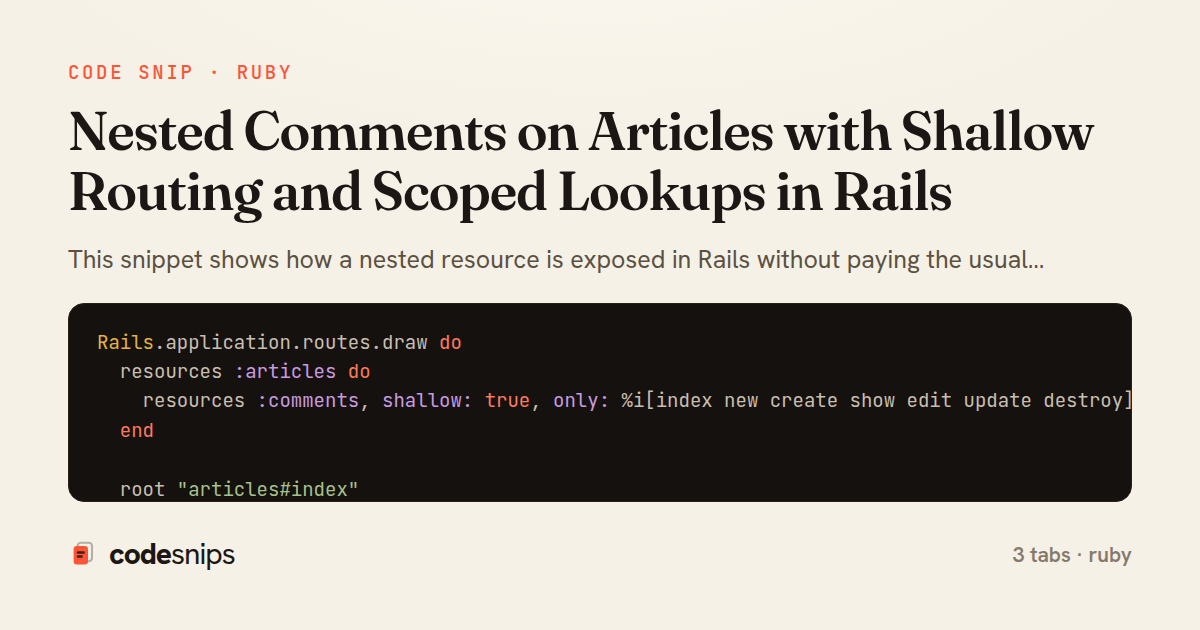
Rails.application.routes.draw do
  resources :articles do
    resources :comments, shallow: true, only: %i[index new create show edit update destroy]
  end

  root "articles#index"
end
class CommentsController < ApplicationController
  before_action :set_article, only: %i[index new create]
  before_action :set_comment, only: %i[show edit update destroy]
  rescue_from ActiveRecord::RecordNotFound, with: :not_found

  def index
    @comments = @article.comments.recent.page(params[:page])
  end

  def new
    @comment = @article.comments.build
  end

  def create
    @comment = @article.comments.build(comment_params)
    if @comment.save
      redirect_to [@article, @comment], notice: "Comment posted."
    else
      render :new, status: :unprocessable_entity
    end
  end

  def show; end
  def edit; end

  def update
    if @comment.update(comment_params)
      redirect_to @comment, notice: "Comment updated."
    else
      render :edit, status: :unprocessable_entity
    end
  end

  def destroy
    @comment.destroy!
    redirect_to @comment.article, notice: "Comment removed."
  end

  private

  def set_article
    @article = Article.find(params[:article_id])
  end

  def set_comment
    scope = params[:article_id] ? Article.find(params[:article_id]).comments : Comment
    @comment = scope.find(params[:id])
  end

  def comment_params
    params.require(:comment).permit(:body)
  end

  def not_found
    redirect_to articles_path, alert: "Comment not found.", status: :see_other
  end
end
class Comment < ApplicationRecord
  belongs_to :article, counter_cache: true

  validates :body, presence: true, length: { maximum: 10_000 }

  scope :recent, -> { order(created_at: :desc) }

  def to_param
    "#{id}-#{body.parameterize.first(40)}"
  end
end
This snippet shows how a nested resource is exposed in Rails without paying the usual cost of deeply nested URLs. In config/routes.rb, comments is nested under articles but declared with shallow: true, which is the crux of the pattern: routes that need the parent for context (index, new, create) keep the /articles/:article_id/... prefix, while routes that already have a unique comment id (show, edit, update, destroy) collapse to flat /comments/:id paths. The result is short, canonical URLs for individual records and correctly scoped collection routes, without hand-writing two route blocks.
Because shallow routing produces two different parameter shapes, the controller must load records differently depending on the action. In CommentsController, a before_action :set_article runs only for the parent-scoped actions and looks the article up by params[:article_id]. A second before_action :set_comment handles the member actions, and it deliberately scopes the lookup through @article.comments when a parent is present, falling back to a global Comment.find otherwise. Scoping the query through the association is what enforces the tenancy boundary: a request for a comment id that does not belong to the given article raises ActiveRecord::RecordNotFound instead of silently loading another article's data.
The create action builds through @article.comments, so the foreign key is set implicitly and mass-assignment cannot be tricked into reparenting a comment. comment_params uses strong parameters to whitelist only body, keeping article_id server-controlled. The redirect_to [@article, @comment] call leans on polymorphic routing so Rails picks the shallow member path automatically.
In Comment model, a default_scope-free ordering is exposed through an explicit recent scope, and a belongs_to :article, counter_cache: true keeps articles.comments_count accurate for cheap display. The not_found rescue centralizes error handling so both lookup strategies degrade to a 404. This approach is worth reaching for whenever a child resource is always accessed in the context of its parent for listing and creation, but benefits from stable, shareable URLs for individual items. The main pitfall is forgetting to scope member lookups through the parent, which reintroduces the authorization hole shallow routing otherwise sidesteps.
Related snips
class CommentsController < ApplicationController
  before_action :set_post

  def create
    @comment = @post.comments.build(comment_params)
System test: asserting Turbo Stream responses
class Post < ApplicationRecord
  belongs_to :author, class_name: 'User'
  has_many :comments, dependent: :destroy

  scope :published, -> { where.not(published_at: nil).where('published_at <= ?', Time.current) }
  scope :draft, -> { where(published_at: nil) }
ActiveRecord scopes for reusable query logic
module Api
  module V1
    class UsersController < BaseController
      def show
        user = User.includes(:profile).find(params[:id])
ETags for conditional requests and caching
class PostsController < ApplicationController
  def index
    @posts = Post.includes(:author)
                 .order(created_at: :desc)
                 .page(params[:page])
                 .per(10)
Turbo Frames: infinite scroll with lazy-loading frame
require "csv"

class PeopleCsvStream
  include Enumerable

  HEADERS = %w[id full_name email signed_up_at plan].freeze
Resilient CSV Export as a Streamed Response
<form data-controller="query-sync" data-action="change->query-sync#apply">
  <select name="status" class="rounded border p-2">
    <option value="">Any</option>
    <option value="open">Open</option>
    <option value="closed">Closed</option>
  </select>
Filter UI that syncs query params via Stimulus (no front-end router)
Share this code
Here's the card — post it anywhere.