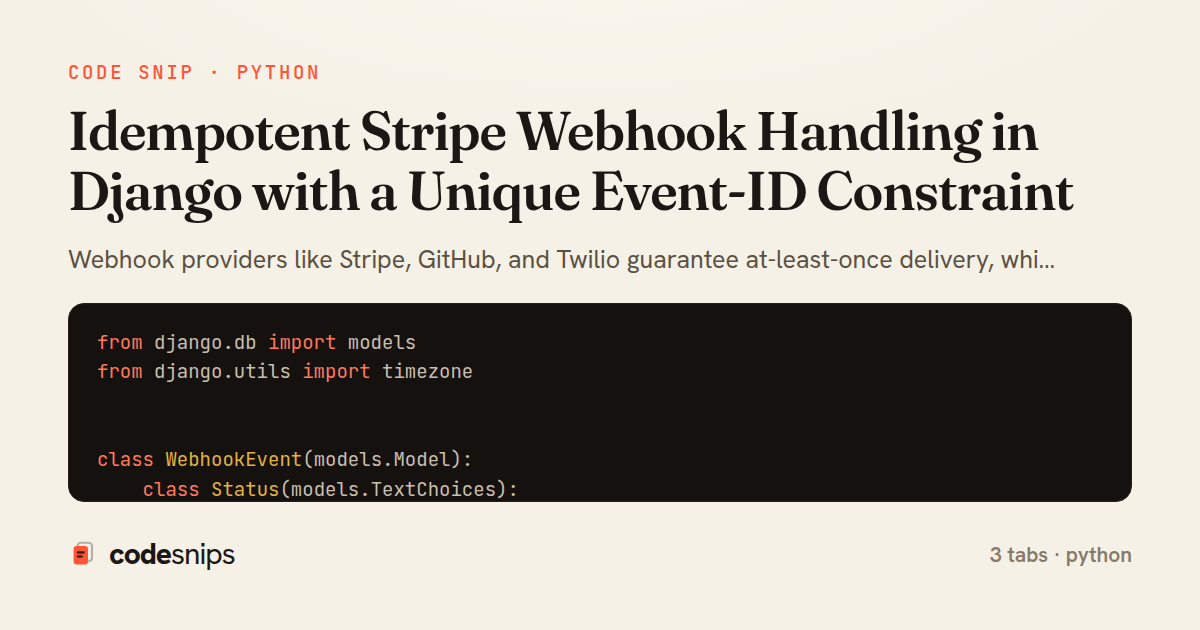
from django.db import models
from django.utils import timezone


class WebhookEvent(models.Model):
    class Status(models.TextChoices):
        PENDING = "pending", "Pending"
        PROCESSED = "processed", "Processed"
        FAILED = "failed", "Failed"

    provider = models.CharField(max_length=32, default="stripe")
    event_id = models.CharField(max_length=255, unique=True)
    event_type = models.CharField(max_length=120)
    payload = models.JSONField()
    status = models.CharField(
        max_length=16, choices=Status.choices, default=Status.PENDING
    )
    error = models.TextField(blank=True, default="")
    received_at = models.DateTimeField(auto_now_add=True)
    processed_at = models.DateTimeField(null=True, blank=True)

    class Meta:
        constraints = [
            models.UniqueConstraint(
                fields=["provider", "event_id"], name="uniq_provider_event"
            )
        ]

    def mark_processed(self):
        self.status = self.Status.PROCESSED
        self.processed_at = timezone.now()
        self.save(update_fields=["status", "processed_at"])

    def mark_failed(self, message):
        self.status = self.Status.FAILED
        self.error = str(message)[:2000]
        self.save(update_fields=["status", "error"])

    def __str__(self):
        return f"{self.provider}:{self.event_id}"
from django.db import migrations, models


class Migration(migrations.Migration):

    dependencies = [
        ("payments", "0001_initial"),
    ]

    operations = [
        migrations.CreateModel(
            name="WebhookEvent",
            fields=[
                ("id", models.BigAutoField(primary_key=True, serialize=False)),
                ("provider", models.CharField(default="stripe", max_length=32)),
                ("event_id", models.CharField(max_length=255, unique=True)),
                ("event_type", models.CharField(max_length=120)),
                ("payload", models.JSONField()),
                (
                    "status",
                    models.CharField(
                        choices=[
                            ("pending", "Pending"),
                            ("processed", "Processed"),
                            ("failed", "Failed"),
                        ],
                        db_index=True,
                        default="pending",
                        max_length=16,
                    ),
                ),
                ("error", models.TextField(blank=True, default="")),
                ("received_at", models.DateTimeField(auto_now_add=True)),
                ("processed_at", models.DateTimeField(blank=True, null=True)),
            ],
        ),
        migrations.AddConstraint(
            model_name="webhookevent",
            constraint=models.UniqueConstraint(
                fields=["provider", "event_id"], name="uniq_provider_event"
            ),
        ),
    ]
import stripe
from django.conf import settings
from django.db import IntegrityError, transaction
from django.http import HttpResponse, HttpResponseBadRequest
from django.views.decorators.csrf import csrf_exempt
from django.views.decorators.http import require_POST

from .models import WebhookEvent
from .services import fulfil_payment


@csrf_exempt
@require_POST
def stripe_webhook(request):
    payload = request.body
    sig = request.META.get("HTTP_STRIPE_SIGNATURE", "")
    try:
        event = stripe.Webhook.construct_event(
            payload, sig, settings.STRIPE_WEBHOOK_SECRET
        )
    except (ValueError, stripe.error.SignatureVerificationError):
        return HttpResponseBadRequest("invalid signature")

    try:
        record, created = WebhookEvent.objects.get_or_create(
            provider="stripe",
            event_id=event["id"],
            defaults={
                "event_type": event["type"],
                "payload": event.to_dict(),
            },
        )
    except IntegrityError:
        # A concurrent request inserted the same event first: treat as duplicate.
        return HttpResponse(status=200)

    if not created:
        return HttpResponse(status=200)

    try:
        with transaction.atomic():
            if event["type"] == "payment_intent.succeeded":
                fulfil_payment(event["data"]["object"])
            record.mark_processed()
    except Exception as exc:
        record.mark_failed(exc)
        return HttpResponse(status=500)

    return HttpResponse(status=200)
Webhook providers like Stripe, GitHub, and Twilio guarantee at-least-once delivery, which means the same event can arrive twice — after a network timeout, a retry, or a load-balancer hiccup. Processing the same payment_intent.succeeded twice could double-credit an account, so the handler must be idempotent. This snippet shows the standard defence: store every event's provider-assigned ID under a database unique constraint and let the database, not application logic, be the source of truth for "have I seen this before?".
The WebhookEvent model tab defines a durable row per delivery. The event_id field carries unique=True, and the status field tracks the processing lifecycle with a TextChoices enum. Because the uniqueness lives in the schema, two concurrent workers racing on the same event cannot both win — one insert succeeds and the other hits an IntegrityError. The mark_processed and mark_failed helpers keep state transitions in one place.
The 0002_webhookevent migration tab makes that guarantee explicit. Beyond the field-level unique=True, it adds a UniqueConstraint named uniq_provider_event, scoped to (provider, event_id). Scoping by provider matters when several webhook sources share one table, since a Stripe event ID could theoretically collide with a different provider's ID namespace. A db_index on status keeps the "find unprocessed events" query cheap.
The stripe_webhook view tab ties it together. It first verifies the signature with stripe.Webhook.construct_event, rejecting forged or malformed payloads with a 400 before any database work. It then calls get_or_create, keyed on the provider and event ID, which is the crux of the pattern: if the row already exists, created is False and the handler returns 200 immediately without re-running side effects. The get_or_create call is wrapped in a try/except IntegrityError to close the last race window — two requests can both pass the existence check and then attempt the insert, but the unique constraint ensures only one commits.
Returning 200 for duplicates is deliberate: any non-2xx status tells Stripe to retry, so a well-behaved handler acknowledges duplicates as success. Actual business work runs inside a transaction only on the created path, and failures flip the row to FAILED so a replay job can retry later without losing the audit trail.
Related snips
timestamp = request.headers.fetch('X-Signature-Timestamp')
signature = request.headers.fetch('X-Signature')
payload = request.raw_post

data = "#{timestamp}.#{payload}"
expected = OpenSSL::HMAC.hexdigest('SHA256', ENV.fetch('WEBHOOK_SECRET'), data)
HMAC signed API requests for webhook and partner integrity
export interface RetryOptions {
  retries: number;
  baseMs: number;
  maxMs: number;
  signal?: AbortSignal;
  onRetry?: (attempt: number, delay: number, err: unknown) => void;
Exponential backoff with jitter for retries
class Product(models.Model):
    name = models.CharField(max_length=200)
    slug = models.SlugField(blank=True)
    price = models.DecimalField(max_digits=10, decimal_places=2)
    cost = models.DecimalField(max_digits=10, decimal_places=2)
    margin = models.DecimalField(max_digits=5, decimal_places=2, blank=True)
Django model signals vs overriding save
package dbutil

import (
  "context"

  "github.com/jackc/pgconn"
Retry Postgres serialization failures with bounded attempts
require "csv"

class PeopleCsvStream
  include Enumerable

  HEADERS = %w[id full_name email signed_up_at plan].freeze
Resilient CSV Export as a Streamed Response
from django.urls import path
from . import views

app_name = 'blog'

urlpatterns = [
Django URL namespacing and reverse lookups
Share this code
Here's the card — post it anywhere.