<%= form_with url: bulk_update_orders_path, method: :patch, data: { turbo_confirm: "Update selected orders?" } do %>
  <div class="batch-toolbar">
    <%= select_tag :status,
          options_for_select(Order.statuses.keys.map { |s| [s.humanize, s] }),
          prompt: "Set status to\u2026" %>
    <%= submit_tag "Apply to selected", class: "btn" %>
  </div>

  <table class="orders">
    <thead>
      <tr><th></th><th>Order</th><th>Customer</th><th>Status</th></tr>
    </thead>
    <tbody>
      <% @orders.each do |order| %>
        <tr>
          <td>
            <%= check_box_tag "order_ids[]", order.id, false,
                  disabled: !order.updatable?, id: dom_id(order, :select) %>
          </td>
          <td>#<%= order.number %></td>
          <td><%= order.customer_name %></td>
          <td><span class="badge badge-<%= order.status %>"><%= order.status.humanize %></span></td>
        </tr>
      <% end %>
    </tbody>
  </table>
<% end %>
class OrdersController < ApplicationController
  def index
    @orders = Order.order(created_at: :desc).page(params[:page])
  end

  def bulk_update
    ids, status = bulk_update_params
    assert_valid_status!(status)

    count = Order.bulk_transition_to(status, ids)

    if count.positive?
      redirect_to orders_path, notice: "Updated #{count} order#{'s' unless count == 1}."
    else
      redirect_to orders_path, alert: "No eligible orders were updated."
    end
  rescue ArgumentError => e
    redirect_to orders_path, alert: e.message
  end

  private

  def bulk_update_params
    ids = Array(params[:order_ids]).map(&:to_i).reject(&:zero?)
    [ids, params[:status].to_s]
  end

  def assert_valid_status!(status)
    return if Order.statuses.key?(status)

    raise ArgumentError, "#{status.inspect} is not a valid status"
  end
end
class Order < ApplicationRecord
  enum status: {
    pending: 0,
    processing: 1,
    packed: 2,
    shipped: 3,
    cancelled: 4
  }

  scope :updatable, -> { where(status: %i[pending processing packed]) }

  def updatable?
    self.class.updatable.exists?(id)
  end

  def self.bulk_transition_to(status, ids)
    return 0 if ids.blank?

    scope = updatable.where(id: ids)
    affected_ids = scope.pluck(:id)
    return 0 if affected_ids.empty?

    count = scope.update_all(status: statuses.fetch(status), updated_at: Time.current)

    OrderTransitionNotificationJob.perform_later(affected_ids, status)
    count
  end
end
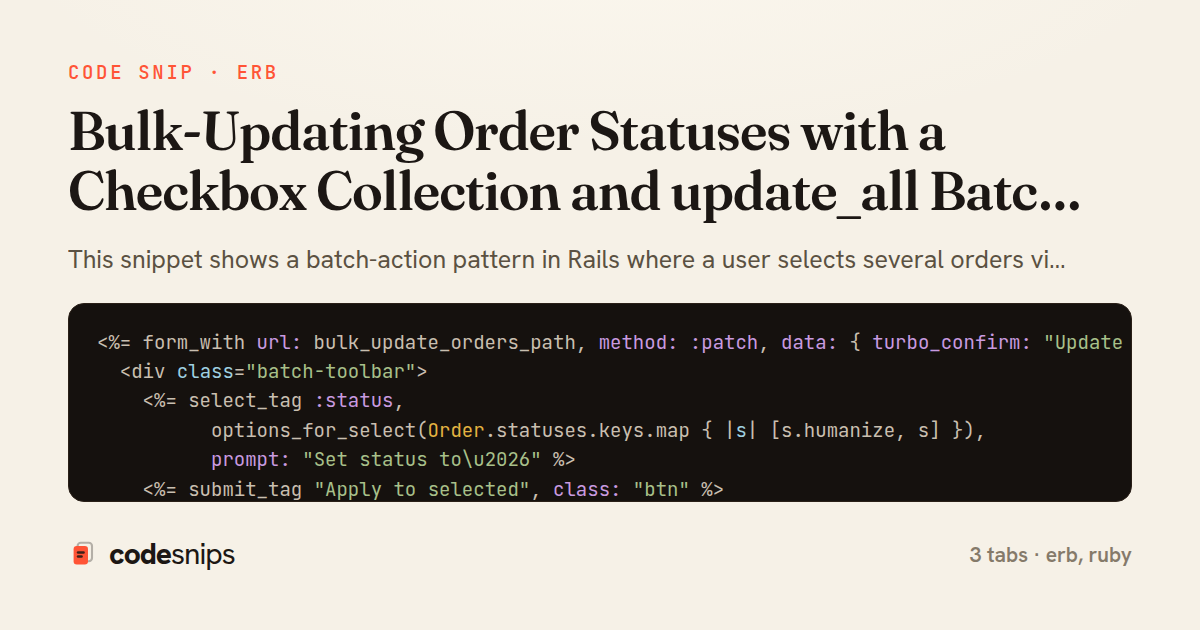
This snippet shows a batch-action pattern in Rails where a user selects several orders via checkboxes and transitions them to a new status in a single request. The point is to do the work as one set-based UPDATE rather than looping and saving each record, which is faster and avoids N callbacks firing per row.
The orders/index view renders a form_with posting to a member-less collection route (bulk_update_orders_path). Each row includes check_box_tag with the shared name order_ids[], so the browser submits an array of selected primary keys. A select_tag lets the operator choose the target status, and the same form is reused for filtering — the important detail is that the checkbox name uses [] so Rails parses params[:order_ids] into an array.
In OrdersController, bulk_update reads and sanitizes those params. bulk_update_params whitelists the incoming array and coerces the ids to integers, while assert_valid_status! guards against arbitrary status strings by checking against Order.statuses, the hash defined by the enum. The scope Order.where(id: ids) is narrowed further by updatable so already-shipped or cancelled orders are excluded. The call to .update_all writes every matching row in one statement and returns the affected count, which is surfaced back to the operator via flash. Because update_all bypasses validations and callbacks, updated_at is set explicitly so timestamps stay honest.
The Order model defines the status enum and an updatable scope listing the states that may still transition. The bulk_transition_to class method centralizes the guard-plus-update_all logic so it is testable in isolation and reusable from a background job. The trade-off of update_all is real: no paper_trail versions, no after_update hooks, no email side effects — so anything requiring per-record logic must be enqueued separately, which bulk_transition_to does by collecting ids before the write. This pattern fits admin dashboards and moderation queues where throughput matters and the transition is a simple column change. A pitfall to watch is that update_all does not run optimistic-locking checks, so concurrent edits can be silently overwritten; scoping by updatable limits that blast radius.
Related snips
class CommentsController < ApplicationController
  before_action :set_post

  def create
    @comment = @post.comments.build(comment_params)
System test: asserting Turbo Stream responses
class Post < ApplicationRecord
  belongs_to :author, class_name: 'User'
  has_many :comments, dependent: :destroy

  scope :published, -> { where.not(published_at: nil).where('published_at <= ?', Time.current) }
  scope :draft, -> { where(published_at: nil) }
ActiveRecord scopes for reusable query logic
module Api
  module V1
    class UsersController < BaseController
      def show
        user = User.includes(:profile).find(params[:id])
ETags for conditional requests and caching
class PostsController < ApplicationController
  def index
    @posts = Post.includes(:author)
                 .order(created_at: :desc)
                 .page(params[:page])
                 .per(10)
Turbo Frames: infinite scroll with lazy-loading frame
package dbutil

import (
  "context"

  "github.com/jackc/pgconn"
Retry Postgres serialization failures with bounded attempts
require "csv"

class PeopleCsvStream
  include Enumerable

  HEADERS = %w[id full_name email signed_up_at plan].freeze
Resilient CSV Export as a Streamed Response
Share this code
Here's the card — post it anywhere.