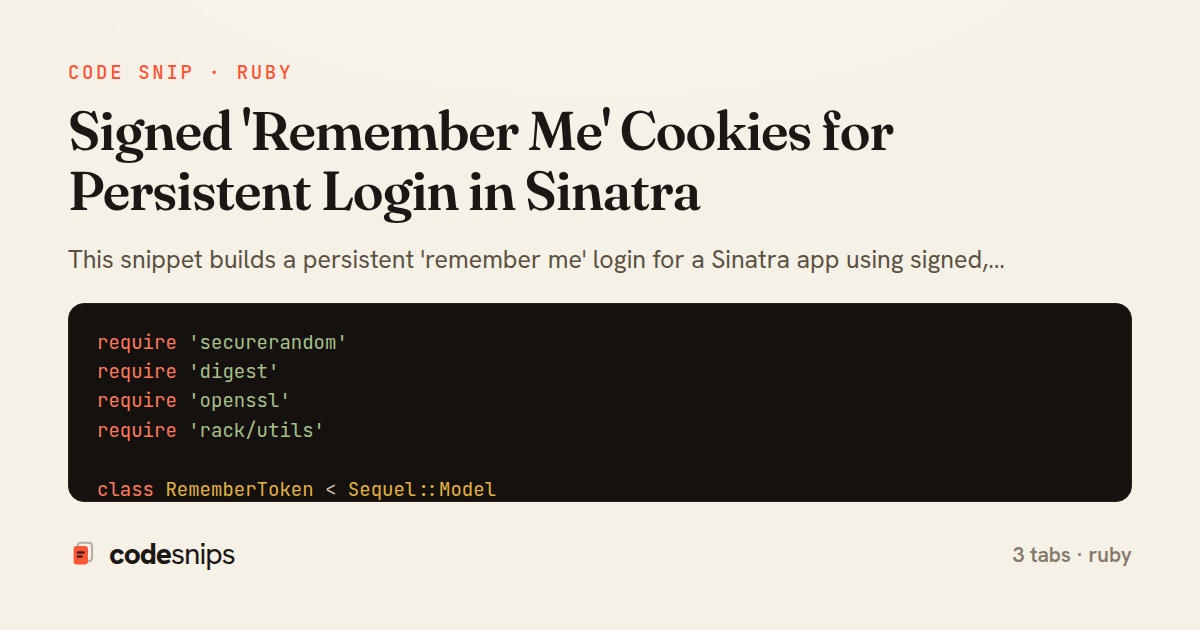
require 'securerandom'
require 'digest'
require 'openssl'
require 'rack/utils'

class RememberToken < Sequel::Model
  SIGNING_KEY = ENV.fetch('REMEMBER_SIGNING_KEY')

  def self.issue(user_id, ttl: 365 * 24 * 3600)
    selector  = SecureRandom.urlsafe_base64(12)
    validator = SecureRandom.urlsafe_base64(24)
    create(
      user_id: user_id,
      selector: selector,
      validator_digest: Digest::SHA256.hexdigest(validator),
      expires_at: Time.now + ttl
    )
    { selector: selector, validator: validator }
  end

  def self.authenticate(selector, validator)
    token = where(selector: selector).first
    return nil unless token && token.expires_at > Time.now
    expected = token.validator_digest
    given    = Digest::SHA256.hexdigest(validator)
    return nil unless Rack::Utils.secure_compare(expected, given)
    token.user_id
  end

  def self.cookie_value(selector, validator)
    payload = "#{selector}:#{validator}"
    sig = OpenSSL::HMAC.hexdigest('SHA256', SIGNING_KEY, payload)
    "#{payload}:#{sig}"
  end

  def self.parse(raw)
    return nil unless raw
    selector, validator, sig = raw.split(':', 3)
    return nil unless selector && validator && sig
    payload  = "#{selector}:#{validator}"
    expected = OpenSSL::HMAC.hexdigest('SHA256', SIGNING_KEY, payload)
    return nil unless Rack::Utils.secure_compare(expected, sig)
    [selector, validator]
  end
end
require 'sinatra/base'
require_relative 'remember_token'

class Web < Sinatra::Base
  enable :sessions

  before do
    @current_user ||= session[:user_id] && User[session[:user_id]]
    next if @current_user

    parsed = RememberToken.parse(request.cookies['remember'])
    if parsed
      user_id = RememberToken.authenticate(*parsed)
      if user_id
        session[:user_id] = user_id
        @current_user = User[user_id]
      else
        response.delete_cookie('remember')
      end
    end
  end

  post '/login' do
    user = User.authenticate(params[:email], params[:password])
    halt 401, 'Invalid credentials' unless user
    session[:user_id] = user.id

    if params[:remember] == '1'
      pair = RememberToken.issue(user.id)
      response.set_cookie('remember',
        value:    RememberToken.cookie_value(pair[:selector], pair[:validator]),
        path:     '/',
        httponly: true,
        secure:   production?,
        same_site: :lax,
        max_age:  365 * 24 * 3600
      )
    end

    redirect '/dashboard'
  end

  post '/logout' do
    parsed = RememberToken.parse(request.cookies['remember'])
    RememberToken.where(selector: parsed.first).delete if parsed
    response.delete_cookie('remember')
    session.clear
    redirect '/'
  end

  helpers do
    def production?
      ENV['RACK_ENV'] == 'production'
    end
  end
end
Sequel.migration do
  change do
    create_table(:remember_tokens) do
      primary_key :id
      foreign_key :user_id, :users, null: false, on_delete: :cascade
      String   :selector, null: false, fixed: false
      String   :validator_digest, null: false
      DateTime :expires_at, null: false
      DateTime :created_at

      index :selector, unique: true
      index :user_id
    end
  end
end
This snippet builds a persistent 'remember me' login for a Sinatra app using signed, tamper-evident cookies. The core idea is that a login form can drop a long-lived cookie that survives browser restarts, but that cookie must not be forgeable: if a client could edit the user id inside it, they could impersonate anyone. The solution stores a random selector plus a hashed validator server-side, and signs the cookie payload with an HMAC so the server can detect tampering before it ever hits the database.
In RememberToken model, each remember token is split into a public selector and a secret validator. Only the SHA-256 digest of the validator is persisted in validator_digest, so a leaked database row cannot be replayed directly. RememberToken.issue mints a fresh pair with SecureRandom.urlsafe_base64 and returns the raw values to the caller exactly once. authenticate looks the row up by selector, checks expiry, and uses Rack::Utils.secure_compare for a constant-time comparison to avoid timing attacks. The cookie value is built by cookie_value and verified by parse using OpenSSL::HMAC, again with secure_compare, so a mismatched signature is rejected without a DB hit.
In app.rb, the /login route calls RememberToken.issue and writes the signed value through response.set_cookie with httponly and secure flags plus a one-year max_age; these flags keep the cookie out of JavaScript and off plain HTTP. The before filter reads request.cookies['remember'], runs it through RememberToken.parse and authenticate, and hydrates @current_user on success while silently clearing a bad cookie. /logout both deletes the DB row and calls response.delete_cookie so the token can never be reused.
The SIGNING_KEY is loaded from the environment because the whole scheme collapses if the key leaks or is hardcoded. A subtle trade-off worth noting: signed cookies prove integrity, not confidentiality, so the validator still lives only as a digest server-side. Rotating tokens on each use would harden this further against theft, at the cost of extra writes. This pattern is what a developer reaches for when sessions alone are too short-lived but storing a bare user id in a cookie is unacceptable.
Related snips
payload = {
  sub: user.id,
  iss: 'https://auth.example.com',
  aud: 'codesnips-api',
  exp: 15.minutes.from_now.to_i,
  iat: Time.now.to_i,
JWT issuance and verification without common footguns
timestamp = request.headers.fetch('X-Signature-Timestamp')
signature = request.headers.fetch('X-Signature')
payload = request.raw_post

data = "#{timestamp}.#{payload}"
expected = OpenSSL::HMAC.hexdigest('SHA256', ENV.fetch('WEBHOOK_SECRET'), data)
HMAC signed API requests for webhook and partner integrity
require "csv"

class PeopleCsvStream
  include Enumerable

  HEADERS = %w[id full_name email signed_up_at plan].freeze
Resilient CSV Export as a Streamed Response
#!/usr/bin/env bash
set -euo pipefail

export VAULT_ADDR="https://vault.internal:8200"
export VAULT_TOKEN="${VAULT_TOKEN:?missing VAULT_TOKEN}"
Secrets management with environment isolation and Vault
import { randomBytes, createHash } from "crypto";
import jwt from "jsonwebtoken";
import { RefreshTokenStore } from "./store";

const ACCESS_SECRET = process.env.ACCESS_SECRET!;
const ACCESS_TTL = "15m";
JWT access + refresh token rotation (conceptual)
package files

import (
  "context"
  "time"
Presigned S3 upload URLs (AWS SDK v2)
Share this code
Here's the card — post it anywhere.