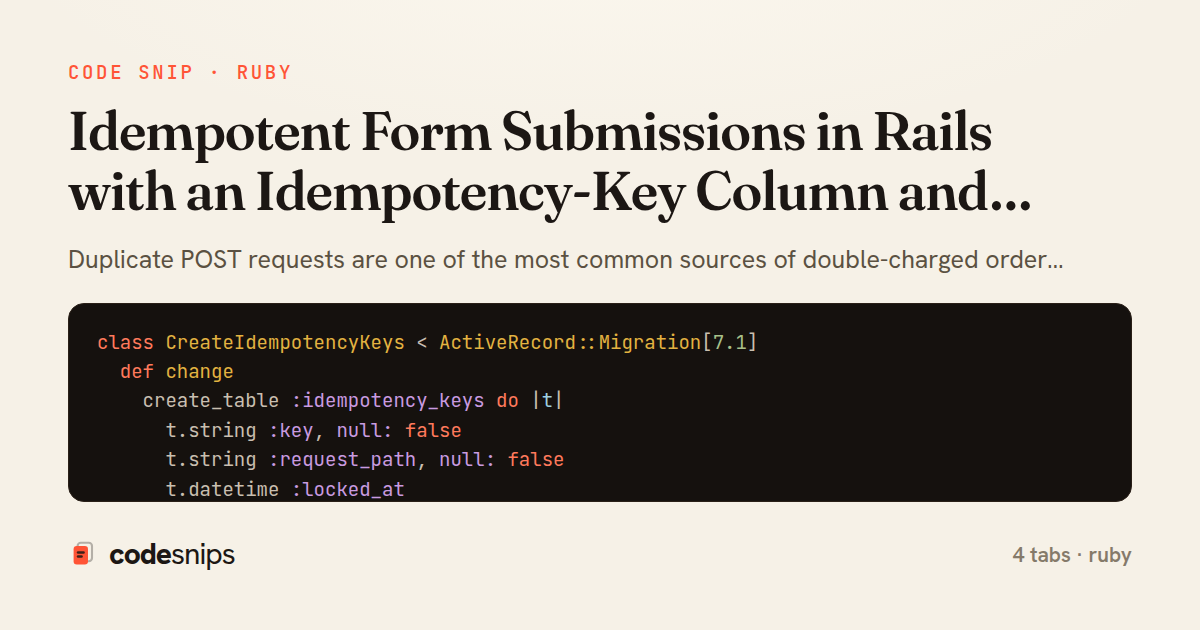
class CreateIdempotencyKeys < ActiveRecord::Migration[7.1]
  def change
    create_table :idempotency_keys do |t|
      t.string :key, null: false
      t.string :request_path, null: false
      t.datetime :locked_at
      t.integer :response_status
      t.jsonb :response_body
      t.references :user, foreign_key: true
      t.timestamps
    end

    add_index :idempotency_keys, [:key, :request_path], unique: true
    add_index :idempotency_keys, :created_at
  end
end
class IdempotencyKey < ApplicationRecord
  belongs_to :user, optional: true

  def self.claim!(key:, path:, user_id: nil)
    result = insert_all(
      [{ key: key, request_path: path, user_id: user_id, locked_at: Time.current,
         created_at: Time.current, updated_at: Time.current }],
      unique_by: [:key, :request_path],
      on_duplicate: :skip
    )

    record = find_by!(key: key, request_path: path)
    fresh_claim = result.rows.any?
    [record, fresh_claim]
  end

  def in_progress?
    locked_at.present? && response_status.nil?
  end

  def completed?
    response_status.present?
  end

  def store_response!(status:, body:)
    update!(response_status: status, response_body: body)
  end
end
module Idempotent
  extend ActiveSupport::Concern

  private

  def require_idempotency_key
    key = request.headers["Idempotency-Key"].presence
    return render_missing_key unless key

    @idempotency_key, fresh = IdempotencyKey.claim!(
      key: key,
      path: request.path,
      user_id: current_user&.id
    )

    return if fresh

    if @idempotency_key.completed?
      render json: @idempotency_key.response_body,
             status: @idempotency_key.response_status
    else
      render json: { error: "Request already in progress" }, status: :conflict
    end
  end

  def store_idempotent_response(status:, body:)
    @idempotency_key&.store_response!(status: Rack::Utils.status_code(status), body: body)
  end

  def render_missing_key
    render json: { error: "Idempotency-Key header required" }, status: :bad_request
  end
end
class OrdersController < ApplicationController
  include Idempotent

  before_action :authenticate_user!
  before_action :require_idempotency_key, only: :create

  def create
    order = current_user.orders.create!(order_params)
    ChargePaymentJob.perform_later(order.id)

    body = OrderSerializer.new(order).as_json
    store_idempotent_response(status: :created, body: body)
    render json: body, status: :created
  rescue ActiveRecord::RecordInvalid => e
    body = { errors: e.record.errors.full_messages }
    store_idempotent_response(status: :unprocessable_entity, body: body)
    render json: body, status: :unprocessable_entity
  end

  private

  def order_params
    params.require(:order).permit(:sku, :quantity, :shipping_address_id)
  end
end
Duplicate POST requests are one of the most common sources of double-charged orders and duplicate records: a user double-clicks submit, a proxy retries a timed-out request, or a mobile client replays a queued mutation. This snippet enforces exactly-once semantics at the application layer using an idempotency key persisted per client, so replaying the same request returns the original result instead of creating a second row.
The CreateIdempotencyKeys migration establishes the storage. Each row is keyed by a key string plus a request_path so the same UUID can be reused safely across different endpoints. A unique index on [:key, :request_path] is the real enforcement mechanism — the database, not Ruby, guarantees no two concurrent requests can both insert the same key. The locked_at, response_status, and response_body columns let the record double as both a lock and a cache of the completed response.
In IdempotencyKey model, claim! performs an atomic upsert: insert_all with unique_by and on_duplicate: :skip inserts the row only if it does not already exist, and the return value reveals whether this request won the race. store_response! records the final status and body once the action succeeds. Keeping this logic on the model keeps the controller thin.
The Idempotent concern provides require_idempotency_key, wired in as a before_action. It reads the Idempotency-Key header, rejects requests without one, and calls claim!. If the key was already claimed, it replays the stored response verbatim — or returns 409 Conflict if the original request is still in flight (locked_at set but no response yet). Otherwise the action runs normally.
OrdersController shows the integration: before_action :require_idempotency_key, only: :create, then a call to store_idempotent_response after the order is created. A subtle trade-off is deciding when to store — storing on both success and handled failures avoids re-running expensive side effects, but transient 500s should generally NOT be cached so genuine retries can succeed. Old keys should be swept periodically to bound table growth. This pattern shifts correctness from client discipline to a server-side guarantee backed by a unique constraint.
Related snips
class CommentsController < ApplicationController
  before_action :set_post

  def create
    @comment = @post.comments.build(comment_params)
System test: asserting Turbo Stream responses
class Post < ApplicationRecord
  belongs_to :author, class_name: 'User'
  has_many :comments, dependent: :destroy

  scope :published, -> { where.not(published_at: nil).where('published_at <= ?', Time.current) }
  scope :draft, -> { where(published_at: nil) }
ActiveRecord scopes for reusable query logic
export interface RetryOptions {
  retries: number;
  baseMs: number;
  maxMs: number;
  signal?: AbortSignal;
  onRetry?: (attempt: number, delay: number, err: unknown) => void;
Exponential backoff with jitter for retries
module Api
  module V1
    class UsersController < BaseController
      def show
        user = User.includes(:profile).find(params[:id])
ETags for conditional requests and caching
class PostsController < ApplicationController
  def index
    @posts = Post.includes(:author)
                 .order(created_at: :desc)
                 .page(params[:page])
                 .per(10)
Turbo Frames: infinite scroll with lazy-loading frame
package dbutil

import (
  "context"

  "github.com/jackc/pgconn"
Retry Postgres serialization failures with bounded attempts
Share this code
Here's the card — post it anywhere.