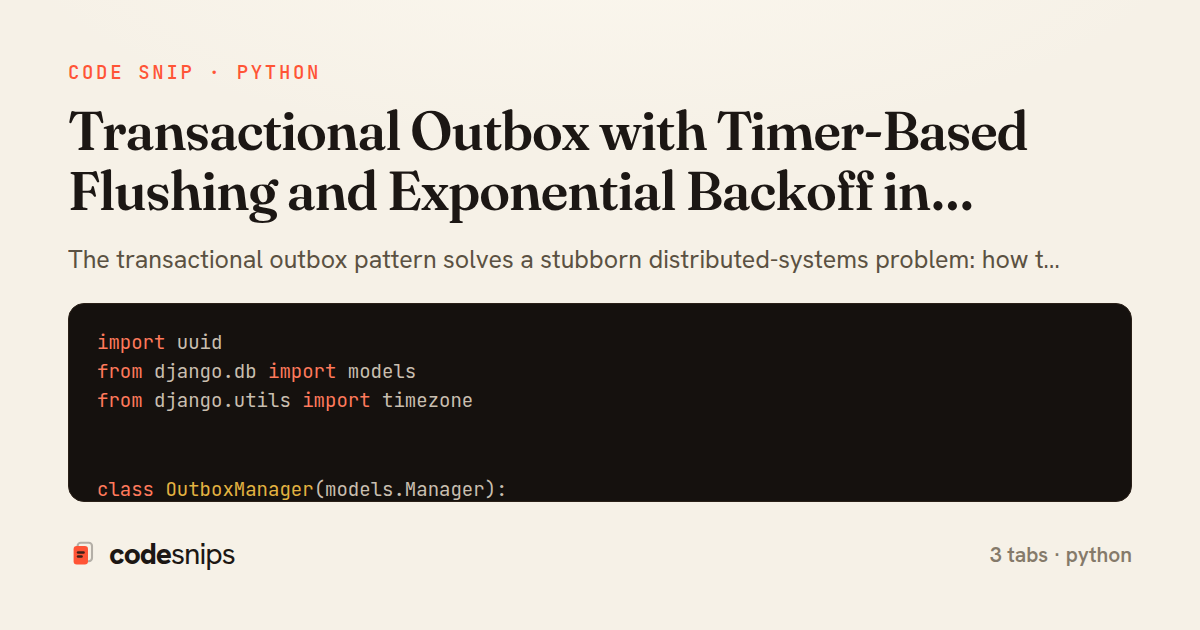
import uuid
from django.db import models
from django.utils import timezone


class OutboxManager(models.Manager):
    def available(self, limit=100):
        now = timezone.now()
        return (
            self.filter(status=OutboxMessage.PENDING, next_retry_at__lte=now)
            .order_by("created_at")[:limit]
        )


class OutboxMessage(models.Model):
    PENDING, SENT, FAILED = "pending", "sent", "failed"
    STATUS_CHOICES = [(PENDING, "Pending"), (SENT, "Sent"), (FAILED, "Failed")]

    id = models.UUIDField(primary_key=True, default=uuid.uuid4, editable=False)
    topic = models.CharField(max_length=200)
    payload = models.JSONField()
    dedupe_key = models.CharField(max_length=255, unique=True)
    status = models.CharField(max_length=16, choices=STATUS_CHOICES, default=PENDING)
    attempts = models.PositiveIntegerField(default=0)
    max_attempts = models.PositiveIntegerField(default=8)
    last_error = models.TextField(blank=True, default="")
    next_retry_at = models.DateTimeField(default=timezone.now)
    created_at = models.DateTimeField(auto_now_add=True)
    updated_at = models.DateTimeField(auto_now=True)

    objects = OutboxManager()

    class Meta:
        indexes = [
            models.Index(fields=["status", "next_retry_at"]),
        ]

    def __str__(self):
        return "{}:{} ({})".format(self.topic, self.dedupe_key, self.status)
import logging
from datetime import timedelta

from django.db import transaction
from django.utils import timezone

from .models import OutboxMessage

logger = logging.getLogger(__name__)

MAX_BACKOFF_SECONDS = 3600


def _schedule_retry(message, error):
    message.attempts += 1
    message.last_error = str(error)[:2000]
    if message.attempts >= message.max_attempts:
        message.status = OutboxMessage.FAILED
        logger.error("Outbox message %s exhausted retries", message.id)
    else:
        delay = min(2 ** message.attempts, MAX_BACKOFF_SECONDS)
        message.next_retry_at = timezone.now() + timedelta(seconds=delay)
    message.save(update_fields=["attempts", "last_error", "status", "next_retry_at", "updated_at"])


def flush_once(publish, batch_size=100):
    sent = 0
    with transaction.atomic():
        rows = list(
            OutboxMessage.objects.available(limit=batch_size)
            .select_for_update(skip_locked=True)
        )
        for message in rows:
            try:
                publish(message.topic, message.payload, key=message.dedupe_key)
            except Exception as exc:  # broker/network failures are expected
                _schedule_retry(message, exc)
                continue
            message.status = OutboxMessage.SENT
            message.save(update_fields=["status", "updated_at"])
            sent += 1
    return sent
from celery import shared_task
from django.db import transaction

from .flusher import flush_once
from .models import OutboxMessage
from .publisher import kafka_publish


@shared_task(bind=True, max_retries=3, default_retry_delay=30)
def flush_outbox(self, batch_size=100):
    try:
        return flush_once(kafka_publish, batch_size=batch_size)
    except Exception as exc:
        raise self.retry(exc=exc)


def enqueue_message(topic, payload, dedupe_key):
    with transaction.atomic():
        obj, created = OutboxMessage.objects.get_or_create(
            dedupe_key=dedupe_key,
            defaults={"topic": topic, "payload": payload},
        )
        return obj, created


# celery beat schedule (settings.py)
CELERY_BEAT_SCHEDULE = {
    "flush-outbox-every-5s": {
        "task": "outbox.tasks.flush_outbox",
        "schedule": 5.0,
        "kwargs": {"batch_size": 200},
    },
}
The transactional outbox pattern solves a stubborn distributed-systems problem: how to atomically commit a database change and publish a message about it. Writing to the database and then calling a broker in the same request is not atomic — a crash between the two leaves the system inconsistent. Instead the message is written to an outbox table inside the same transaction as the business change, and a separate process later reads pending rows and publishes them. This snippet builds that flusher end to end in Django.
In models.py, OutboxMessage is the durable queue row. Each record carries a topic, a JSON payload, and a dedupe_key that is unique, giving idempotency: producers can safely retry writing the same logical event without creating duplicates. The status, attempts, and next_retry_at columns track delivery state, and available() is a manager method that selects rows that are PENDING and due, ordered oldest-first so delivery is roughly FIFO.
In flusher.py, flush_once() is the heart of the worker. It opens a transaction and uses select_for_update(skip_locked=True) so multiple flusher processes can run concurrently without stepping on each other — Postgres hands each worker a disjoint batch and skips rows another worker already locked. Each message is passed to a publish callable; on success the row is marked SENT, and on failure _schedule_retry computes an exponential backoff (2 ** attempts seconds, capped) and pushes next_retry_at into the future, or marks the row FAILED once max_attempts is exhausted. Because publishing happens outside the row's own commit isn't possible here, the code keeps the DB transaction short and tolerates at-least-once delivery — the consumer must dedupe on dedupe_key.
In tasks.py, flush_outbox is a Celery task wrapping flush_once, and Celery Beat schedules it on a fixed interval so pending messages drain on a timer even when no new writes arrive. enqueue_message shows the producer side: it writes the outbox row inside transaction.atomic() alongside whatever business logic committed the change. The main trade-offs are added write amplification and eventual (not instant) delivery, in exchange for never losing a message to a mid-flight crash. This approach is worth reaching for whenever a service must reliably emit events to Kafka, a webhook, or another service.
Related snips
export interface RetryOptions {
  retries: number;
  baseMs: number;
  maxMs: number;
  signal?: AbortSignal;
  onRetry?: (attempt: number, delay: number, err: unknown) => void;
Exponential backoff with jitter for retries
class Product(models.Model):
    name = models.CharField(max_length=200)
    slug = models.SlugField(blank=True)
    price = models.DecimalField(max_digits=10, decimal_places=2)
    cost = models.DecimalField(max_digits=10, decimal_places=2)
    margin = models.DecimalField(max_digits=5, decimal_places=2, blank=True)
Django model signals vs overriding save
package dbutil

import (
  "context"

  "github.com/jackc/pgconn"
Retry Postgres serialization failures with bounded attempts
require "csv"

class PeopleCsvStream
  include Enumerable

  HEADERS = %w[id full_name email signed_up_at plan].freeze
Resilient CSV Export as a Streamed Response
from django.urls import path
from . import views

app_name = 'blog'

urlpatterns = [
Django URL namespacing and reverse lookups
import graphene
from graphene_django import DjangoObjectType
from blog.models import Post, Comment


class PostType(DjangoObjectType):
Django GraphQL with Graphene
Share this code
Here's the card — post it anywhere.