typescript
11 lines · 1 tab
Mateo Rodriguez
Jan 2026
1 tab
import crypto from 'node:crypto';

export function base64url(buf: Buffer) {
  return buf.toString('base64').replace(/+/g, '-').replace(///g, '_').replace(/=+$/g, '');
}

export function createPkcePair() {
  const verifier = base64url(crypto.randomBytes(32));
  const challenge = base64url(crypto.createHash('sha256').update(verifier).digest());
  return { verifier, challenge, method: 'S256' as const };
}
1 file · typescript
Explain with highlit
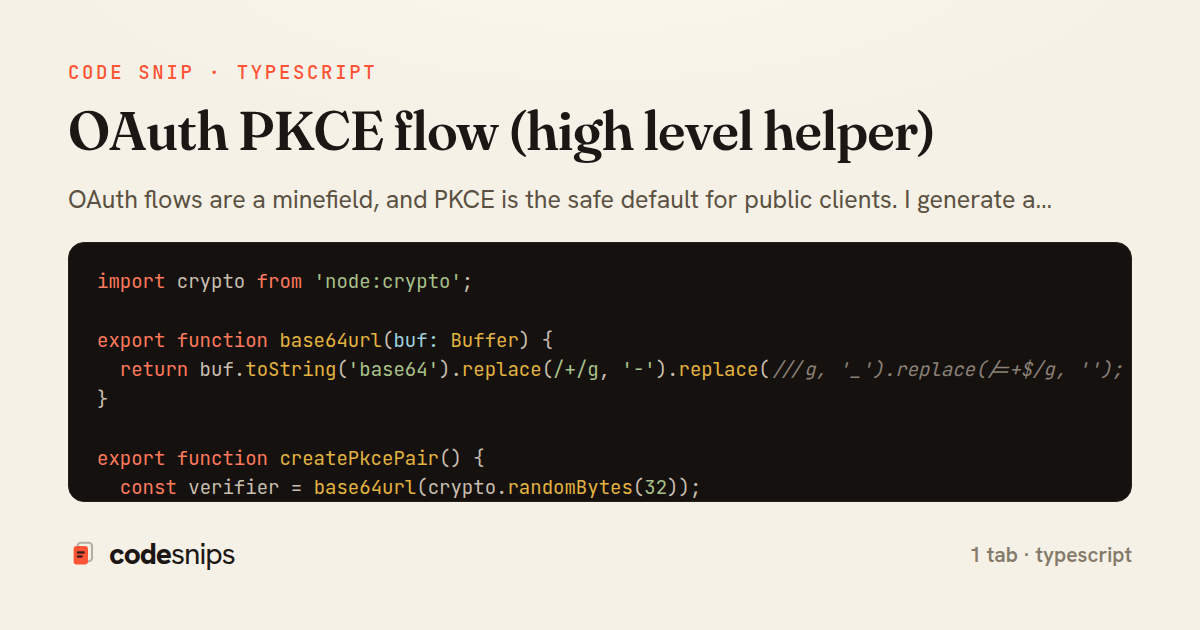
OAuth flows are a minefield, and PKCE is the safe default for public clients. I generate a verifier, derive a challenge, store the verifier in a short-lived session, and then exchange the authorization code for tokens. The key detail is treating the verifier like a secret: keep it server-side when possible, or store it in a secure, short-lived cookie if you’re doing a pure browser flow. I also validate state to prevent CSRF. In production I prefer a well-maintained OAuth library, but understanding the moving parts helps debug ‘works locally but not in prod’ issues around redirect_uri, scopes, and token lifetimes.
Related snips
ruby
payload = {
  sub: user.id,
  iss: 'https://auth.example.com',
  aud: 'codesnips-api',
  exp: 15.minutes.from_now.to_i,
  iat: Time.now.to_i,
JWT issuance and verification without common footguns
jwt
authentication
api
by Kai Nakamura
2 tabs
bash
#!/usr/bin/env bash
set -euo pipefail

export VAULT_ADDR="https://vault.internal:8200"
export VAULT_TOKEN="${VAULT_TOKEN:?missing VAULT_TOKEN}"
Secrets management with environment isolation and Vault
secrets-management
vault
environment-variables
by Kai Nakamura
1 tab
typescript
import { randomBytes, createHash } from "crypto";
import jwt from "jsonwebtoken";
import { RefreshTokenStore } from "./store";

const ACCESS_SECRET = process.env.ACCESS_SECRET!;
const ACCESS_TTL = "15m";
JWT access + refresh token rotation (conceptual)
security
node
jwt
by codesnips
3 tabs
go
package files

import (
  "context"
  "time"
Presigned S3 upload URLs (AWS SDK v2)
go
aws
s3
by Leah Thompson
1 tab
erb
<%# private stream: turbo signs the serialized record name %>
<%= turbo_stream_from current_user %>

<section class="notifications">
  <h1>Notifications</h1>
Turbo Streams + authorization: signed per-user stream name
rails
turbo
hotwire
by codesnips
3 tabs
go
package api

import (
  "io"
  "net/http"
  "os"
Safe multipart uploads using temp files (bounded memory)
go
http
uploads
by Leah Thompson
1 tab
Share this code
Here's the card — post it anywhere.