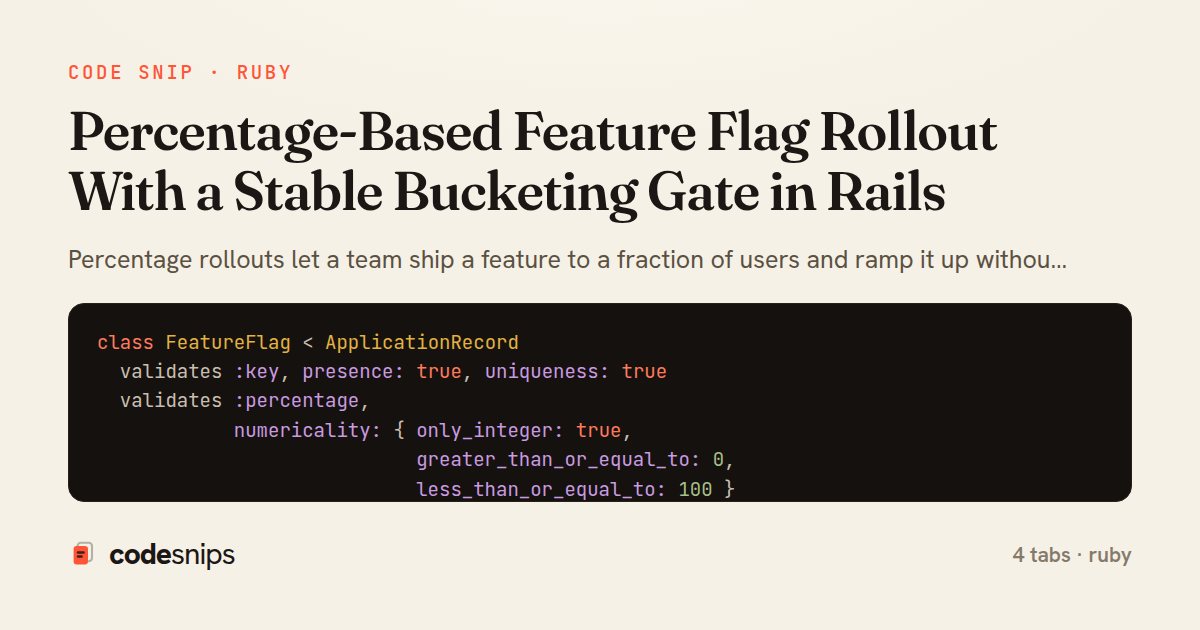
class FeatureFlag < ApplicationRecord
  validates :key, presence: true, uniqueness: true
  validates :percentage,
            numericality: { only_integer: true,
                            greater_than_or_equal_to: 0,
                            less_than_or_equal_to: 100 }

  scope :by_key, ->(key) { find_by(key: key.to_s) }

  def enabled_for?(actor)
    return false unless enabled?
    return false if percentage.zero?
    return true  if percentage >= 100

    actor_id = actor.respond_to?(:id) ? actor.id : actor
    return false if actor_id.blank?

    bucket_for(actor_id) < percentage
  end

  private

  def bucket_for(actor_id)
    seed = "#{key}:#{actor_id}"
    Digest::SHA256.hexdigest(seed).to_i(16) % 100
  end
end
class FeatureGate
  CACHE_TTL = 30.seconds

  class << self
    def on?(key, actor)
      flag = fetch(key)
      return false if flag.nil?

      flag.enabled_for?(actor)
    end

    def bust(key)
      Rails.cache.delete(cache_key(key))
    end

    private

    def fetch(key)
      Rails.cache.fetch(cache_key(key), expires_in: CACHE_TTL) do
        FeatureFlag.by_key(key)
      end
    end

    def cache_key(key)
      "feature_flag/#{key}"
    end
  end
end
module FeatureGating
  extend ActiveSupport::Concern

  included do
    helper_method :feature_on?
  end

  class_methods do
    def require_feature(key, **before_action_opts)
      before_action(**before_action_opts) do
        next if feature_on?(key)

        raise ActionController::RoutingError, "Not Found"
      end
    end
  end

  def feature_on?(key)
    FeatureGate.on?(key, current_user)
  end
end
class BetaDashboardController < ApplicationController
  include FeatureGating

  before_action :authenticate_user!
  require_feature :new_dashboard, only: %i[show]

  def show
    @widgets = current_user.dashboard_widgets.ordered
    render :show
  end
end
Percentage rollouts let a team ship a feature to a fraction of users and ramp it up without redeploying. The naive approach — rand < percentage — is wrong because it re-rolls the dice on every request, so a user flickers in and out of the feature. The correct pattern is stable bucketing: hash a stable identifier into a fixed range and compare that bucket against the rollout percentage, so a given user's membership only changes when the percentage crosses their bucket.
In FeatureFlag model, each flag is a durable row keyed by a unique key, with an integer percentage (0–100) and an enabled boolean master switch. The core logic lives in enabled_for?, which short-circuits when the flag is off or fully rolled out, then calls bucket_for to derive a deterministic value. bucket_for salts the actor id with the flag key and runs it through Digest::SHA256, taking the number modulo 100. Salting with the key is important: without it the same user would land in the same bucket for every flag, so early adopters of one feature would always be early adopters of everything. The by_key scope and validations keep lookups and data clean.
Because flags are read on nearly every request, FeatureGate service wraps FeatureFlag.by_key in Rails.cache.fetch with a short TTL so the database isn't hit constantly, while still letting percentage changes propagate within seconds. It exposes a simple on?(key, actor) predicate and a bust helper to clear the cache after an admin edits a flag. Fetching a missing flag returns a safe false default rather than raising.
FeaturesController concern mixes require_feature and feature_on? into controllers. require_feature acts as a before_action-style gate that renders 404 when the current user isn't in the rollout, hiding the feature's existence entirely. feature_on? is exposed as a helper_method so views can conditionally render UI. The trade-off of this design is that bucketing is only as stable as the actor id, and anonymous users need a persistent surrogate id; the pattern also assumes uniform hash distribution, which SHA256 provides in practice. It's the right tool for gradual canary releases and kill-switch style flags.
Related snips
class CommentsController < ApplicationController
  before_action :set_post

  def create
    @comment = @post.comments.build(comment_params)
System test: asserting Turbo Stream responses
class Post < ApplicationRecord
  belongs_to :author, class_name: 'User'
  has_many :comments, dependent: :destroy

  scope :published, -> { where.not(published_at: nil).where('published_at <= ?', Time.current) }
  scope :draft, -> { where(published_at: nil) }
ActiveRecord scopes for reusable query logic
module Api
  module V1
    class UsersController < BaseController
      def show
        user = User.includes(:profile).find(params[:id])
ETags for conditional requests and caching
class PostsController < ApplicationController
  def index
    @posts = Post.includes(:author)
                 .order(created_at: :desc)
                 .page(params[:page])
                 .per(10)
Turbo Frames: infinite scroll with lazy-loading frame
require "csv"

class PeopleCsvStream
  include Enumerable

  HEADERS = %w[id full_name email signed_up_at plan].freeze
Resilient CSV Export as a Streamed Response
<form data-controller="query-sync" data-action="change->query-sync#apply">
  <select name="status" class="rounded border p-2">
    <option value="">Any</option>
    <option value="open">Open</option>
    <option value="closed">Closed</option>
  </select>
Filter UI that syncs query params via Stimulus (no front-end router)
Share this code
Here's the card — post it anywhere.