module EmailNormalization
  extend ActiveSupport::Concern

  included do
    attr_accessor :soft_warnings

    before_validation :normalize_email
    validate :soft_validate_email

    validates :email,
              presence: true,
              format: { with: URI::MailTo::EMAIL_REGEXP, message: "is not a valid address" }
  end

  private

  def normalize_email
    return if email.blank?

    self.email = email.strip.downcase
    self.canonical_email = EmailPolicy.canonicalize(email)
  end

  def soft_validate_email
    self.soft_warnings = []
    return if email.blank?

    warnings = EmailPolicy.warnings_for(email)
    self.soft_warnings.concat(warnings)
  end
end
class User < ApplicationRecord
  include EmailNormalization

  validates :canonical_email, uniqueness: { case_sensitive: false }

  scope :by_email, ->(address) do
    where(canonical_email: EmailPolicy.canonicalize(address.to_s.strip.downcase))
  end

  def risky_email?
    soft_warnings.present?
  end

  def disposable_email?
    soft_warnings.to_a.include?(:disposable_domain)
  end
end
module EmailPolicy
  DISPOSABLE_DOMAINS = %w[mailinator.com guerrillamail.com 10minutemail.com tempmail.com].freeze
  SUSPICIOUS_TLDS = %w[.test .invalid .localhost].freeze

  module_function

  def canonicalize(address)
    local, domain = address.split("@", 2)
    return address if domain.nil?

    local = local.split("+", 2).first
    if %w[gmail.com googlemail.com].include?(domain)
      local = local.delete(".")
      domain = "gmail.com"
    end

    "#{local}@#{domain}"
  end

  def warnings_for(address)
    domain = address.split("@", 2).last.to_s
    warnings = []

    warnings << :disposable_domain if DISPOSABLE_DOMAINS.include?(domain)
    warnings << :suspicious_tld if SUSPICIOUS_TLDS.any? { |tld| domain.end_with?(tld) }
    warnings << :plus_addressing if address.include?("+")
    warnings
  end
end
class AddCanonicalEmailToUsers < ActiveRecord::Migration[7.1]
  def up
    enable_extension "citext" unless extension_enabled?("citext")

    add_column :users, :canonical_email, :citext

    execute <<~SQL
      UPDATE users
      SET canonical_email = lower(trim(email))
      WHERE canonical_email IS NULL
    SQL

    change_column_null :users, :canonical_email, false
    add_index :users, :canonical_email, unique: true
  end

  def down
    remove_index :users, :canonical_email
    remove_column :users, :canonical_email
  end
end
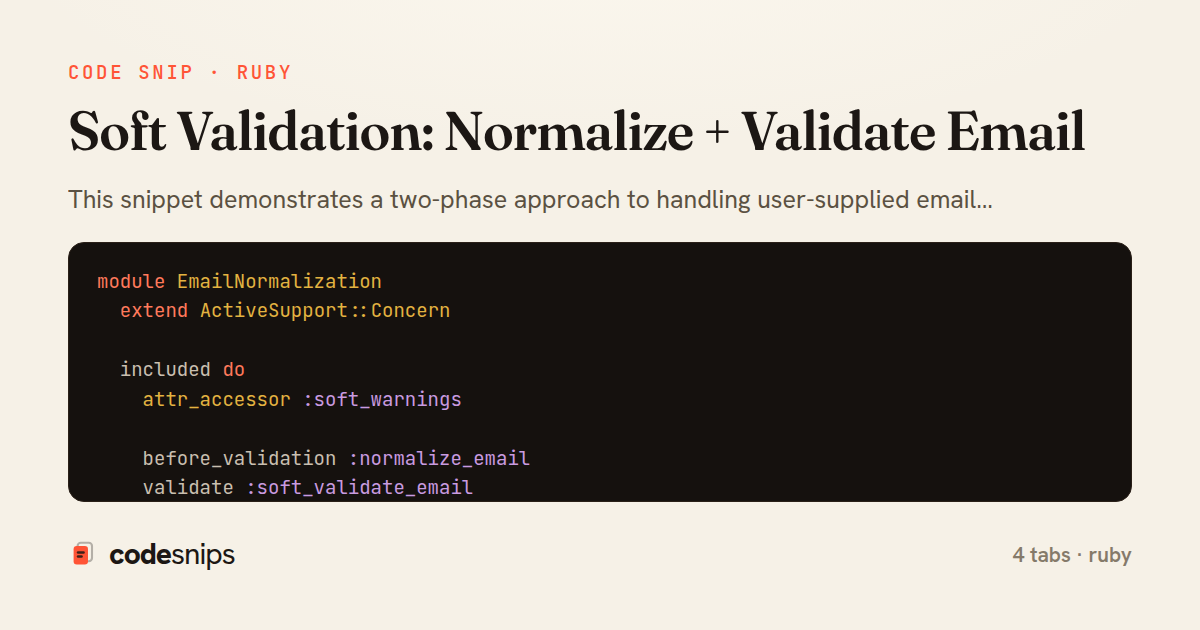
This snippet demonstrates a two-phase approach to handling user-supplied email addresses in a Rails application: normalization first, then validation, with a distinction between hard failures and soft warnings. In EmailNormalization concern, the email is treated as untrusted input that must be cleaned into a canonical form before any comparison or persistence. The normalize_email callback runs before_validation so that downcasing, whitespace stripping, and dotless-Gmail folding happen before uniqueness and format checks see the value. This ordering matters because a uniqueness index or validation that runs against un-normalized input will let John@Gmail.com and john@gmail.com coexist, defeating the point of the constraint.
The concern separates two ideas that are easy to conflate. A format validation is a hard rule: a syntactically broken address blocks the save entirely. The soft_validate_email step, by contrast, records advisory concerns — a disposable-domain match or a suspicious top-level domain — into a soft_warnings accessor without adding to errors. This lets the record persist while surfacing risk signals the application can act on later, which is the right trade-off for signup flows where being too strict costs real conversions.
In User model, the concern is mixed in and the canonical column is protected by a real database guarantee. The model relies on a normalized value for its uniqueness check, and canonical_email is derived so lookups stay stable even when the display email varies. The EmailPolicy service centralizes the domain knowledge — disposable providers, plus-addressing, and Gmail dot-folding — so the rules live in one testable place rather than scattered across callbacks.
The migration backs the invariant with a citext column and a unique index, so uniqueness holds even under a race where two requests pass the ActiveRecord check simultaneously. The citext type makes comparisons case-insensitive at the storage layer, complementing the application-side downcasing. A pitfall worth noting: normalization must be idempotent, since callbacks can run more than once; each transform here yields the same output when applied to already-normalized input. This pattern is worth reaching for whenever an identity field must be both flexible for humans and strictly unique for the system.
Related snips
class CommentsController < ApplicationController
  before_action :set_post

  def create
    @comment = @post.comments.build(comment_params)
System test: asserting Turbo Stream responses
class Post < ApplicationRecord
  belongs_to :author, class_name: 'User'
  has_many :comments, dependent: :destroy

  scope :published, -> { where.not(published_at: nil).where('published_at <= ?', Time.current) }
  scope :draft, -> { where(published_at: nil) }
ActiveRecord scopes for reusable query logic
module Api
  module V1
    class UsersController < BaseController
      def show
        user = User.includes(:profile).find(params[:id])
ETags for conditional requests and caching
class PostsController < ApplicationController
  def index
    @posts = Post.includes(:author)
                 .order(created_at: :desc)
                 .page(params[:page])
                 .per(10)
Turbo Frames: infinite scroll with lazy-loading frame
package dbutil

import (
  "context"

  "github.com/jackc/pgconn"
Retry Postgres serialization failures with bounded attempts
require "csv"

class PeopleCsvStream
  include Enumerable

  HEADERS = %w[id full_name email signed_up_at plan].freeze
Resilient CSV Export as a Streamed Response
Share this code
Here's the card — post it anywhere.