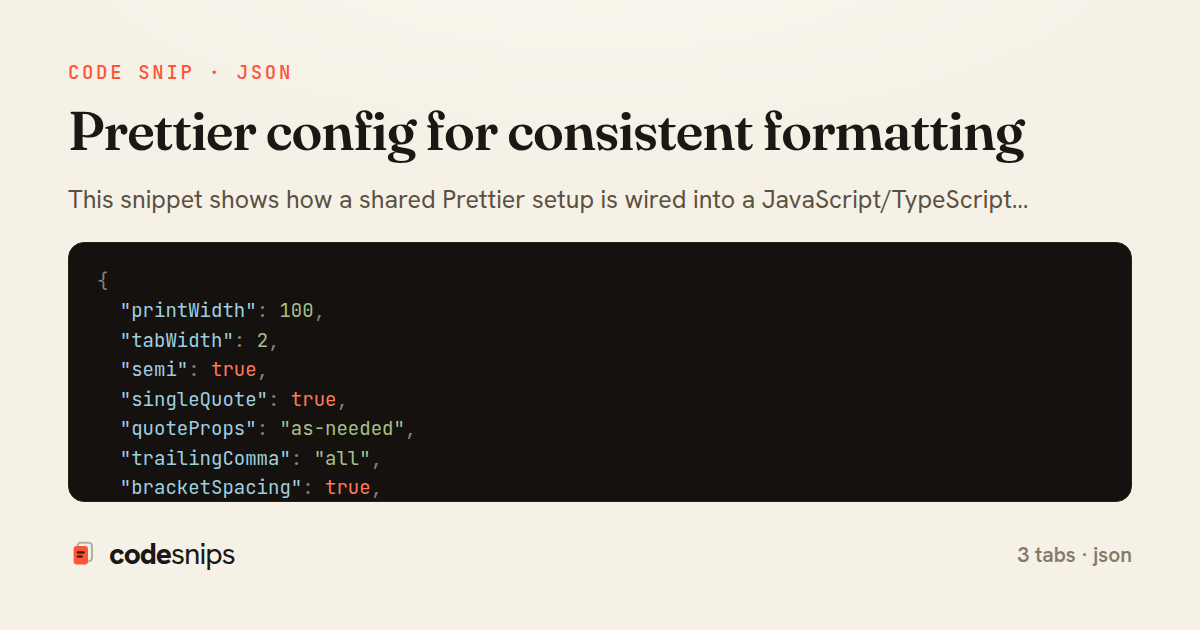
{
  "printWidth": 100,
  "tabWidth": 2,
  "semi": true,
  "singleQuote": true,
  "quoteProps": "as-needed",
  "trailingComma": "all",
  "bracketSpacing": true,
  "arrowParens": "always",
  "endOfLine": "lf",
  "plugins": ["prettier-plugin-tailwindcss"],
  "overrides": [
    {
      "files": "*.md",
      "options": {
        "tabWidth": 2,
        "proseWrap": "preserve"
      }
    },
    {
      "files": ["*.yml", "*.yaml"],
      "options": {
        "singleQuote": false
      }
    },
    {
      "files": "*.json",
      "options": {
        "printWidth": 80,
        "trailingComma": "none"
      }
    }
  ]
}
{
  "root": true,
  "parser": "@typescript-eslint/parser",
  "parserOptions": {
    "ecmaVersion": 2021,
    "sourceType": "module"
  },
  "plugins": ["@typescript-eslint"],
  "extends": [
    "eslint:recommended",
    "plugin:@typescript-eslint/recommended",
    "plugin:prettier/recommended",
    "prettier"
  ],
  "rules": {
    "prettier/prettier": "error",
    "no-unused-vars": "off",
    "@typescript-eslint/no-unused-vars": ["warn", { "argsIgnorePattern": "^_" }]
  },
  "ignorePatterns": ["dist/", "build/", "coverage/", "node_modules/"]
}
{
  "name": "@acme/monorepo",
  "private": true,
  "version": "1.4.0",
  "workspaces": ["packages/*", "apps/*"],
  "scripts": {
    "format": "prettier --write \"**/*.{ts,tsx,js,jsx,json,md,yml,yaml,css}\"",
    "format:check": "prettier --check \"**/*.{ts,tsx,js,jsx,json,md,yml,yaml,css}\"",
    "lint": "eslint . --ext .ts,.tsx,.js,.jsx",
    "prepare": "husky install"
  },
  "lint-staged": {
    "*.{ts,tsx,js,jsx}": ["eslint --fix", "prettier --write"],
    "*.{json,md,yml,yaml,css}": ["prettier --write"]
  },
  "devDependencies": {
    "@typescript-eslint/eslint-plugin": "6.21.0",
    "@typescript-eslint/parser": "6.21.0",
    "eslint": "8.57.0",
    "eslint-config-prettier": "9.1.0",
    "eslint-plugin-prettier": "5.1.3",
    "husky": "9.0.11",
    "lint-staged": "15.2.2",
    "prettier": "3.2.5",
    "prettier-plugin-tailwindcss": "0.5.11"
  }
}
This snippet shows how a shared Prettier setup is wired into a JavaScript/TypeScript monorepo so that every package formats code the same way, with a few well-justified per-language exceptions. The core idea is to make formatting a non-negotiable, machine-enforced concern: developers stop debating quote style and trailing commas because a single config decides, and a pre-commit hook guarantees the rules are applied before anything lands in version control.
The .prettierrc.json tab is the single source of truth. Base options like singleQuote, trailingComma: "all", and printWidth: 100 set the house style, while the overrides array narrows behavior by file glob. Markdown gets proseWrap: "preserve" so hand-wrapped prose is not reflowed, and .md files use two-space tabs; YAML sets singleQuote: false because YAML string quoting rules differ from JS and double quotes are safer. The plugins entry pulls in prettier-plugin-tailwindcss, which reorders utility classes deterministically. Using overrides rather than multiple config files keeps everything discoverable in one place.
Because a formatter and a linter can disagree, .eslintrc.json disables stylistic ESLint rules and delegates them to Prettier. Extending "prettier" last turns off conflicting rules, and "plugin:prettier/recommended" surfaces formatting drift as a single prettier/prettier lint error. This separation of concerns lets ESLint focus on correctness while Prettier owns layout.
The package.json tab connects the config to actual workflows. The format and format:check scripts run Prettier over the tree, the latter used in CI to fail builds on unformatted code. The prepare script installs Husky, and lint-staged runs Prettier only on staged files matching each glob, so commits are fast and touch only what changed. A .prettierignore (referenced implicitly) would exclude build output.
A common pitfall is letting editors reformat entire files and creating noisy diffs; scoping lint-staged to changed files avoids that. Another is forgetting to pin the Prettier version, since output can shift between majors — pinning keeps formatting reproducible across machines and CI. This layout is the pragmatic default for teams that want zero formatting bikeshedding.
Related snips
const withBundleAnalyzer = require('@next/bundle-analyzer')({
  enabled: process.env.ANALYZE === 'true',
  openAnalyzer: true,
});

/** @type {import('next').NextConfig} */
Next.js bundle analyzer for targeted performance work
import { defineConfig } from 'vite';
import react from '@vitejs/plugin-react';
import { fileURLToPath, URL } from 'node:url';

const resolvePath = (relative: string): string =>
  fileURLToPath(new URL(relative, import.meta.url));
TypeScript path aliases (tsconfig + bundler)
package config

import (
  "errors"
  "os"
  "strconv"
Config parsing with env defaults and strict validation
import js from '@eslint/js';
import tseslint from 'typescript-eslint';
import prettierConfig from 'eslint-config-prettier';

export default [
  js.configs.recommended,
ESLint config that avoids bikeshedding
use std::fmt;

struct Point {
    x: i32,
    y: i32,
}
std::fmt::Display for user-facing string representations
use std::env;

fn main() {
    let port: u16 = env::var("PORT")
        .unwrap_or_else(|_| "8080".to_string())
        .parse()
Environment variables with std::env for configuration
Share this code
Here's the card — post it anywhere.