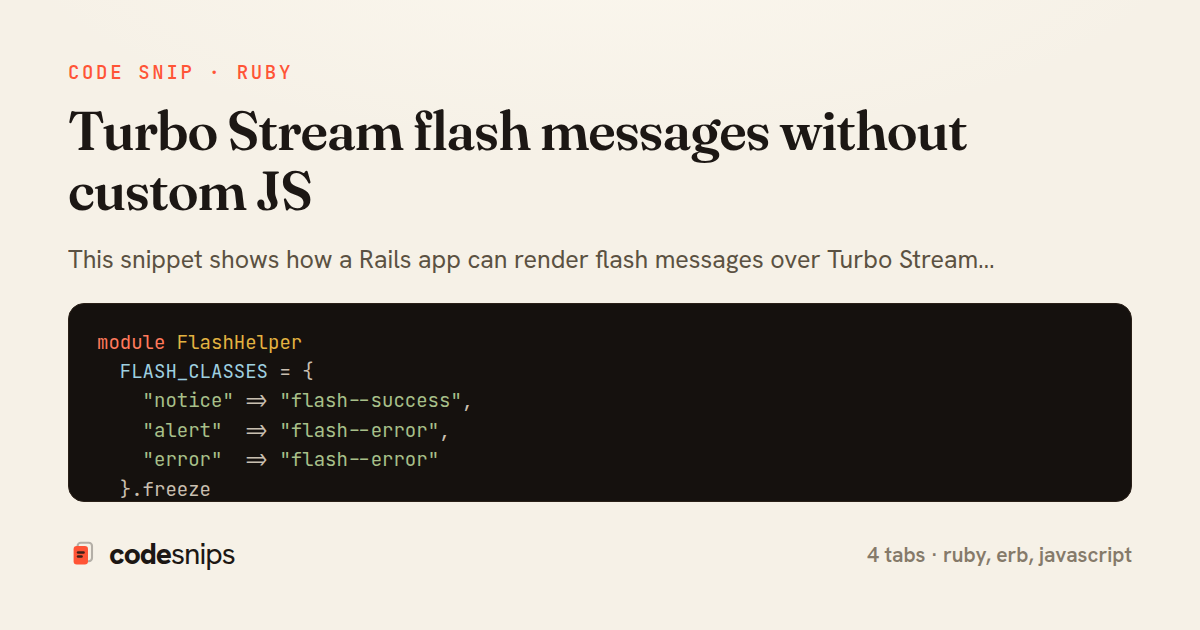
module FlashHelper
  FLASH_CLASSES = {
    "notice" => "flash--success",
    "alert"  => "flash--error",
    "error"  => "flash--error"
  }.freeze

  def flash_class(type)
    FLASH_CLASSES.fetch(type.to_s, "flash--info")
  end

  def turbo_flash
    flash.map do |type, message|
      turbo_stream.append "flash", partial: "shared/flash",
                                   locals: { type: type, message: message }
    end.join.html_safe
  end
end
<%# app/views/shared/_flash.html.erb %>
<div id="flash" class="flash-container">
<%# messages are appended here by turbo streams %>
</div>
<%# app/views/shared/_flash_message.html.erb %>
<div id="<%= dom_id(type, :flash) %>"
class="flash <%= flash_class(type) %>"
role="alert"
data-controller="removals"
data-removals-delay-value="4000">
<span class="flash__text"><%= message %></span>
<button type="button"
class="flash__close"
data-action="removals#remove">×</button>
</div>
class ArticlesController < ApplicationController
  before_action :set_article, only: :destroy

  def create
    @article = Article.new(article_params)

    respond_to do |format|
      if @article.save
        flash.now[:notice] = "Article published."
        format.turbo_stream do
          render turbo_stream: [
            turbo_stream.prepend("articles", partial: "articles/article", locals: { article: @article }),
            turbo_flash
          ]
        end
        format.html { redirect_to @article, notice: "Article published." }
      else
        flash.now[:alert] = @article.errors.full_messages.to_sentence
        format.turbo_stream { render turbo_stream: turbo_flash, status: :unprocessable_entity }
        format.html { render :new, status: :unprocessable_entity }
      end
    end
  end

  def destroy
    @article.destroy
    flash.now[:notice] = "Article deleted."

    respond_to do |format|
      format.turbo_stream do
        render turbo_stream: [
          turbo_stream.remove(dom_id(@article)),
          turbo_flash
        ]
      end
      format.html { redirect_to articles_path, notice: "Article deleted." }
    end
  end

  private

  def set_article
    @article = Article.find(params[:id])
  end

  def article_params
    params.require(:article).permit(:title, :body)
  end
end
import { Controller } from "@hotwired/stimulus"

export default class extends Controller {
  static values = { delay: { type: Number, default: 5000 } }

  connect() {
    if (this.delayValue > 0) {
      this.timeout = setTimeout(() => this.remove(), this.delayValue)
    }
  }

  disconnect() {
    clearTimeout(this.timeout)
  }

  remove() {
    this.element.classList.add("flash--leaving")
    this.element.addEventListener("transitionend", () => this.element.remove(), { once: true })
  }
}
This snippet shows how a Rails app can render flash messages over Turbo Stream responses without writing any custom JavaScript. The pattern relies on Turbo's built-in stream actions (append, update, remove) targeting a stable DOM container, so ordinary controller actions that respond with turbo_stream can push toasts into the page as a side effect of any create/update/destroy.
The flash partial defines the visual container #flash plus one partial per message. Each toast carries a data-controller="removals" hook whose only job is to auto-dismiss after a delay — this is a tiny, generic Stimulus controller, not feature-specific glue, and it degrades gracefully if JS is disabled since the message still renders. Giving each toast a dom_id based on the flash type keeps replacements idempotent.
The FlashHelper centralizes the mapping from Rails flash keys (:notice, :alert) to CSS classes via flash_class, and exposes turbo_flash which wraps turbo_stream.append "flash" for every pending flash entry. Rendering the partial through the helper means both full-page loads and stream responses share exactly one template, avoiding drift between the two rendering paths.
In ArticlesController, the create action responds to turbo_stream by concatenating two streams: one that prepends the new article row and one produced by turbo_flash. Because flash.now is used, the message lives only for this response and is not persisted into the session — important for stream responses, which do not perform a redirect and would otherwise leave a stale flash for the next request. The destroy action follows the same shape, removing the row and emitting a confirmation toast.
The main trade-off is that the #flash container must already exist in the layout for append to find a target; if it is missing, Turbo silently drops the stream. The approach shines when an app already uses Turbo for CRUD and wants consistent feedback without a bespoke notification stack. Pitfalls to watch include double-rendering flashes when a redirect is mixed with a stream, and forgetting flash.now, which reintroduces the classic "message shows one action too late" bug.
Related snips
class CommentsController < ApplicationController
  before_action :set_post

  def create
    @comment = @post.comments.build(comment_params)
System test: asserting Turbo Stream responses
class Post < ApplicationRecord
  belongs_to :author, class_name: 'User'
  has_many :comments, dependent: :destroy

  scope :published, -> { where.not(published_at: nil).where('published_at <= ?', Time.current) }
  scope :draft, -> { where(published_at: nil) }
ActiveRecord scopes for reusable query logic
module Api
  module V1
    class UsersController < BaseController
      def show
        user = User.includes(:profile).find(params[:id])
ETags for conditional requests and caching
class PostsController < ApplicationController
  def index
    @posts = Post.includes(:author)
                 .order(created_at: :desc)
                 .page(params[:page])
                 .per(10)
Turbo Frames: infinite scroll with lazy-loading frame
require "csv"

class PeopleCsvStream
  include Enumerable

  HEADERS = %w[id full_name email signed_up_at plan].freeze
Resilient CSV Export as a Streamed Response
<form data-controller="query-sync" data-action="change->query-sync#apply">
  <select name="status" class="rounded border p-2">
    <option value="">Any</option>
    <option value="open">Open</option>
    <option value="closed">Closed</option>
  </select>
Filter UI that syncs query params via Stimulus (no front-end router)
Share this code
Here's the card — post it anywhere.