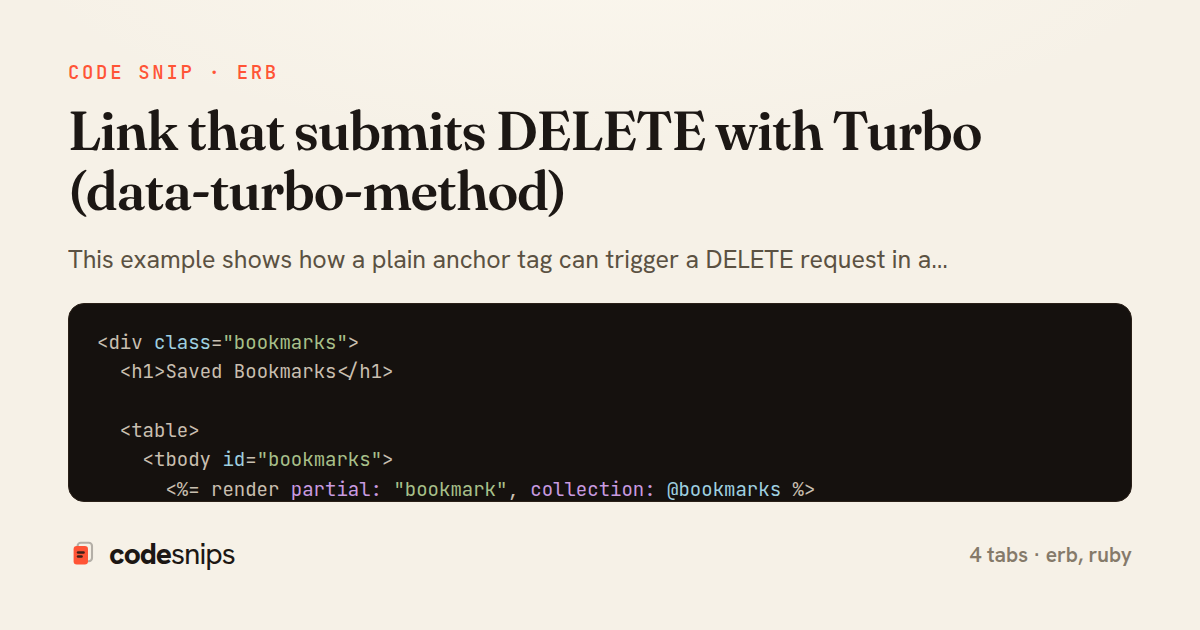
<div class="bookmarks">
  <h1>Saved Bookmarks</h1>

  <table>
    <tbody id="bookmarks">
      <%= render partial: "bookmark", collection: @bookmarks %>
    </tbody>
  </table>

  <%= link_to "Add bookmark", new_bookmark_path, class: "btn" %>
</div>
<tr id="<%= dom_id(bookmark) %>" class="bookmark-row">
  <td>
    <%= link_to bookmark.title, bookmark.url, target: "_blank", rel: "noopener" %>
  </td>
  <td class="muted"><%= bookmark.url %></td>
  <td class="actions">
    <%= link_to "Delete",
          bookmark_path(bookmark),
          class: "link-danger",
          data: {
            turbo_method: :delete,
            turbo_confirm: "Remove this bookmark?"
          } %>
  </td>
</tr>
class BookmarksController < ApplicationController
  before_action :set_bookmark, only: :destroy

  def index
    @bookmarks = current_user.bookmarks.order(created_at: :desc)
  end

  def destroy
    @bookmark.destroy

    respond_to do |format|
      format.turbo_stream do
        render turbo_stream: turbo_stream.remove(@bookmark)
      end
      format.html do
        redirect_to bookmarks_path, notice: "Bookmark removed."
      end
    end
  end

  private

  def set_bookmark
    @bookmark = current_user.bookmarks.find(params[:id])
  end
end
<!DOCTYPE html>
<html>
  <head>
    <title>Bookmarks</title>
    <%= csrf_meta_tags %>
    <%= csp_meta_tag %>
    <%= stylesheet_link_tag "application", "data-turbo-track": "reload" %>
    <%= javascript_importmap_tags %>
  </head>
  <body>
    <%= yield %>
  </body>
</html>
This example shows how a plain anchor tag can trigger a DELETE request in a Rails/Hotwire application without wrapping it in a <form>, and how the server responds with a Turbo Stream that surgically removes the record's row from the page. The data-turbo-method attribute is Turbo's replacement for the older Rails UJS data-method: when Turbo intercepts a click on a link carrying data-turbo-method="delete", it builds a synthetic form, injects the CSRF token, and submits it as a real HTTP DELETE.
In bookmarks/index.html.erb, each bookmark is rendered inside a partial and wrapped in a turbo_frame_tag-independent <tr> whose id comes from dom_id(bookmark). The delete link uses link_to with data: { turbo_method: :delete, turbo_confirm: "Remove this bookmark?" }. The turbo_confirm value drives a native confirmation dialog before the request fires, which matters because DELETE is destructive and easy to trigger accidentally. Note there is no method: :delete here — that is the legacy UJS API and is ignored once @rails/ujs is dropped in favor of Turbo.
The _bookmark.html.erb partial is deliberately tiny and keyed on dom_id, because the same DOM id is what the Turbo Stream targets on removal. Keeping the id generation in one place (dom_id) avoids the classic mismatch bug where the markup says bookmark_12 but the stream tries to remove bookmarks_12.
In BookmarksController, the destroy action calls @bookmark.destroy and then a respond_to block branches on format. The format.turbo_stream branch renders a turbo_stream.remove targeting the record, so only the affected row leaves the DOM — no full-page reload, no re-render of the list. The format.html fallback keeps the endpoint usable for non-Turbo clients and tests by redirecting with a flash. This dual response is what makes the feature degrade gracefully.
A key trade-off: because Turbo synthesizes the form client-side, the endpoint still relies on standard Rails CSRF protection, so the meta CSRF tag must be present in the layout. Also, data-turbo-method links are not crawlable actions and search bots won't follow them, which is desirable for destructive routes. Reach for this pattern whenever a list needs inline delete affordances with minimal JavaScript and precise DOM updates.
Related snips
class CommentsController < ApplicationController
  before_action :set_post

  def create
    @comment = @post.comments.build(comment_params)
System test: asserting Turbo Stream responses
class Post < ApplicationRecord
  belongs_to :author, class_name: 'User'
  has_many :comments, dependent: :destroy

  scope :published, -> { where.not(published_at: nil).where('published_at <= ?', Time.current) }
  scope :draft, -> { where(published_at: nil) }
ActiveRecord scopes for reusable query logic
module Api
  module V1
    class UsersController < BaseController
      def show
        user = User.includes(:profile).find(params[:id])
ETags for conditional requests and caching
class PostsController < ApplicationController
  def index
    @posts = Post.includes(:author)
                 .order(created_at: :desc)
                 .page(params[:page])
                 .per(10)
Turbo Frames: infinite scroll with lazy-loading frame
require "csv"

class PeopleCsvStream
  include Enumerable

  HEADERS = %w[id full_name email signed_up_at plan].freeze
Resilient CSV Export as a Streamed Response
<form data-controller="query-sync" data-action="change->query-sync#apply">
  <select name="status" class="rounded border p-2">
    <option value="">Any</option>
    <option value="open">Open</option>
    <option value="closed">Closed</option>
  </select>
Filter UI that syncs query params via Stimulus (no front-end router)
Share this code
Here's the card — post it anywhere.