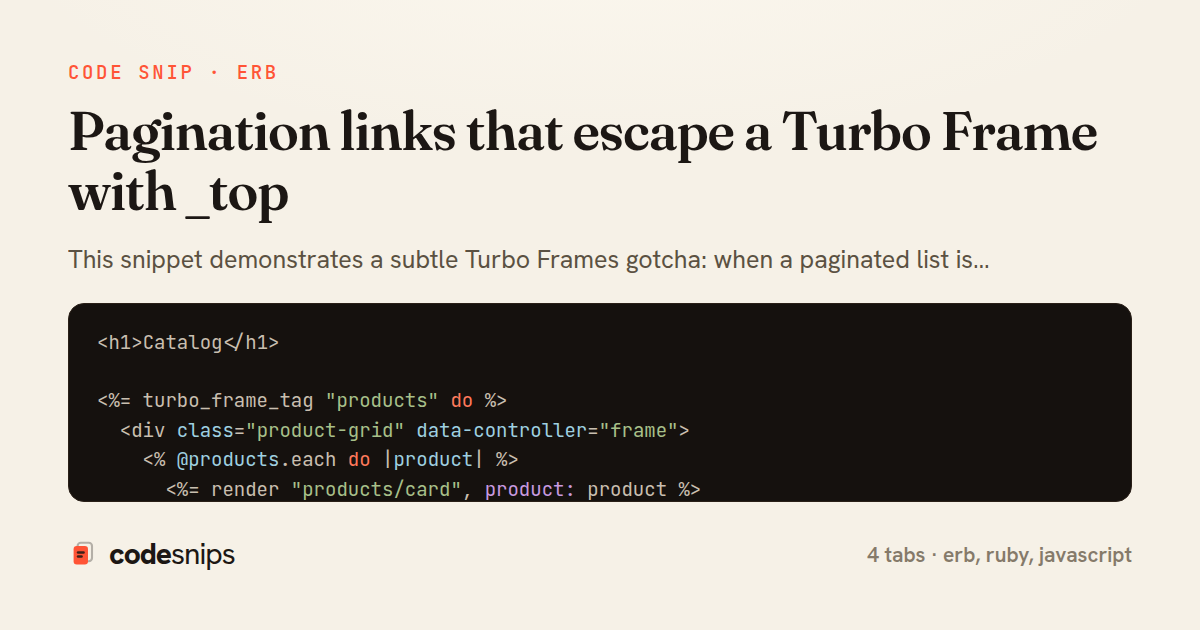
<h1>Catalog</h1>

<%= turbo_frame_tag "products" do %>
  <div class="product-grid" data-controller="frame">
    <% @products.each do |product| %>
      <%= render "products/card", product: product %>
    <% end %>
  </div>

  <nav class="pagination">
    <%= paginate @products, views_prefix: "escaping" %>
  </nav>
<% end %>
module Pagination
  class LinkRenderer < Kaminari::Helpers::Paginator
    def page_tag(page)
      Kaminari::Helpers::Page.new(@template, **@options.merge(page: page.number)).tap do |tag|
        tag.instance_variable_set(:@options, tag_options)
      end
    end

    private

    def tag_options
      @options.merge(remote: false, data: { turbo_frame: "_top" })
    end
  end

  module LinkHelper
    def link_to_next_page(scope, name, **options)
      options[:data] = (options[:data] || {}).merge(turbo_frame: "_top")
      super(scope, name, **options)
    end

    def link_to_previous_page(scope, name, **options)
      options[:data] = (options[:data] || {}).merge(turbo_frame: "_top")
      super(scope, name, **options)
    end
  end
end

ActionView::Base.include(Pagination::LinkHelper)
<%= paginator.render do -%>
  <nav class="pagination-inner" role="navigation" aria-label="pager">
    <%= first_page_tag unless current_page.first? %>
    <%= prev_page_tag unless current_page.first? %>
    <% each_page do |page| -%>
      <% if page.left_outer? || page.right_outer? || page.inside_window? -%>
        <%= link_to page.number,
                    url_for(params.to_unsafe_h.merge(page: page.number)),
                    remote: false,
                    data: { turbo_frame: "_top" },
                    class: ("active" if page.current?) %>
      <% elsif !page.was_truncated? -%>
        <%= gap_tag %>
      <% end -%>
    <% end -%>
    <%= next_page_tag unless current_page.last? %>
    <%= last_page_tag unless current_page.last? %>
  </nav>
<% end -%>
import { Controller } from "@hotwired/stimulus";

export default class extends Controller {
  connect() {
    this.frame = this.element.closest("turbo-frame");
    if (!this.frame) return;

    this.onBeforeVisit = this.logEscape.bind(this);
    document.addEventListener("turbo:before-frame-render", this.onBeforeVisit);
  }

  disconnect() {
    document.removeEventListener("turbo:before-frame-render", this.onBeforeVisit);
  }

  logEscape(event) {
    const link = event.target.activeElement;
    if (link && link.dataset.turboFrame === "_top") {
      console.debug(`Link escaping frame #${this.frame.id} to top-level navigation`);
    }
  }
}
This snippet demonstrates a subtle Turbo Frames gotcha: when a paginated list is rendered inside a turbo-frame, the pagination links generated by a gem like Kaminari inherit the frame's scope, so clicking "Next" replaces only the frame's contents rather than driving a full-page navigation and updating the browser URL. In many product listings that is exactly wrong — the page should feel like a normal paginated view, with the address bar reflecting ?page=2 so the state is shareable and bookmarkable.
The fix is to make the pagination links target _top, which tells Turbo to break out of the enclosing frame and perform a top-level visit. In products/index.html.erb, the product grid is wrapped in a turbo-frame tagged products so that other interactions (like filtering) can update just that region. The paginate call is passed params: { turbo_frame: "_top" } through a custom views partial, but the real work happens in PaginationLinkRenderer.
In PaginationLinkRenderer, a subclass of Kaminari::Helpers::Tag machinery, the page_url_for and link-building logic is overridden so every generated anchor carries data-turbo-frame="_top". This is cleaner than post-processing HTML or sprinkling attributes in templates, because it centralizes the behavior in one renderer that Kaminari uses for every page link, gap, and prev/next control.
The _paginator.html.erb partial shows the Kaminari override point: by defining a custom paginator partial, the renderer's link_to calls consistently emit the escape attribute. The Stimulus frame_controller.js handles the complementary case — when a link should stay inside the frame, data-turbo-frame is left alone, and the controller simply logs frame lifecycle events for debugging flaky navigations.
The trade-off is intentional: pagination becomes a real navigation (full history entry, scroll reset, URL change) rather than a cheap frame swap. That costs a slightly heavier request but buys correct back-button behavior and shareable URLs. A common pitfall is forgetting that _top also discards any unsaved frame state, so it should only be used where a fresh page load is acceptable. When a developer wants in-frame pagination instead, they omit _top and let the frame lazily reload its src.
Related snips
class CommentsController < ApplicationController
  before_action :set_post

  def create
    @comment = @post.comments.build(comment_params)
System test: asserting Turbo Stream responses
class Post < ApplicationRecord
  belongs_to :author, class_name: 'User'
  has_many :comments, dependent: :destroy

  scope :published, -> { where.not(published_at: nil).where('published_at <= ?', Time.current) }
  scope :draft, -> { where(published_at: nil) }
ActiveRecord scopes for reusable query logic
module Api
  module V1
    class UsersController < BaseController
      def show
        user = User.includes(:profile).find(params[:id])
ETags for conditional requests and caching
class PostsController < ApplicationController
  def index
    @posts = Post.includes(:author)
                 .order(created_at: :desc)
                 .page(params[:page])
                 .per(10)
Turbo Frames: infinite scroll with lazy-loading frame
require "csv"

class PeopleCsvStream
  include Enumerable

  HEADERS = %w[id full_name email signed_up_at plan].freeze
Resilient CSV Export as a Streamed Response
<form data-controller="query-sync" data-action="change->query-sync#apply">
  <select name="status" class="rounded border p-2">
    <option value="">Any</option>
    <option value="open">Open</option>
    <option value="closed">Closed</option>
  </select>
Filter UI that syncs query params via Stimulus (no front-end router)
Share this code
Here's the card — post it anywhere.