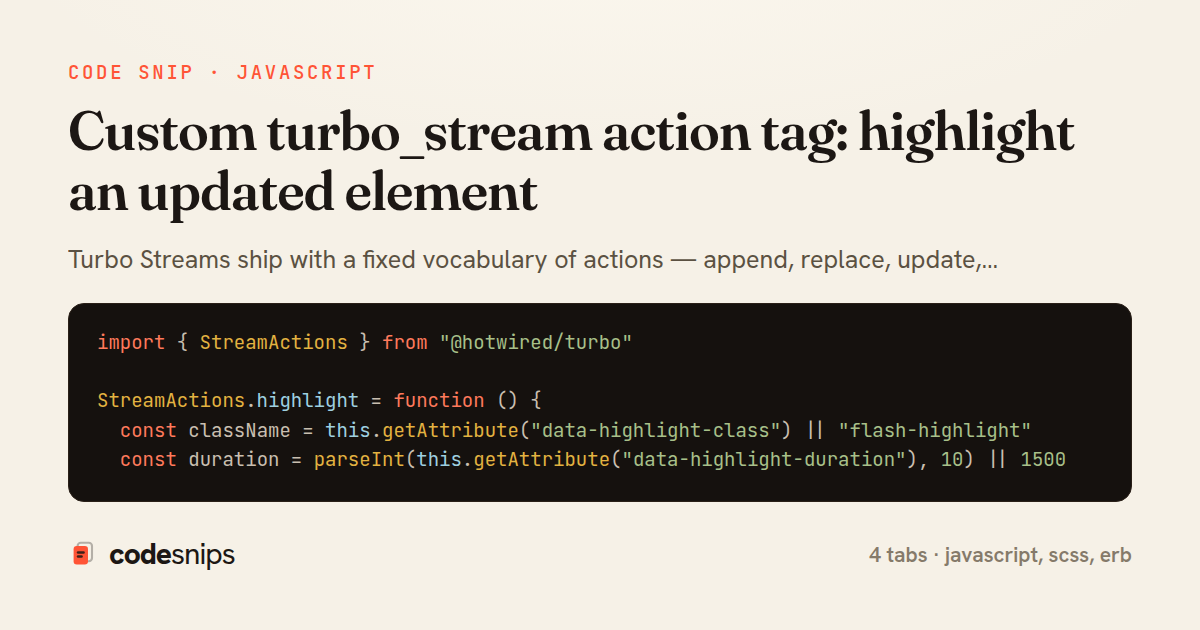
import { StreamActions } from "@hotwired/turbo"

StreamActions.highlight = function () {
  const className = this.getAttribute("data-highlight-class") || "flash-highlight"
  const duration = parseInt(this.getAttribute("data-highlight-duration"), 10) || 1500

  this.targetElements.forEach((element) => {
    // Force a reflow so the class add always triggers the transition.
    element.classList.remove(className)
    void element.offsetWidth
    element.classList.add(className)

    window.setTimeout(() => {
      element.classList.remove(className)
    }, duration)
  })
}
import "@hotwired/turbo-rails"
import "./controllers"

// Registers StreamActions.highlight before any stream can reference it.
import "./highlight_stream_action"
.highlightable {
  transition: background-color 400ms ease-out;
  background-color: transparent;
}

.highlightable.flash-highlight {
  background-color: #fff3bf; // soft amber cue
}
<%= turbo_stream.replace dom_id(@item) do %>
  <%= render partial: "items/item", locals: { item: @item } %>
<% end %>

<turbo-stream
  action="highlight"
  target="<%= dom_id(@item) %>"
  data-highlight-class="flash-highlight"
  data-highlight-duration="1500">
  <template></template>
</turbo-stream>
Turbo Streams ship with a fixed vocabulary of actions — append, replace, update, remove, and a few more — but the underlying StreamActions object is an ordinary JavaScript map that can be extended. This snippet registers a custom highlight action so the server can tell the browser to briefly flash an element after it changes, giving users a visual cue that a value updated without any bespoke controller wiring per feature.
The first tab, highlight_stream_action.js, defines the action by assigning a function to StreamActions.highlight. Inside that function this is the <turbo-stream> element itself, so this.targetElements resolves the CSS selector in the target/targets attribute to real DOM nodes. Custom data-* attributes on the stream tag flow through via this.getAttribute, which is how data-highlight-class and data-highlight-duration are read. The action toggles a class, then removes it after a timeout so the CSS transition can animate back to the resting state. Because it is registered once at import time, every stream the app renders — over WebSocket, SSE, or a form response — can use it.
The second tab, application.js, is the entrypoint that imports the action module for its side effect. It must run before any stream referencing highlight arrives; importing it alongside the Turbo setup guarantees StreamActions.highlight exists when Turbo processes an incoming frame.
The third tab, flash.scss, backs the effect. The base class defines a transition on background-color, and the .flash-highlight modifier sets the highlighted color. Putting the animation in CSS keeps the JavaScript trivial and lets designers tune timing independently.
The fourth tab, update.turbo_stream.erb, shows the server side: a standard turbo_stream.replace swaps the row, and a second, hand-written <turbo-stream action="highlight"> targets the same DOM id to trigger the flash. Note the duration passed as data-highlight-duration must comfortably exceed the CSS transition, otherwise the class is stripped before the animation finishes. This pattern is worth reaching for when many views need the same post-update affordance; a custom action centralizes the behavior instead of scattering Stimulus controllers everywhere.
Related snips
class CommentsController < ApplicationController
  before_action :set_post

  def create
    @comment = @post.comments.build(comment_params)
System test: asserting Turbo Stream responses
class Post < ApplicationRecord
  belongs_to :author, class_name: 'User'
  has_many :comments, dependent: :destroy

  scope :published, -> { where.not(published_at: nil).where('published_at <= ?', Time.current) }
  scope :draft, -> { where(published_at: nil) }
ActiveRecord scopes for reusable query logic
module Api
  module V1
    class UsersController < BaseController
      def show
        user = User.includes(:profile).find(params[:id])
ETags for conditional requests and caching
class PostsController < ApplicationController
  def index
    @posts = Post.includes(:author)
                 .order(created_at: :desc)
                 .page(params[:page])
                 .per(10)
Turbo Frames: infinite scroll with lazy-loading frame
require "csv"

class PeopleCsvStream
  include Enumerable

  HEADERS = %w[id full_name email signed_up_at plan].freeze
Resilient CSV Export as a Streamed Response
<form data-controller="query-sync" data-action="change->query-sync#apply">
  <select name="status" class="rounded border p-2">
    <option value="">Any</option>
    <option value="open">Open</option>
    <option value="closed">Closed</option>
  </select>
Filter UI that syncs query params via Stimulus (no front-end router)
Share this code
Here's the card — post it anywhere.