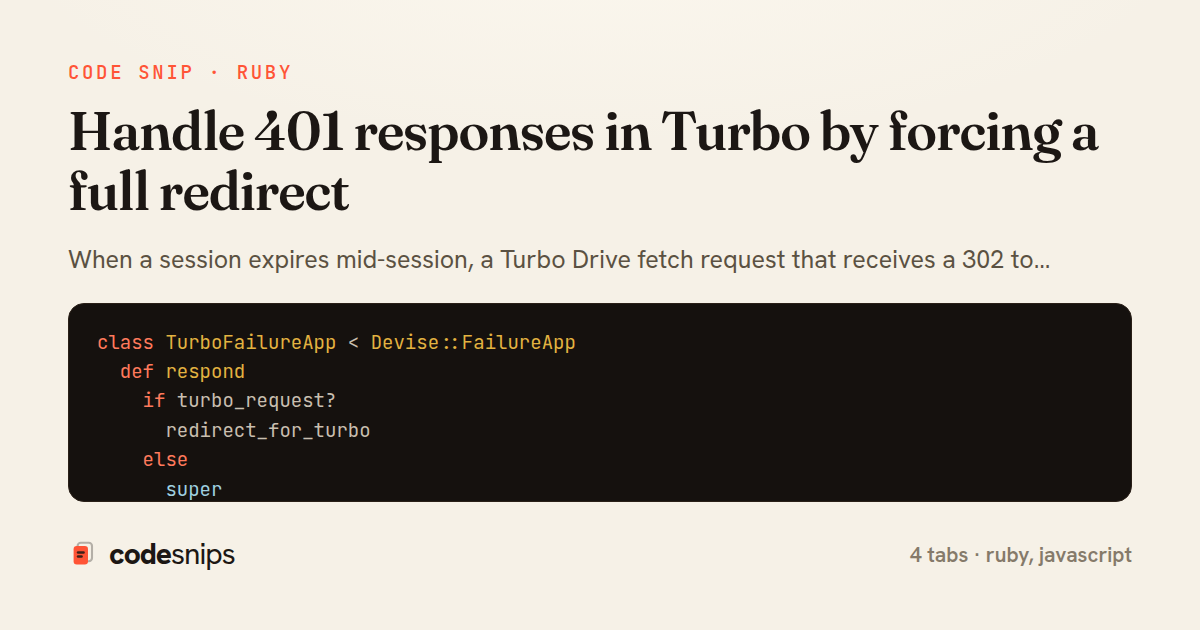
class TurboFailureApp < Devise::FailureApp
  def respond
    if turbo_request?
      redirect_for_turbo
    else
      super
    end
  end

  def redirect_for_turbo
    store_location!
    flash[:alert] = i18n_message
    self.status = 303
    self.response_body = ""
    self.headers["Location"] = scope_url
  end

  private

  def turbo_request?
    request.headers["Turbo-Frame"].present? ||
      request.headers["Accept"].to_s.include?("text/vnd.turbo-stream.html")
  end

  def scope_url
    new_user_session_path
  end
end
class TurboAuthMiddleware
  STREAM_MIME = "text/vnd.turbo-stream.html".freeze

  def initialize(app)
    @app = app
  end

  def call(env)
    status, headers, response = @app.call(env)
    return [status, headers, response] unless intercept?(status, env)

    login_url = "/users/sign_in"
    body = <<~HTML
      <turbo-stream action="append" target="body">
        <template>
          <div data-controller="redirect" data-redirect-url-value="#{login_url}"></div>
        </template>
      </turbo-stream>
    HTML

    headers = headers.dup
    headers["Content-Type"] = "#{STREAM_MIME}; charset=utf-8"
    headers["Content-Length"] = body.bytesize.to_s
    headers["Turbo-Location"] = login_url
    [200, headers, [body]]
  end

  private

  def intercept?(status, env)
    status.to_i == 401 &&
      env["HTTP_ACCEPT"].to_s.include?(STREAM_MIME)
  end
end
require_relative "boot"
require "rails/all"

Bundler.require(*Rails.groups)

module Shop
  class Application < Rails::Application
    config.load_defaults 7.1

    # Rewrite escaped 401s into a Turbo-driven full redirect
    config.middleware.insert_before(
      ActionDispatch::ShowExceptions,
      TurboAuthMiddleware
    )

    config.to_prepare do
      Devise::SessionsController.respond_to :html, :turbo_stream
    end
  end
end
import { Controller } from "@hotwired/stimulus";
import * as Turbo from "@hotwired/turbo";

export default class extends Controller {
  static values = { url: String };

  connect() {
    const url = this.urlValue;
    if (!url) return;

    // Force a real navigation so the document, CSRF token and cookies rebuild.
    try {
      Turbo.visit(url, { action: "replace" });
    } catch (_error) {
      window.location.assign(url);
    }

    // Drop the injected node so it never lingers in the Turbo cache.
    this.element.remove();
  }
}
When a session expires mid-session, a Turbo Drive fetch request that receives a 302 to the login page silently follows the redirect and swaps the login form into a <turbo-frame> or the <body>, producing a broken half-rendered page instead of a real navigation. The reason is that Turbo treats XHR-style responses differently from top-level browser navigation: it will not perform a full document replacement for a redirect the way the browser would for a plain link click. The fix is to detect an unauthenticated Turbo request on the server, respond with a status Turbo cannot silently absorb, and tell the browser to do a hard window.location change instead.
In TurboFailureApp, the Devise failure app is overridden so that when the incoming request is a Turbo Drive request it emits a redirect_to wrapped for Turbo. The key detail is request_format and the check on the Turbo-Frame / text/vnd.turbo-stream.html accept header: normal HTML navigations keep Devise's default 302 behaviour, while Turbo requests are steered toward a response Turbo will honour as a genuine visit.
TurboAuthMiddleware is the belt-and-suspenders layer for any 401 that escapes the Devise path — API-ish endpoints, custom head :unauthorized, or Pundit failures. It inspects the response after the app runs, and when it sees a 401 on a request whose Accept header contains text/vnd.turbo-stream.html, it rewrites the response into a 200 carrying a small turbo-stream that drives a redirect. Returning 200 matters: a 401 body is not rendered as a stream by Turbo, so the middleware normalises the status while preserving intent. The Turbo-Location style header and the stream action both point at new_user_session_path.
redirect_controller.js is the Stimulus companion that executes the actual hard navigation. When the injected element connects, it reads its data-redirect-url-value and calls Turbo.visit(url, { action: 'replace' }), falling back to window.location.assign so the entire document reloads and the CSRF token, cookies, and layout are all rebuilt cleanly.
The trade-off is a little duplicated redirect logic across the failure app and the middleware, but each covers a different escape hatch. A common pitfall is forgetting that Turbo caches pages: forcing action: 'replace' avoids leaving the expired page in the back-forward cache. This pattern is worth reaching for whenever authentication or authorization can fail asynchronously inside a Turbo-driven app.
Related snips
class CommentsController < ApplicationController
  before_action :set_post

  def create
    @comment = @post.comments.build(comment_params)
System test: asserting Turbo Stream responses
class Post < ApplicationRecord
  belongs_to :author, class_name: 'User'
  has_many :comments, dependent: :destroy

  scope :published, -> { where.not(published_at: nil).where('published_at <= ?', Time.current) }
  scope :draft, -> { where(published_at: nil) }
ActiveRecord scopes for reusable query logic
payload = {
  sub: user.id,
  iss: 'https://auth.example.com',
  aud: 'codesnips-api',
  exp: 15.minutes.from_now.to_i,
  iat: Time.now.to_i,
JWT issuance and verification without common footguns
module Api
  module V1
    class UsersController < BaseController
      def show
        user = User.includes(:profile).find(params[:id])
ETags for conditional requests and caching
class PostsController < ApplicationController
  def index
    @posts = Post.includes(:author)
                 .order(created_at: :desc)
                 .page(params[:page])
                 .per(10)
Turbo Frames: infinite scroll with lazy-loading frame
require "csv"

class PeopleCsvStream
  include Enumerable

  HEADERS = %w[id full_name email signed_up_at plan].freeze
Resilient CSV Export as a Streamed Response
Share this code
Here's the card — post it anywhere.