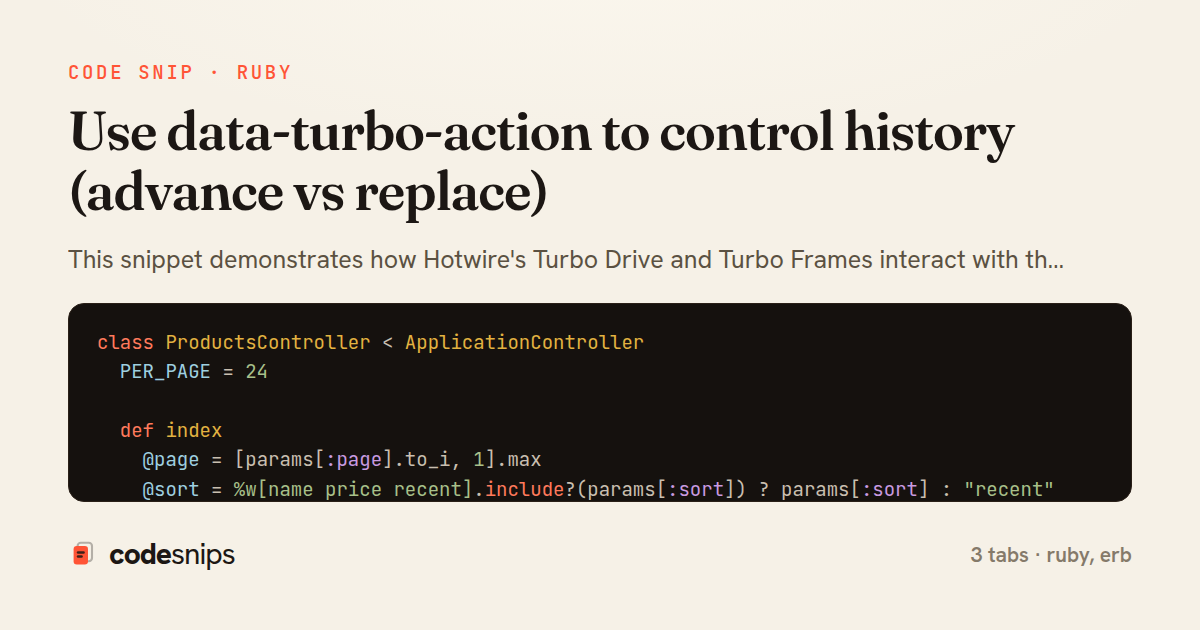
class ProductsController < ApplicationController
  PER_PAGE = 24

  def index
    @page = [params[:page].to_i, 1].max
    @sort = %w[name price recent].include?(params[:sort]) ? params[:sort] : "recent"

    scope = Product.available.order(sort_column(@sort))
    @total_pages = (scope.count.to_f / PER_PAGE).ceil
    @products = scope.offset((@page - 1) * PER_PAGE).limit(PER_PAGE)
  end

  private

  def sort_column(sort)
    case sort
    when "name"  then { name: :asc }
    when "price" then { price_cents: :asc }
    else { created_at: :desc }
    end
  end
end
<h1>Catalog</h1>

<%= turbo_frame_tag "products", data: { turbo_action: "advance" } do %>
  <div class="toolbar">
    <%= render "sort_control", sort: @sort %>
  </div>

  <div class="product-grid">
    <% @products.each do |product| %>
      <%= render "products/card", product: product %>
    <% end %>
  </div>

  <%= render "pager", page: @page, total_pages: @total_pages, sort: @sort %>
<% end %>
<nav class="pager" aria-label="Pagination">
  <% if page > 1 %>
    <%= link_to "← Prev", products_path(page: page - 1, sort: sort), class: "pager__link" %>
  <% end %>

  <% (1..total_pages).each do |n| %>
    <% if n == page %>
      <span class="pager__link is-current" aria-current="page"><%= n %></span>
    <% else %>
      <%= link_to n, products_path(page: n, sort: sort), class: "pager__link" %>
    <% end %>
  <% end %>

  <% if page < total_pages %>
    <%= link_to "Next →", products_path(page: page + 1, sort: sort), class: "pager__link" %>
  <% end %>

  <div class="pager__jump">
    <%# Jumping to page 1 is incidental state — do not push a history entry. %>
    <%= link_to "First page", products_path(page: 1, sort: sort),
          class: "pager__reset",
          data: { turbo_action: "replace" } %>
  </div>
</nav>
This snippet demonstrates how Hotwire's Turbo Drive and Turbo Frames interact with the browser History API through the data-turbo-action attribute. When a Turbo Frame navigates, it normally does not touch the URL or push a history entry. Setting data-turbo-action="advance" promotes a frame navigation into a full history push, so the frame's src becomes the visible URL and a new back-button entry is created. Setting data-turbo-action="replace" instead swaps the current entry in place, changing the URL without growing the history stack.
The ProductsController in the first tab is a plain Rails index action with keyset-free offset pagination via a page param. It renders normally on full loads and renders the same view when a frame requests a page, because Turbo Frame requests carry a Turbo-Frame header that Rails handles transparently — no special branch is needed here.
The index.html.erb tab wraps the product grid and pager inside a turbo_frame_tag named products. The key detail is data: { turbo_action: "advance" } on the frame: this tells Turbo that any navigation landing in this frame should advance history and update the address bar. As a result, paginating deep into the catalog leaves the browser back button working exactly as a user expects, and the current page number is shareable and bookmarkable.
The _pager.html.erb partial shows the trade-off in miniature. The numbered page links inherit advance from the frame, so each click is a distinct history entry. The compact "filter" style links use data: { turbo_action: "replace" } at the link level, which overrides the frame default for that single navigation — appropriate for state that should not pollute history, like toggling a sort order the user will tweak repeatedly.
The practical rule is: use advance for navigations a user would want to reverse with the back button, and replace for incidental state changes. A common pitfall is enabling advance on a frame whose src diverges from the real controller route, producing URLs that 404 on refresh; keeping frame src values aligned with actual routes, as done in _pager.html.erb, avoids that.
Related snips
class CommentsController < ApplicationController
  before_action :set_post

  def create
    @comment = @post.comments.build(comment_params)
System test: asserting Turbo Stream responses
class Post < ApplicationRecord
  belongs_to :author, class_name: 'User'
  has_many :comments, dependent: :destroy

  scope :published, -> { where.not(published_at: nil).where('published_at <= ?', Time.current) }
  scope :draft, -> { where(published_at: nil) }
ActiveRecord scopes for reusable query logic
module Api
  module V1
    class UsersController < BaseController
      def show
        user = User.includes(:profile).find(params[:id])
ETags for conditional requests and caching
class PostsController < ApplicationController
  def index
    @posts = Post.includes(:author)
                 .order(created_at: :desc)
                 .page(params[:page])
                 .per(10)
Turbo Frames: infinite scroll with lazy-loading frame
require "csv"

class PeopleCsvStream
  include Enumerable

  HEADERS = %w[id full_name email signed_up_at plan].freeze
Resilient CSV Export as a Streamed Response
<form data-controller="query-sync" data-action="change->query-sync#apply">
  <select name="status" class="rounded border p-2">
    <option value="">Any</option>
    <option value="open">Open</option>
    <option value="closed">Closed</option>
  </select>
Filter UI that syncs query params via Stimulus (no front-end router)
Share this code
Here's the card — post it anywhere.