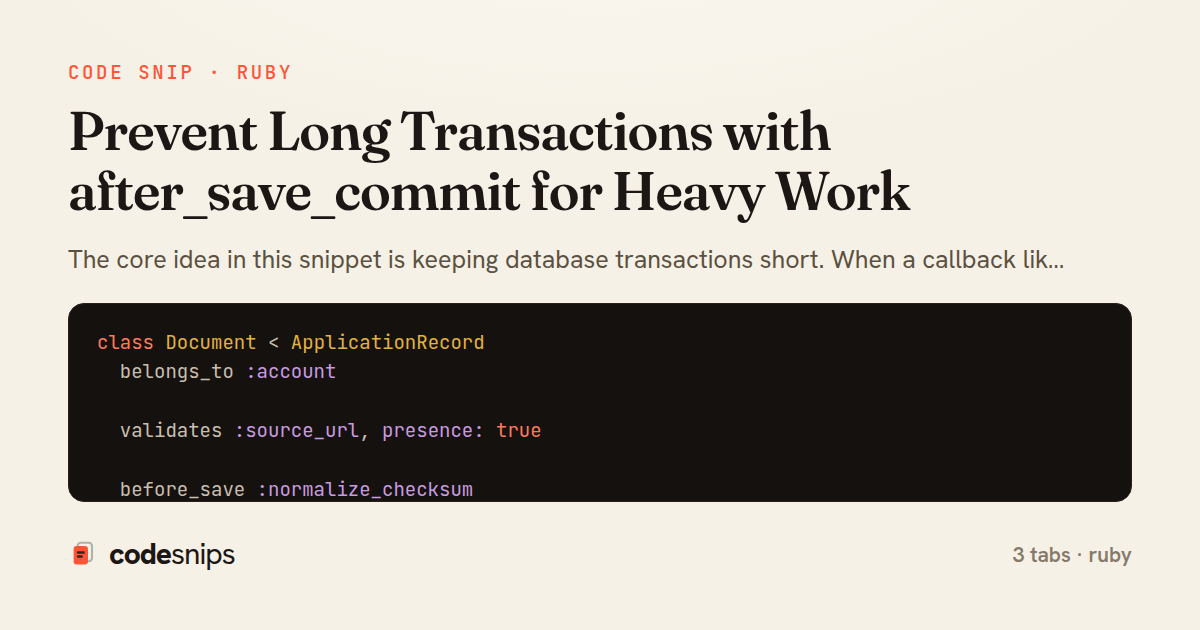
class Document < ApplicationRecord
  belongs_to :account

  validates :source_url, presence: true

  before_save :normalize_checksum

  after_save_commit :enqueue_processing, if: :saved_change_to_source_url?

  def mark_processed(checksum)
    return if checksum != self.checksum # stale job from a superseded update

    update_columns(processed_at: Time.current, processing_state: "ready")
  end

  private

  def normalize_checksum
    self.checksum = Digest::SHA256.hexdigest(source_url.to_s.strip.downcase)
  end

  def enqueue_processing
    update_column(:processing_state, "pending")
    ProcessDocumentJob.perform_later(id, checksum)
  end
end
class ProcessDocumentJob < ApplicationJob
  queue_as :media
  retry_on Faraday::TimeoutError, wait: :polynomially_longer, attempts: 5

  def perform(document_id, expected_checksum)
    document = Document.find_by(id: document_id)
    return unless document                      # deleted after commit
    return unless document.checksum == expected_checksum # superseded update

    thumbnail = ThumbnailGenerator.call(document.source_url)
    document.update_columns(
      thumbnail_url: thumbnail.url,
      thumbnail_width: thumbnail.width,
      thumbnail_height: thumbnail.height
    )

    WebhookClient.deliver(
      document.account,
      event: "document.processed",
      document_id: document.id
    )

    document.mark_processed(expected_checksum)
  end
end
class DocumentsController < ApplicationController
  before_action :set_document, only: %i[update]

  def create
    @document = current_account.documents.new(document_params)

    if @document.save
      render json: serialize(@document), status: :created
    else
      render json: { errors: @document.errors }, status: :unprocessable_entity
    end
  end

  def update
    if @document.update(document_params)
      # Returns immediately; thumbnail + webhook run after commit, off-request.
      render json: serialize(@document), status: :ok
    else
      render json: { errors: @document.errors }, status: :unprocessable_entity
    end
  end

  private

  def set_document
    @document = current_account.documents.find(params[:id])
  end

  def document_params
    params.require(:document).permit(:source_url, :title)
  end

  def serialize(document)
    document.slice(:id, :title, :source_url, :processing_state, :thumbnail_url)
  end
end
The core idea in this snippet is keeping database transactions short. When a callback like after_save runs, it executes inside the same transaction that wrote the row, so any slow work performed there — HTTP calls, image processing, enqueuing to a broker — holds row locks and an open connection for the entire duration. Under load this leads to lock contention, connection-pool exhaustion, and long-running transactions that block VACUUM on Postgres. The fix demonstrated here is after_save_commit, which fires only after the transaction has actually committed, so heavy work happens with no locks held and no risk of firing on a rolled-back write.
In Document model, the fast, transactional part stays inline: normalize_checksum runs before_save because it only mutates in-memory attributes. The expensive part — regenerating a thumbnail and notifying downstream services — is deferred to after_save_commit. The if: :saved_change_to_source_url? guard ensures the job is only scheduled when the relevant column actually changed, avoiding redundant work on unrelated updates. Crucially, enqueue_processing calls perform_later, so even enqueuing happens post-commit; the worker will always find the committed row.
A subtle but common pitfall is addressed in Document model too: after_create_commit versus after_save_commit. Using after_save_commit covers both creates and updates, while the changed-attribute guard keeps it precise.
In ProcessDocumentJob, the work is written to be idempotent and safe against the row disappearing between commit and execution — find_by(id:) returns early if the document was deleted. The job passes processed_checksum back so mark_processed can skip stale runs, protecting against duplicate deliveries from Sidekiq retries. Because the job runs outside any request transaction, its own update_columns write is a short, isolated statement.
The DocumentsController shows the payoff: the update action does an ordinary save, returns immediately, and never blocks on network I/O. The trade-off is eventual consistency — the thumbnail and webhook lag slightly behind the write — which is almost always acceptable for derived data. This pattern is the right reach whenever a callback would otherwise perform work that can fail, retry, or take longer than a database write reasonably should.
Related snips
class CommentsController < ApplicationController
  before_action :set_post

  def create
    @comment = @post.comments.build(comment_params)
System test: asserting Turbo Stream responses
class Post < ApplicationRecord
  belongs_to :author, class_name: 'User'
  has_many :comments, dependent: :destroy

  scope :published, -> { where.not(published_at: nil).where('published_at <= ?', Time.current) }
  scope :draft, -> { where(published_at: nil) }
ActiveRecord scopes for reusable query logic
export interface RetryOptions {
  retries: number;
  baseMs: number;
  maxMs: number;
  signal?: AbortSignal;
  onRetry?: (attempt: number, delay: number, err: unknown) => void;
Exponential backoff with jitter for retries
module Api
  module V1
    class UsersController < BaseController
      def show
        user = User.includes(:profile).find(params[:id])
ETags for conditional requests and caching
class PostsController < ApplicationController
  def index
    @posts = Post.includes(:author)
                 .order(created_at: :desc)
                 .page(params[:page])
                 .per(10)
Turbo Frames: infinite scroll with lazy-loading frame
package dbutil

import (
  "context"

  "github.com/jackc/pgconn"
Retry Postgres serialization failures with bounded attempts
Share this code
Here's the card — post it anywhere.