python
29 lines · 1 tab
Priya Sharma
Jan 2026
1 tab
import logging
import time

logger = logging.getLogger(__name__)


class RequestLoggingMiddleware:
    def __init__(self, get_response):
        self.get_response = get_response

    def __call__(self, request):
        request.start_time = time.time()

        response = self.get_response(request)

        duration = time.time() - request.start_time

        logger.info(
            'request_completed',
            extra={
                'method': request.method,
                'path': request.path,
                'status': response.status_code,
                'duration_ms': round(duration * 1000, 2),
                'user': str(request.user) if request.user.is_authenticated else 'anonymous',
            }
        )

        return response
1 file · python
Explain with highlit
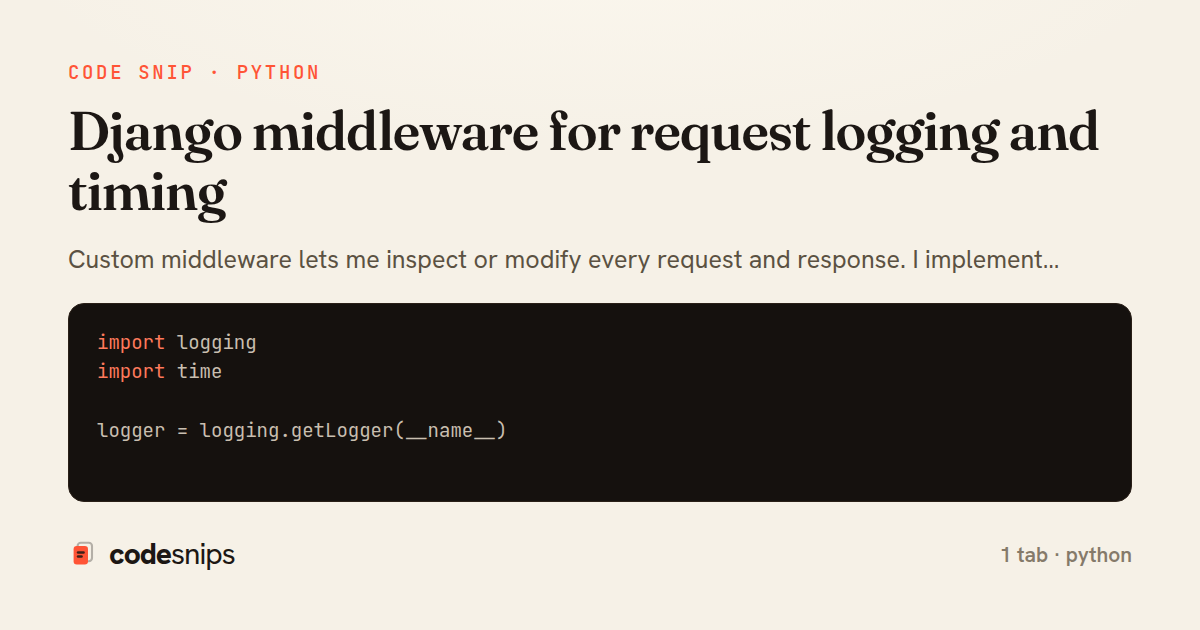
Custom middleware lets me inspect or modify every request and response. I implement both __init__ (called once at startup) and __call__ (for each request). By storing start time in the request, I can measure total processing time including view and template rendering. I log requests to a structured logger with contextual data like user, path, and duration. Middleware order matters—I place this early in MIDDLEWARE to capture total time. For production, I sample or filter to avoid log spam on high-traffic endpoints.
Related snips
python
import os
import stat

for root, _dirs, files in os.walk('/etc'):
    for name in files:
        path = os.path.join(root, name)
Python security audit script for exposed risky filesystem state
python
auditing
host-security
by Kai Nakamura
1 tab
python
class Product(models.Model):
    name = models.CharField(max_length=200)
    slug = models.SlugField(blank=True)
    price = models.DecimalField(max_digits=10, decimal_places=2)
    cost = models.DecimalField(max_digits=10, decimal_places=2)
    margin = models.DecimalField(max_digits=5, decimal_places=2, blank=True)
Django model signals vs overriding save
django
python
models
by Priya Sharma
2 tabs
rust
use tracing::{info, instrument};

#[instrument]
fn process_request(user_id: u64) {
    info!(user_id, "Processing request");
    // Work happens here
tracing for structured logging and distributed tracing
rust
observability
tracing
by Marcus Chen
1 tab
python
from django.urls import path
from . import views

app_name = 'blog'

urlpatterns = [
Django URL namespacing and reverse lookups
django
python
urls
by Priya Sharma
3 tabs
python
import graphene
from graphene_django import DjangoObjectType
from blog.models import Post, Comment


class PostType(DjangoObjectType):
Django GraphQL with Graphene
django
python
graphql
by Priya Sharma
2 tabs
python
from django.db.models import Count, Avg, Sum, Q, F
from django.views.generic import TemplateView
from products.models import Product, Order, OrderItem


class DashboardView(TemplateView):
Django aggregation with annotate for statistics
django
python
database
by Priya Sharma
1 tab
Share this code
Here's the card — post it anywhere.