python
52 lines · 1 tab
Priya Sharma
Jan 2026
1 tab
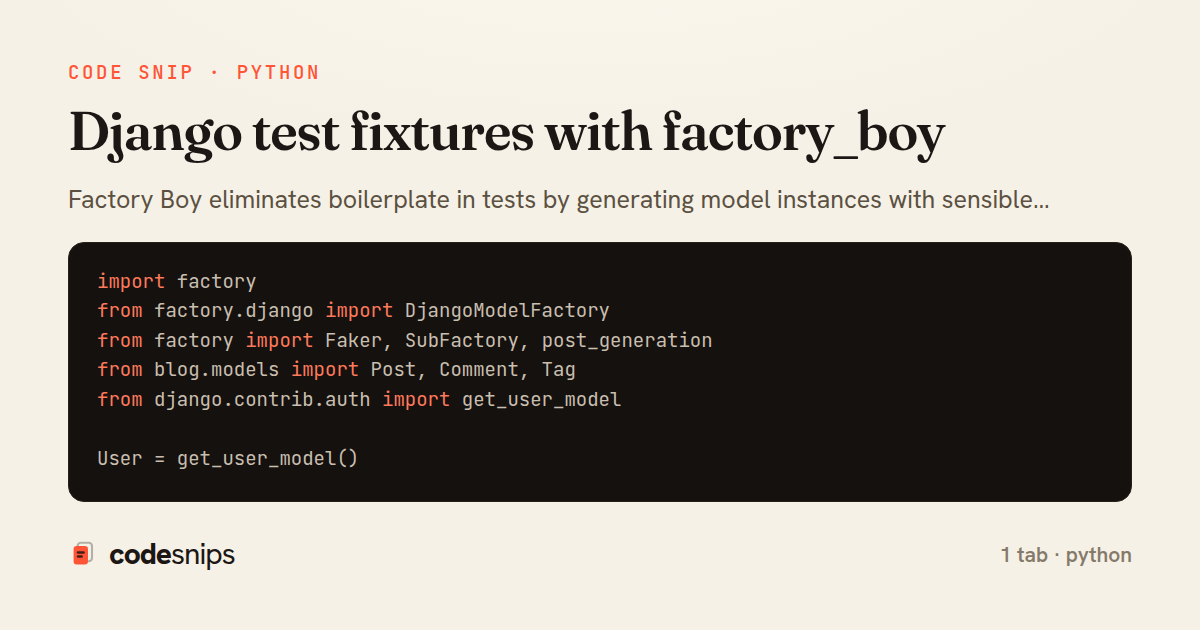
import factory
from factory.django import DjangoModelFactory
from factory import Faker, SubFactory, post_generation
from blog.models import Post, Comment, Tag
from django.contrib.auth import get_user_model

User = get_user_model()


class UserFactory(DjangoModelFactory):
    class Meta:
        model = User

    email = Faker('email')
    first_name = Faker('first_name')
    last_name = Faker('last_name')
    is_active = True


class TagFactory(DjangoModelFactory):
    class Meta:
        model = Tag

    name = factory.Sequence(lambda n: f'tag-{n}')


class PostFactory(DjangoModelFactory):
    class Meta:
        model = Post

    title = Faker('sentence', nb_words=6)
    content = Faker('paragraph', nb_sentences=10)
    author = SubFactory(UserFactory)
    status = 'published'

    @post_generation
    def tags(self, create, extracted, **kwargs):
        if not create:
            return
        if extracted:
            for tag in extracted:
                self.tags.add(tag)


class CommentFactory(DjangoModelFactory):
    class Meta:
        model = Comment

    post = SubFactory(PostFactory)
    author = SubFactory(UserFactory)
    content = Faker('paragraph')
    approved = True
1 file · python
Explain with highlit
Factory Boy eliminates boilerplate in tests by generating model instances with sensible defaults. I use Sequence for unique values, SubFactory for foreign keys, and post_generation for many-to-many relationships. The Faker integration provides realistic data. I create factories in tests/factories.py and import them across test files. For related objects, LazyAttribute computes values based on other fields. This makes tests more readable and maintainable than manual object creation. I can override any attribute when calling the factory.
Related snips
ruby
class CommentsController < ApplicationController
  before_action :set_post

  def create
    @comment = @post.comments.build(comment_params)
System test: asserting Turbo Stream responses
rails
hotwire
turbo
by codesnips
4 tabs
python
import os
import stat

for root, _dirs, files in os.walk('/etc'):
    for name in files:
        path = os.path.join(root, name)
Python security audit script for exposed risky filesystem state
python
auditing
host-security
by Kai Nakamura
1 tab
python
class Product(models.Model):
    name = models.CharField(max_length=200)
    slug = models.SlugField(blank=True)
    price = models.DecimalField(max_digits=10, decimal_places=2)
    cost = models.DecimalField(max_digits=10, decimal_places=2)
    margin = models.DecimalField(max_digits=5, decimal_places=2, blank=True)
Django model signals vs overriding save
django
python
models
by Priya Sharma
2 tabs
python
from django.urls import path
from . import views

app_name = 'blog'

urlpatterns = [
Django URL namespacing and reverse lookups
django
python
urls
by Priya Sharma
3 tabs
python
import graphene
from graphene_django import DjangoObjectType
from blog.models import Post, Comment


class PostType(DjangoObjectType):
Django GraphQL with Graphene
django
python
graphql
by Priya Sharma
2 tabs
rust
use my_crate::add;

#[test]
fn test_public_api() {
    assert_eq!(add(3, 4), 7);
}
Integration tests in tests/ directory
rust
testing
integration
by Marcus Chen
1 tab
Share this code
Here's the card — post it anywhere.