python
42 lines · 3 tabs
Priya Sharma
Jan 2026
3 tabs
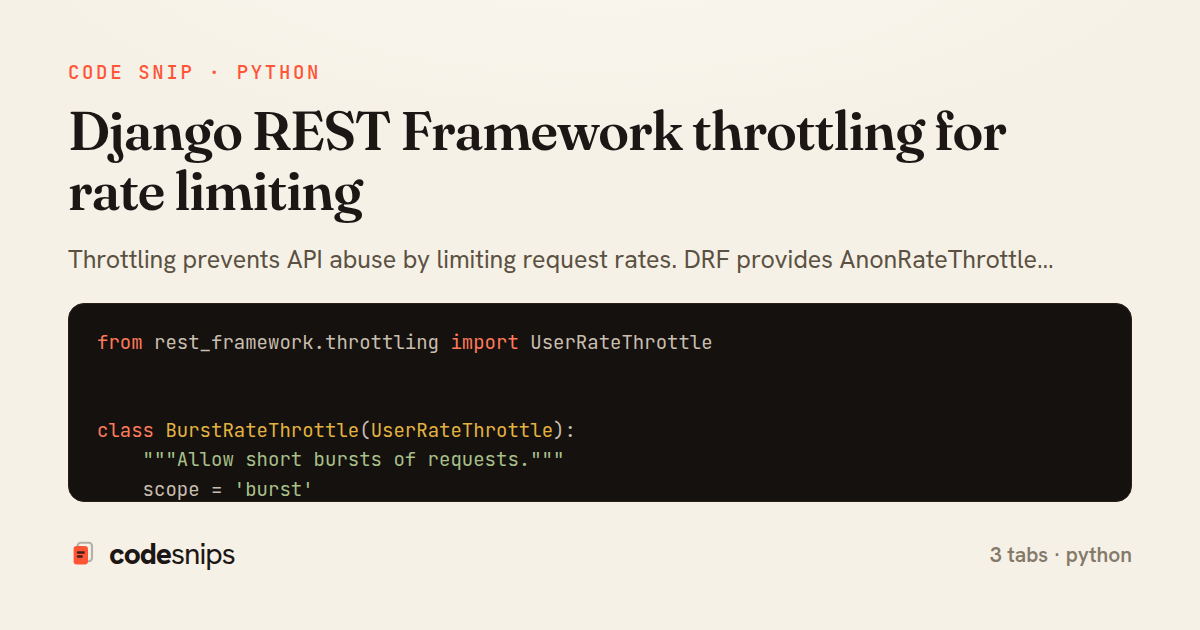
from rest_framework.throttling import UserRateThrottle


class BurstRateThrottle(UserRateThrottle):
    """Allow short bursts of requests."""
    scope = 'burst'


class SustainedRateThrottle(UserRateThrottle):
    """Limit sustained request rate."""
    scope = 'sustained'
REST_FRAMEWORK = {
    'DEFAULT_THROTTLE_CLASSES': [
        'api.throttling.BurstRateThrottle',
        'api.throttling.SustainedRateThrottle',
    ],
    'DEFAULT_THROTTLE_RATES': {
        'anon': '100/day',
        'user': '1000/day',
        'burst': '60/min',
        'sustained': '1000/hour',
    }
}
from rest_framework import viewsets
from rest_framework.throttling import UserRateThrottle
from .models import Article
from .serializers import ArticleSerializer


class ExpensiveOperationThrottle(UserRateThrottle):
    rate = '10/hour'


class ArticleViewSet(viewsets.ModelViewSet):
    queryset = Article.objects.all()
    serializer_class = ArticleSerializer

    def get_throttles(self):
        """Apply stricter throttling to create/update."""
        if self.action in ['create', 'update', 'partial_update']:
            return [ExpensiveOperationThrottle()]
        return super().get_throttles()
3 files · python
Explain with highlit
Throttling prevents API abuse by limiting request rates. DRF provides AnonRateThrottle for anonymous users and UserRateThrottle for authenticated users. I configure rates in settings like 'user': '100/hour'. For custom logic, I subclass BaseThrottle and implement allow_request(). Throttle scope lets me set different rates for different endpoints. I use Redis as cache backend for production to share throttle state across servers. The 429 Too Many Requests response includes a Retry-After header. This protects APIs from both malicious attacks and client bugs causing request loops.
Related snips
python
import os
import stat

for root, _dirs, files in os.walk('/etc'):
    for name in files:
        path = os.path.join(root, name)
Python security audit script for exposed risky filesystem state
python
auditing
host-security
by Kai Nakamura
1 tab
python
class Product(models.Model):
    name = models.CharField(max_length=200)
    slug = models.SlugField(blank=True)
    price = models.DecimalField(max_digits=10, decimal_places=2)
    cost = models.DecimalField(max_digits=10, decimal_places=2)
    margin = models.DecimalField(max_digits=5, decimal_places=2, blank=True)
Django model signals vs overriding save
django
python
models
by Priya Sharma
2 tabs
python
from django.urls import path
from . import views

app_name = 'blog'

urlpatterns = [
Django URL namespacing and reverse lookups
django
python
urls
by Priya Sharma
3 tabs
typescript
export type Settled<R> =
  | { status: 'fulfilled'; value: R }
  | { status: 'rejected'; reason: unknown };

export interface ConcurrencyOptions {
  limit: number;
Simple concurrency limiter for batch operations
node
concurrency
async
by codesnips
2 tabs
python
import graphene
from graphene_django import DjangoObjectType
from blog.models import Post, Comment


class PostType(DjangoObjectType):
Django GraphQL with Graphene
django
python
graphql
by Priya Sharma
2 tabs
python
from django.db.models import Count, Avg, Sum, Q, F
from django.views.generic import TemplateView
from products.models import Product, Order, OrderItem


class DashboardView(TemplateView):
Django aggregation with annotate for statistics
django
python
database
by Priya Sharma
1 tab
Share this code
Here's the card — post it anywhere.