python
106 lines · 3 tabs
Priya Sharma
Jan 2026
3 tabs
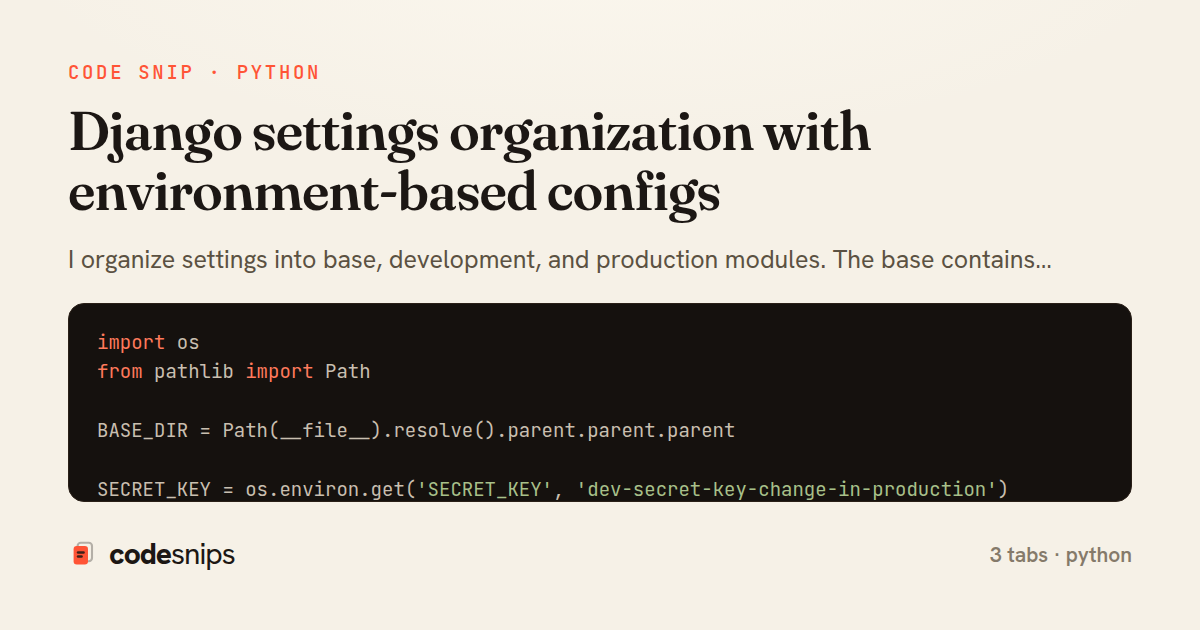
import os
from pathlib import Path

BASE_DIR = Path(__file__).resolve().parent.parent.parent

SECRET_KEY = os.environ.get('SECRET_KEY', 'dev-secret-key-change-in-production')

INSTALLED_APPS = [
    'django.contrib.admin',
    'django.contrib.auth',
    'django.contrib.contenttypes',
    'django.contrib.sessions',
    'django.contrib.messages',
    'django.contrib.staticfiles',
    # Third party
    'rest_framework',
    # Local apps
    'core',
    'accounts',
    'blog',
]

MIDDLEWARE = [
    'django.middleware.security.SecurityMiddleware',
    'django.contrib.sessions.middleware.SessionMiddleware',
    'django.middleware.common.CommonMiddleware',
    'django.middleware.csrf.CsrfViewMiddleware',
    'django.contrib.auth.middleware.AuthenticationMiddleware',
    'django.contrib.messages.middleware.MessageMiddleware',
    'django.middleware.clickjacking.XFrameOptionsMiddleware',
]

ROOT_URLCONF = 'config.urls'

TEMPLATES = [
    {
        'BACKEND': 'django.template.backends.django.DjangoTemplates',
        'DIRS': [BASE_DIR / 'templates'],
        'APP_DIRS': True,
        'OPTIONS': {
            'context_processors': [
                'django.template.context_processors.debug',
                'django.template.context_processors.request',
                'django.contrib.auth.context_processors.auth',
                'django.contrib.messages.context_processors.messages',
            ],
        },
    },
]
from .base import *

DEBUG = True

ALLOWED_HOSTS = ['localhost', '127.0.0.1']

DATABASES = {
    'default': {
        'ENGINE': 'django.db.backends.postgresql',
        'NAME': 'myproject_dev',
        'USER': 'postgres',
        'PASSWORD': 'postgres',
        'HOST': 'localhost',
        'PORT': '5432',
    }
}

# Django Debug Toolbar
INSTALLED_APPS += ['debug_toolbar']
MIDDLEWARE += ['debug_toolbar.middleware.DebugToolbarMiddleware']
INTERNAL_IPS = ['127.0.0.1']

EMAIL_BACKEND = 'django.core.mail.backends.console.EmailBackend'
from .base import *

DEBUG = False

ALLOWED_HOSTS = os.environ.get('ALLOWED_HOSTS', '').split(',')

DATABASES = {
    'default': {
        'ENGINE': 'django.db.backends.postgresql',
        'NAME': os.environ.get('DB_NAME'),
        'USER': os.environ.get('DB_USER'),
        'PASSWORD': os.environ.get('DB_PASSWORD'),
        'HOST': os.environ.get('DB_HOST'),
        'PORT': os.environ.get('DB_PORT', '5432'),
    }
}

# Security settings
SECURE_SSL_REDIRECT = True
SESSION_COOKIE_SECURE = True
CSRF_COOKIE_SECURE = True
SECURE_HSTS_SECONDS = 31536000
SECURE_HSTS_INCLUDE_SUBDOMAINS = True

# Static files
STATICFILES_STORAGE = 'whitenoise.storage.CompressedManifestStaticFilesStorage'

# Email
EMAIL_BACKEND = 'django.core.mail.backends.smtp.EmailBackend'
EMAIL_HOST = os.environ.get('EMAIL_HOST')
EMAIL_PORT = os.environ.get('EMAIL_PORT', 587)
EMAIL_USE_TLS = True
EMAIL_HOST_USER = os.environ.get('EMAIL_HOST_USER')
EMAIL_HOST_PASSWORD = os.environ.get('EMAIL_HOST_PASSWORD')
3 files · python
Explain with highlit
I organize settings into base, development, and production modules. The base contains common settings, while dev and prod override specific values. I use environment variables for secrets via os.environ.get() or python-decouple. The django-environ package simplifies this with .env files. For different environments, I set DJANGO_SETTINGS_MODULE to the appropriate module. I keep sensitive settings out of version control using .env.example as a template. This approach makes deployments predictable and secure, with clear separation between local and production configs.
Related snips
python
import os
import stat

for root, _dirs, files in os.walk('/etc'):
    for name in files:
        path = os.path.join(root, name)
Python security audit script for exposed risky filesystem state
python
auditing
host-security
by Kai Nakamura
1 tab
python
class Product(models.Model):
    name = models.CharField(max_length=200)
    slug = models.SlugField(blank=True)
    price = models.DecimalField(max_digits=10, decimal_places=2)
    cost = models.DecimalField(max_digits=10, decimal_places=2)
    margin = models.DecimalField(max_digits=5, decimal_places=2, blank=True)
Django model signals vs overriding save
django
python
models
by Priya Sharma
2 tabs
python
from django.urls import path
from . import views

app_name = 'blog'

urlpatterns = [
Django URL namespacing and reverse lookups
django
python
urls
by Priya Sharma
3 tabs
python
import graphene
from graphene_django import DjangoObjectType
from blog.models import Post, Comment


class PostType(DjangoObjectType):
Django GraphQL with Graphene
django
python
graphql
by Priya Sharma
2 tabs
python
from django.db.models import Count, Avg, Sum, Q, F
from django.views.generic import TemplateView
from products.models import Product, Order, OrderItem


class DashboardView(TemplateView):
Django aggregation with annotate for statistics
django
python
database
by Priya Sharma
1 tab
python
from rest_framework import permissions


class IsOwner(permissions.BasePermission):
    """Allow only object owner to access."""
Django REST Framework permissions and authorization
django
python
rest
by Priya Sharma
2 tabs
Share this code
Here's the card — post it anywhere.