python
55 lines · 1 tab
Priya Sharma
Jan 2026
1 tab
from django.views.generic import ListView, DetailView, CreateView, UpdateView, DeleteView
from django.contrib.auth.mixins import LoginRequiredMixin
from django.urls import reverse_lazy
from .models import Post
from .forms import PostForm


class PostListView(ListView):
    model = Post
    template_name = 'blog/post_list.html'
    context_object_name = 'posts'
    paginate_by = 20

    def get_queryset(self):
        return Post.objects.filter(status='published').select_related('author')


class PostDetailView(DetailView):
    model = Post
    template_name = 'blog/post_detail.html'
    context_object_name = 'post'

    def get_queryset(self):
        # Increment view count
        qs = super().get_queryset()
        return qs.select_related('author').prefetch_related('comments')


class PostCreateView(LoginRequiredMixin, CreateView):
    model = Post
    form_class = PostForm
    template_name = 'blog/post_form.html'

    def form_valid(self, form):
        form.instance.author = self.request.user
        return super().form_valid(form)


class PostUpdateView(LoginRequiredMixin, UpdateView):
    model = Post
    form_class = PostForm
    template_name = 'blog/post_form.html'

    def get_queryset(self):
        # Only allow editing own posts
        return super().get_queryset().filter(author=self.request.user)


class PostDeleteView(LoginRequiredMixin, DeleteView):
    model = Post
    template_name = 'blog/post_confirm_delete.html'
    success_url = reverse_lazy('blog:post_list')

    def get_queryset(self):
        return super().get_queryset().filter(author=self.request.user)
1 file · python
Explain with highlit
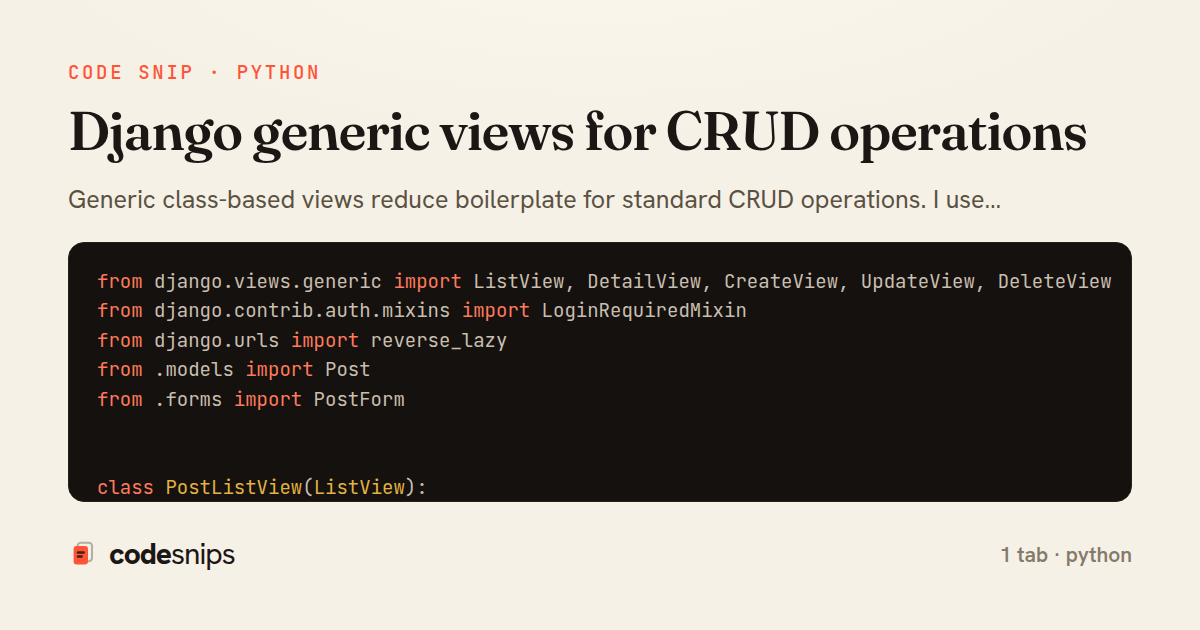
Generic class-based views reduce boilerplate for standard CRUD operations. I use ListView, DetailView, CreateView, UpdateView, and DeleteView. Setting model and template_name is often sufficient. For create/update views, I specify fields or form_class. The get_queryset() method customizes filtering. get_success_url() controls redirects after form submission. For simple cases, generics are faster than writing views from scratch. For complex logic, I override methods or use regular views. This balances productivity with maintainability.
Related snips
python
import os
import stat

for root, _dirs, files in os.walk('/etc'):
    for name in files:
        path = os.path.join(root, name)
Python security audit script for exposed risky filesystem state
python
auditing
host-security
by Kai Nakamura
1 tab
python
class Product(models.Model):
    name = models.CharField(max_length=200)
    slug = models.SlugField(blank=True)
    price = models.DecimalField(max_digits=10, decimal_places=2)
    cost = models.DecimalField(max_digits=10, decimal_places=2)
    margin = models.DecimalField(max_digits=5, decimal_places=2, blank=True)
Django model signals vs overriding save
django
python
models
by Priya Sharma
2 tabs
python
from django.urls import path
from . import views

app_name = 'blog'

urlpatterns = [
Django URL namespacing and reverse lookups
django
python
urls
by Priya Sharma
3 tabs
python
import graphene
from graphene_django import DjangoObjectType
from blog.models import Post, Comment


class PostType(DjangoObjectType):
Django GraphQL with Graphene
django
python
graphql
by Priya Sharma
2 tabs
ruby
class Comment < ApplicationRecord
  belongs_to :post, touch: true
  belongs_to :author, class_name: "User"

  validates :body, presence: true, length: { maximum: 10_000 }
Granular Cache Invalidation with touch: true
rails
caching
activerecord
by codesnips
4 tabs
python
from django.db.models import Count, Avg, Sum, Q, F
from django.views.generic import TemplateView
from products.models import Product, Order, OrderItem


class DashboardView(TemplateView):
Django aggregation with annotate for statistics
django
python
database
by Priya Sharma
1 tab
Share this code
Here's the card — post it anywhere.