python
64 lines · 1 tab
Priya Sharma
Jan 2026
1 tab
LOGGING = {
    'version': 1,
    'disable_existing_loggers': False,
    'formatters': {
        'verbose': {
            'format': '{levelname} {asctime} {module} {message}',
            'style': '{',
        },
        'simple': {
            'format': '{levelname} {message}',
            'style': '{',
        },
    },
    'filters': {
        'require_debug_false': {
            '()': 'django.utils.log.RequireDebugFalse',
        },
    },
    'handlers': {
        'file': {
            'level': 'INFO',
            'class': 'logging.handlers.RotatingFileHandler',
            'filename': '/var/log/django/app.log',
            'maxBytes': 1024 * 1024 * 10,  # 10 MB
            'backupCount': 5,
            'formatter': 'verbose',
        },
        'error_file': {
            'level': 'ERROR',
            'class': 'logging.handlers.RotatingFileHandler',
            'filename': '/var/log/django/error.log',
            'maxBytes': 1024 * 1024 * 10,
            'backupCount': 5,
            'formatter': 'verbose',
        },
        'console': {
            'level': 'INFO',
            'class': 'logging.StreamHandler',
            'formatter': 'simple',
        },
        'mail_admins': {
            'level': 'ERROR',
            'class': 'django.utils.log.AdminEmailHandler',
            'filters': ['require_debug_false'],
        },
    },
    'loggers': {
        'django': {
            'handlers': ['file', 'console'],
            'level': 'INFO',
            'propagate': False,
        },
        'django.request': {
            'handlers': ['error_file', 'mail_admins'],
            'level': 'ERROR',
            'propagate': False,
        },
        'myapp': {
            'handlers': ['file', 'error_file', 'console'],
            'level': 'INFO',
            'propagate': False,
        },
    },
}
1 file · python
Explain with highlit
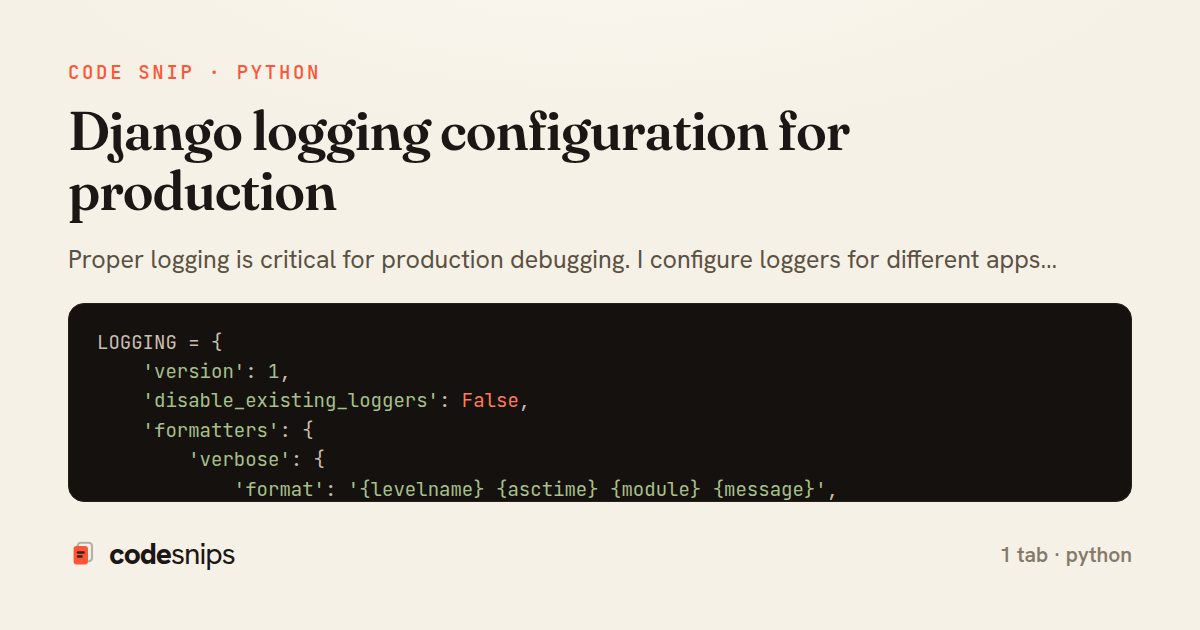
Proper logging is critical for production debugging. I configure loggers for different apps and libraries. I use file handlers for persistence and console handlers for development. Log rotation prevents disk fill-up. I set appropriate levels (DEBUG, INFO, WARNING, ERROR, CRITICAL) per environment. Structured logging with JSON formatters enables log aggregation. I log exceptions with logger.exception() to capture tracebacks. For sensitive data, I filter logs to prevent credential leaks. This provides visibility into application health and user issues.
Related snips
python
import os
import stat

for root, _dirs, files in os.walk('/etc'):
    for name in files:
        path = os.path.join(root, name)
Python security audit script for exposed risky filesystem state
python
auditing
host-security
by Kai Nakamura
1 tab
python
class Product(models.Model):
    name = models.CharField(max_length=200)
    slug = models.SlugField(blank=True)
    price = models.DecimalField(max_digits=10, decimal_places=2)
    cost = models.DecimalField(max_digits=10, decimal_places=2)
    margin = models.DecimalField(max_digits=5, decimal_places=2, blank=True)
Django model signals vs overriding save
django
python
models
by Priya Sharma
2 tabs
rust
use tracing::{info, instrument};

#[instrument]
fn process_request(user_id: u64) {
    info!(user_id, "Processing request");
    // Work happens here
tracing for structured logging and distributed tracing
rust
observability
tracing
by Marcus Chen
1 tab
python
from django.urls import path
from . import views

app_name = 'blog'

urlpatterns = [
Django URL namespacing and reverse lookups
django
python
urls
by Priya Sharma
3 tabs
python
import graphene
from graphene_django import DjangoObjectType
from blog.models import Post, Comment


class PostType(DjangoObjectType):
Django GraphQL with Graphene
django
python
graphql
by Priya Sharma
2 tabs
python
from django.db.models import Count, Avg, Sum, Q, F
from django.views.generic import TemplateView
from products.models import Product, Order, OrderItem


class DashboardView(TemplateView):
Django aggregation with annotate for statistics
django
python
database
by Priya Sharma
1 tab
Share this code
Here's the card — post it anywhere.