python
33 lines · 1 tab
Priya Sharma
Jan 2026
1 tab
from django.db import models


class Product(models.Model):
    name = models.CharField(max_length=200)
    sku = models.CharField(max_length=50)
    category = models.ForeignKey('Category', on_delete=models.CASCADE)
    price = models.DecimalField(max_digits=10, decimal_places=2)
    stock = models.IntegerField(default=0)
    created_at = models.DateTimeField(auto_now_add=True)

    class Meta:
        db_table = 'shop_products'
        ordering = ['-created_at', 'name']
        verbose_name = 'Product'
        verbose_name_plural = 'Products'

        indexes = [
            models.Index(fields=['category', '-created_at']),
            models.Index(fields=['sku']),
        ]

        unique_together = [
            ['sku', 'category']
        ]

        permissions = [
            ('can_publish_product', 'Can publish product'),
            ('can_feature_product', 'Can feature product on homepage'),
        ]

    def __str__(self):
        return self.name
1 file · python
Explain with highlit
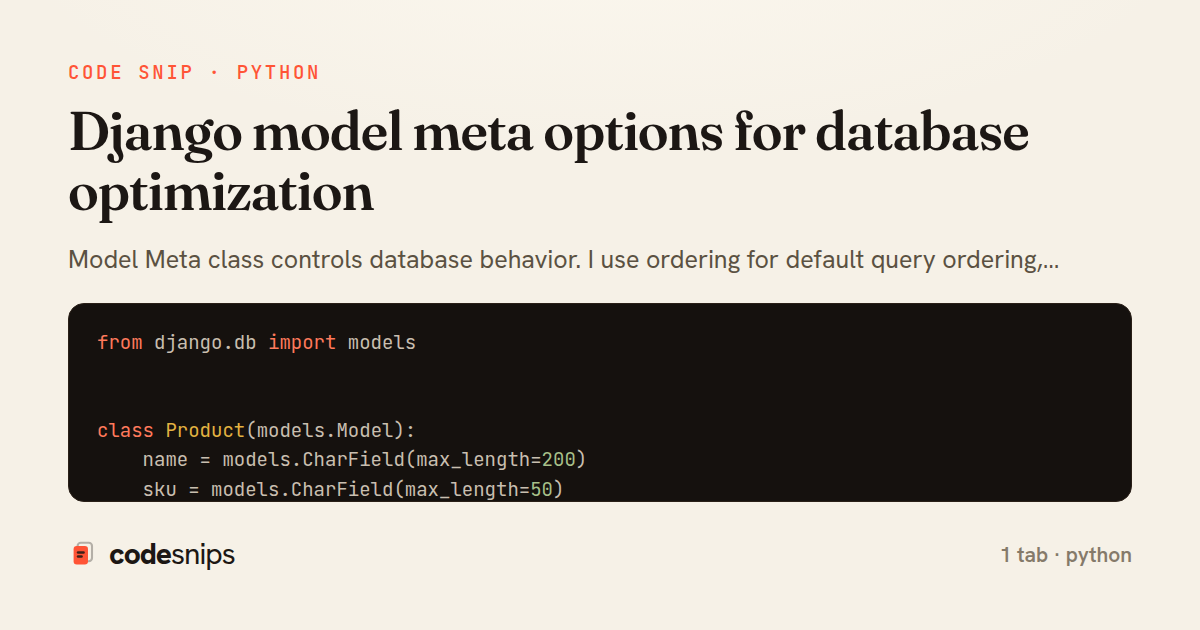
Model Meta class controls database behavior. I use ordering for default query ordering, indexes for database indexes, and unique_together for composite uniqueness constraints. The db_table option customizes table names. For large tables, managed=False creates unmanaged models for existing tables. I use verbose_name and verbose_name_plural for admin readability. Permissions can be added via permissions. These options optimize queries and define database structure without migrations for each change.
Related snips
python
import os
import stat

for root, _dirs, files in os.walk('/etc'):
    for name in files:
        path = os.path.join(root, name)
Python security audit script for exposed risky filesystem state
python
auditing
host-security
by Kai Nakamura
1 tab
python
class Product(models.Model):
    name = models.CharField(max_length=200)
    slug = models.SlugField(blank=True)
    price = models.DecimalField(max_digits=10, decimal_places=2)
    cost = models.DecimalField(max_digits=10, decimal_places=2)
    margin = models.DecimalField(max_digits=5, decimal_places=2, blank=True)
Django model signals vs overriding save
django
python
models
by Priya Sharma
2 tabs
python
from django.urls import path
from . import views

app_name = 'blog'

urlpatterns = [
Django URL namespacing and reverse lookups
django
python
urls
by Priya Sharma
3 tabs
ruby
# Vulnerable: user input is concatenated directly into SQL.
email = params[:email]
password = params[:password]

sql = "SELECT * FROM users WHERE email = '#{email}' AND password_hash = '#{password}'"
user = ActiveRecord::Base.connection.execute(sql).first
SQL injection prevention with unsafe and safe query patterns
sql-injection
owasp
database
by Kai Nakamura
3 tabs
python
import graphene
from graphene_django import DjangoObjectType
from blog.models import Post, Comment


class PostType(DjangoObjectType):
Django GraphQL with Graphene
django
python
graphql
by Priya Sharma
2 tabs
sql
-- EXPLAIN ANALYZE (actual execution statistics)
EXPLAIN ANALYZE
SELECT u.username, COUNT(o.id) AS order_count
FROM users u
LEFT JOIN orders o ON u.id = o.user_id
WHERE u.created_at >= '2024-01-01'
Advanced query optimization techniques
database
optimization
query-performance
by Maria Garcia
2 tabs
Share this code
Here's the card — post it anywhere.