python
38 lines · 2 tabs
Priya Sharma
Jan 2026
2 tabs
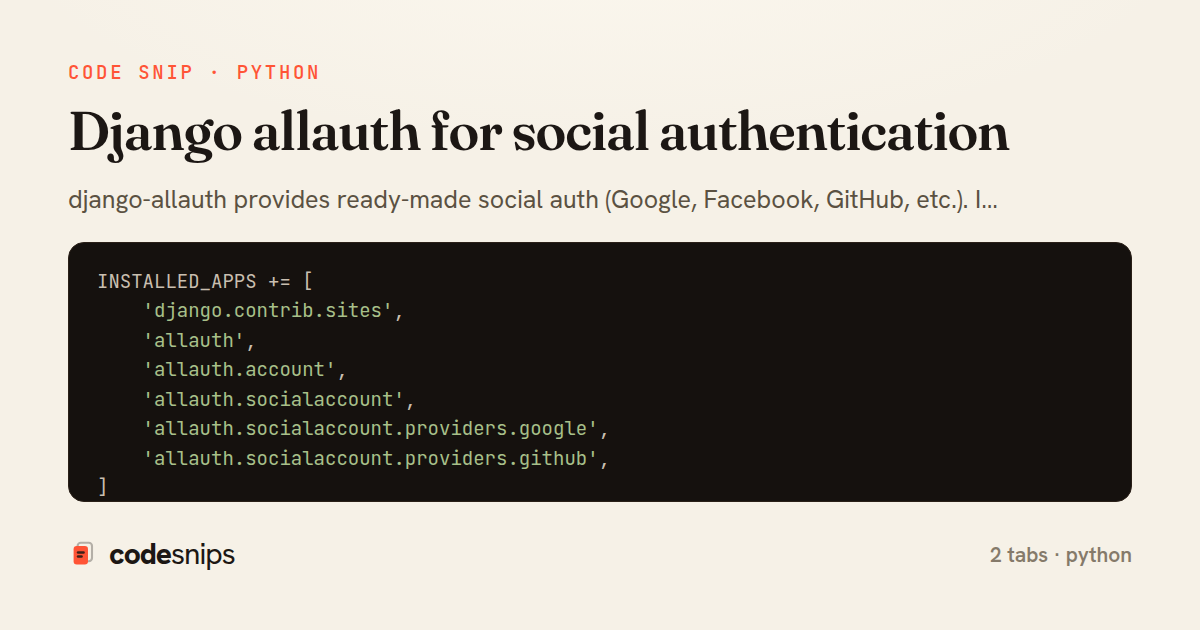
INSTALLED_APPS += [
    'django.contrib.sites',
    'allauth',
    'allauth.account',
    'allauth.socialaccount',
    'allauth.socialaccount.providers.google',
    'allauth.socialaccount.providers.github',
]

SITE_ID = 1

AUTHENTICATION_BACKENDS = [
    'django.contrib.auth.backends.ModelBackend',
    'allauth.account.auth_backends.AuthenticationBackend',
]

# Allauth settings
ACCOUNT_AUTHENTICATION_METHOD = 'email'
ACCOUNT_EMAIL_REQUIRED = True
ACCOUNT_EMAIL_VERIFICATION = 'mandatory'
ACCOUNT_USERNAME_REQUIRED = False

SOCIALACCOUNT_PROVIDERS = {
    'google': {
        'SCOPE': ['profile', 'email'],
        'AUTH_PARAMS': {'access_type': 'online'},
    },
    'github': {
        'SCOPE': ['user', 'repo', 'read:org'],
    }
}

LOGIN_REDIRECT_URL = '/dashboard/'
from django.urls import path, include

urlpatterns = [
    path('accounts/', include('allauth.urls')),
]
2 files · python
Explain with highlit
django-allauth provides ready-made social auth (Google, Facebook, GitHub, etc.). I configure providers in settings with API keys. It handles OAuth flows, token management, and account linking. Users can login with multiple providers. I customize templates to match site design. For custom user models, allauth integrates seamlessly. It includes email verification and password reset. This saves weeks of development compared to implementing OAuth from scratch. I enable only needed providers to reduce dependencies.
Related snips
ruby
payload = {
  sub: user.id,
  iss: 'https://auth.example.com',
  aud: 'codesnips-api',
  exp: 15.minutes.from_now.to_i,
  iat: Time.now.to_i,
JWT issuance and verification without common footguns
jwt
authentication
api
by Kai Nakamura
2 tabs
python
import os
import stat

for root, _dirs, files in os.walk('/etc'):
    for name in files:
        path = os.path.join(root, name)
Python security audit script for exposed risky filesystem state
python
auditing
host-security
by Kai Nakamura
1 tab
python
class Product(models.Model):
    name = models.CharField(max_length=200)
    slug = models.SlugField(blank=True)
    price = models.DecimalField(max_digits=10, decimal_places=2)
    cost = models.DecimalField(max_digits=10, decimal_places=2)
    margin = models.DecimalField(max_digits=5, decimal_places=2, blank=True)
Django model signals vs overriding save
django
python
models
by Priya Sharma
2 tabs
python
from django.urls import path
from . import views

app_name = 'blog'

urlpatterns = [
Django URL namespacing and reverse lookups
django
python
urls
by Priya Sharma
3 tabs
typescript
import { randomBytes, createHash } from "crypto";
import jwt from "jsonwebtoken";
import { RefreshTokenStore } from "./store";

const ACCESS_SECRET = process.env.ACCESS_SECRET!;
const ACCESS_TTL = "15m";
JWT access + refresh token rotation (conceptual)
security
node
jwt
by codesnips
3 tabs
python
import graphene
from graphene_django import DjangoObjectType
from blog.models import Post, Comment


class PostType(DjangoObjectType):
Django GraphQL with Graphene
django
python
graphql
by Priya Sharma
2 tabs
Share this code
Here's the card — post it anywhere.