Priya Sharma
Jan 2026
3 tabs
from django.utils.translation import gettext_lazy as _

LANGUAGE_CODE = 'en-us'

LANGUAGES = [
    ('en', _('English')),
    ('es', _('Spanish')),
    ('fr', _('French')),
    ('de', _('German')),
]

LOCALE_PATHS = [BASE_DIR / 'locale']

USE_I18N = True
USE_L10N = True
USE_TZ = True

MIDDLEWARE += ['django.middleware.locale.LocaleMiddleware']
from django.utils.translation import gettext as _
from django.http import JsonResponse


def my_view(request):
    message = _('Welcome to our site!')
    error = _('An error occurred.')

    return JsonResponse({
        'message': message,
        'error': error
    })
{% load i18n %}

<h1>{% trans "Welcome" %}</h1>

{% blocktrans count counter=items|length %}
  There is {{ counter }} item.
{% plural %}
  There are {{ counter }} items.
{% endblocktrans %}

<p>{% trans "Change language:" %}</p>
<a href="/en/">English</a> |
<a href="/es/">Español</a>
3 files · python, django
Explain with highlit
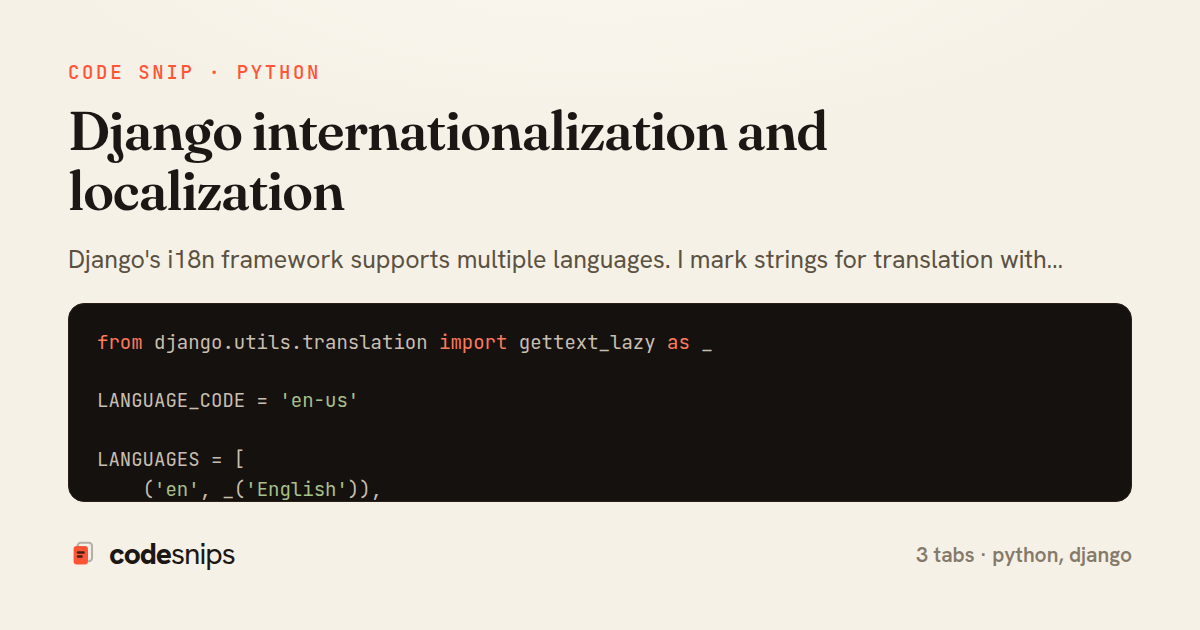
Django's i18n framework supports multiple languages. I mark strings for translation with gettext() or _(). The makemessages command extracts strings to .po files. Translators fill in translations, then compilemessages creates binary .mo files. I use {% trans %} and {% blocktrans %} in templates. The LocaleMiddleware sets language from URL prefix, cookie, or Accept header. For dates and numbers, I use l10n formatting. This enables global reach without code duplication per language.
Related snips
python
import os
import stat

for root, _dirs, files in os.walk('/etc'):
    for name in files:
        path = os.path.join(root, name)
Python security audit script for exposed risky filesystem state
python
auditing
host-security
by Kai Nakamura
1 tab
python
class Product(models.Model):
    name = models.CharField(max_length=200)
    slug = models.SlugField(blank=True)
    price = models.DecimalField(max_digits=10, decimal_places=2)
    cost = models.DecimalField(max_digits=10, decimal_places=2)
    margin = models.DecimalField(max_digits=5, decimal_places=2, blank=True)
Django model signals vs overriding save
django
python
models
by Priya Sharma
2 tabs
python
from django.urls import path
from . import views

app_name = 'blog'

urlpatterns = [
Django URL namespacing and reverse lookups
django
python
urls
by Priya Sharma
3 tabs
python
import graphene
from graphene_django import DjangoObjectType
from blog.models import Post, Comment


class PostType(DjangoObjectType):
Django GraphQL with Graphene
django
python
graphql
by Priya Sharma
2 tabs
python
from django.db.models import Count, Avg, Sum, Q, F
from django.views.generic import TemplateView
from products.models import Product, Order, OrderItem


class DashboardView(TemplateView):
Django aggregation with annotate for statistics
django
python
database
by Priya Sharma
1 tab
python
from rest_framework import permissions


class IsOwner(permissions.BasePermission):
    """Allow only object owner to access."""
Django REST Framework permissions and authorization
django
python
rest
by Priya Sharma
2 tabs
Share this code
Here's the card — post it anywhere.