python
28 lines · 2 tabs
Priya Sharma
Jan 2026
2 tabs
from django.contrib.auth.models import AbstractUser
from django.db import models


class CustomUser(AbstractUser):
    """Extended user model with additional fields."""
    email = models.EmailField(unique=True)
    phone = models.CharField(max_length=20, blank=True)
    avatar = models.ImageField(upload_to='avatars/', null=True, blank=True)
    bio = models.TextField(blank=True)
    date_of_birth = models.DateField(null=True, blank=True)
    email_verified = models.BooleanField(default=False)

    # Use email for login
    USERNAME_FIELD = 'email'
    REQUIRED_FIELDS = ['username', 'first_name', 'last_name']

    class Meta:
        verbose_name = 'User'
        verbose_name_plural = 'Users'

    def get_full_name(self):
        return f'{self.first_name} {self.last_name}'.strip() or self.username

    def __str__(self):
        return self.email
# Point to custom user model
AUTH_USER_MODEL = 'accounts.CustomUser'
2 files · python
Explain with highlit
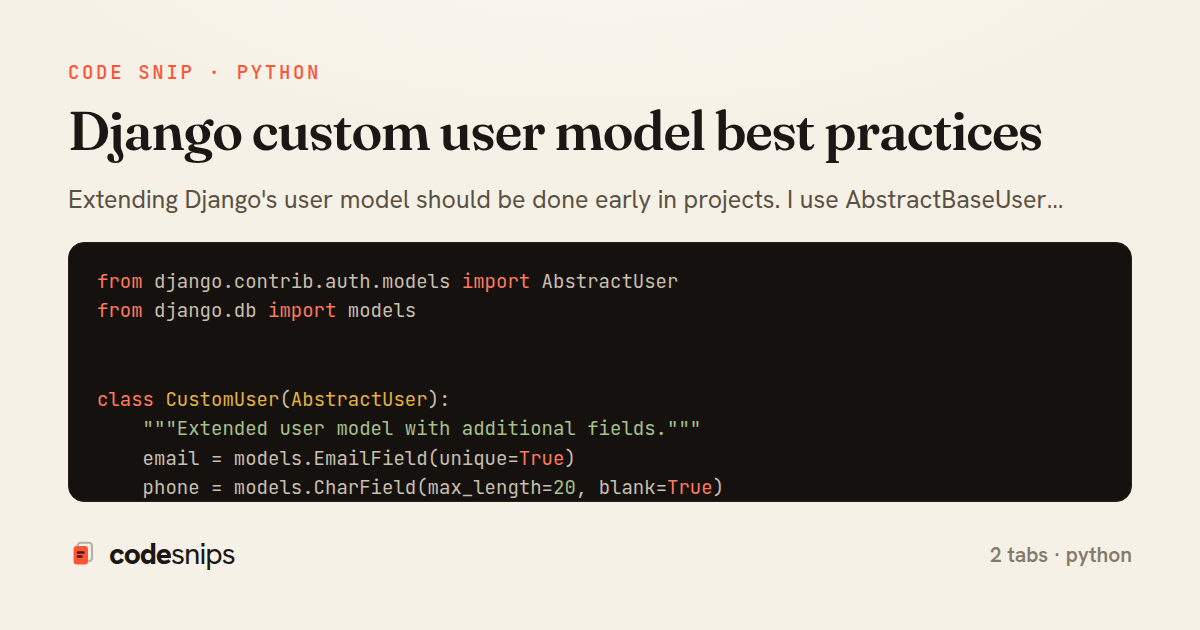
Extending Django's user model should be done early in projects. I use AbstractBaseUser for full control or AbstractUser to extend the default. Setting AUTH_USER_MODEL points Django to my custom model. I add fields like phone, avatar, or preferences. For profile data, I sometimes use a separate Profile model with OneToOneField. Custom user managers handle creation logic. I ensure username/email uniqueness constraints. Migrations become complex if changing user models mid-project. This provides flexibility for auth requirements.
Related snips
ruby
payload = {
  sub: user.id,
  iss: 'https://auth.example.com',
  aud: 'codesnips-api',
  exp: 15.minutes.from_now.to_i,
  iat: Time.now.to_i,
JWT issuance and verification without common footguns
jwt
authentication
api
by Kai Nakamura
2 tabs
python
import os
import stat

for root, _dirs, files in os.walk('/etc'):
    for name in files:
        path = os.path.join(root, name)
Python security audit script for exposed risky filesystem state
python
auditing
host-security
by Kai Nakamura
1 tab
python
class Product(models.Model):
    name = models.CharField(max_length=200)
    slug = models.SlugField(blank=True)
    price = models.DecimalField(max_digits=10, decimal_places=2)
    cost = models.DecimalField(max_digits=10, decimal_places=2)
    margin = models.DecimalField(max_digits=5, decimal_places=2, blank=True)
Django model signals vs overriding save
django
python
models
by Priya Sharma
2 tabs
python
from django.urls import path
from . import views

app_name = 'blog'

urlpatterns = [
Django URL namespacing and reverse lookups
django
python
urls
by Priya Sharma
3 tabs
typescript
import { randomBytes, createHash } from "crypto";
import jwt from "jsonwebtoken";
import { RefreshTokenStore } from "./store";

const ACCESS_SECRET = process.env.ACCESS_SECRET!;
const ACCESS_TTL = "15m";
JWT access + refresh token rotation (conceptual)
security
node
jwt
by codesnips
3 tabs
python
import graphene
from graphene_django import DjangoObjectType
from blog.models import Post, Comment


class PostType(DjangoObjectType):
Django GraphQL with Graphene
django
python
graphql
by Priya Sharma
2 tabs
Share this code
Here's the card — post it anywhere.