python
83 lines · 1 tab
Priya Sharma
Jan 2026
1 tab
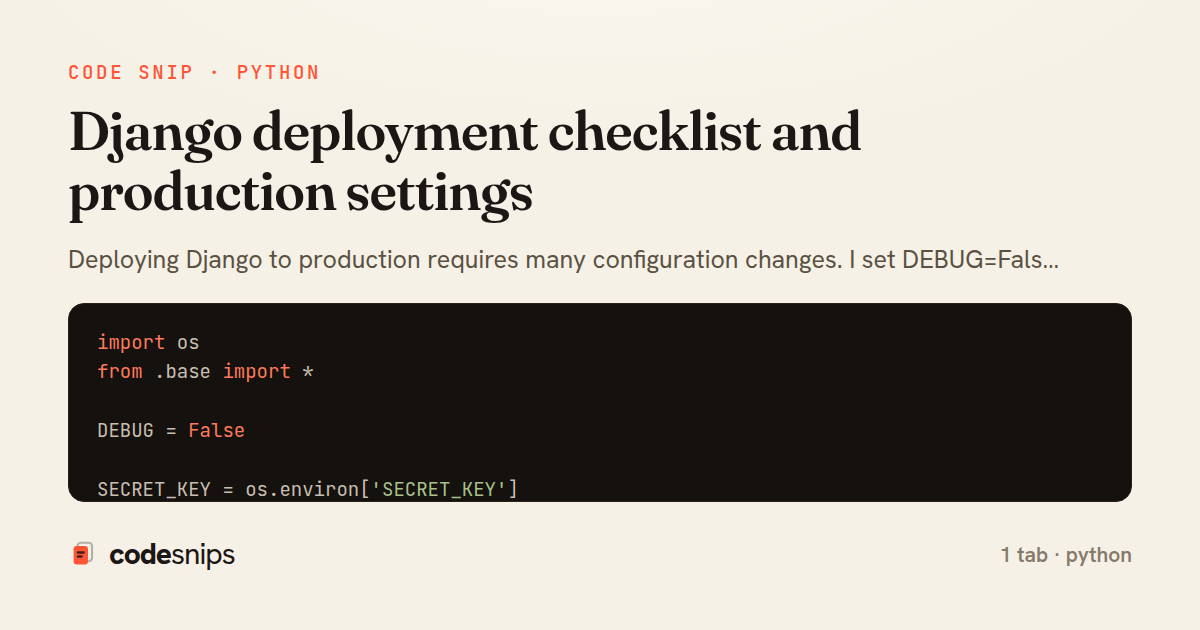
import os
from .base import *

DEBUG = False

SECRET_KEY = os.environ['SECRET_KEY']

ALLOWED_HOSTS = os.environ.get('ALLOWED_HOSTS', '').split(',')

# Security settings
SECURE_SSL_REDIRECT = True
SESSION_COOKIE_SECURE = True
CSRF_COOKIE_SECURE = True
SECURE_BROWSER_XSS_FILTER = True
SECURE_CONTENT_TYPE_NOSNIFF = True
X_FRAME_OPTIONS = 'DENY'
SECURE_HSTS_SECONDS = 31536000
SECURE_HSTS_INCLUDE_SUBDOMAINS = True
SECURE_HSTS_PRELOAD = True

# Database
DATABASES = {
    'default': {
        'ENGINE': 'django.db.backends.postgresql',
        'NAME': os.environ['DB_NAME'],
        'USER': os.environ['DB_USER'],
        'PASSWORD': os.environ['DB_PASSWORD'],
        'HOST': os.environ['DB_HOST'],
        'PORT': os.environ.get('DB_PORT', '5432'),
        'CONN_MAX_AGE': 600,
        'OPTIONS': {
            'sslmode': 'require',
        },
    }
}

# Static files
STATIC_ROOT = os.path.join(BASE_DIR, 'staticfiles')
STATICFILES_STORAGE = 'whitenoise.storage.CompressedManifestStaticFilesStorage'

# Media files
DEFAULT_FILE_STORAGE = 'storages.backends.s3boto3.S3Boto3Storage'
AWS_ACCESS_KEY_ID = os.environ['AWS_ACCESS_KEY_ID']
AWS_SECRET_ACCESS_KEY = os.environ['AWS_SECRET_ACCESS_KEY']
AWS_STORAGE_BUCKET_NAME = os.environ['AWS_STORAGE_BUCKET_NAME']

# Cache
CACHES = {
    'default': {
        'BACKEND': 'django_redis.cache.RedisCache',
        'LOCATION': os.environ['REDIS_URL'],
    }
}

# Email
EMAIL_BACKEND = 'django.core.mail.backends.smtp.EmailBackend'
EMAIL_HOST = os.environ['EMAIL_HOST']
EMAIL_PORT = int(os.environ.get('EMAIL_PORT', 587))
EMAIL_USE_TLS = True
EMAIL_HOST_USER = os.environ['EMAIL_USER']
EMAIL_HOST_PASSWORD = os.environ['EMAIL_PASSWORD']

# Logging
LOGGING = {
    'version': 1,
    'disable_existing_loggers': False,
    'handlers': {
        'file': {
            'level': 'ERROR',
            'class': 'logging.handlers.RotatingFileHandler',
            'filename': '/var/log/django/error.log',
            'maxBytes': 1024 * 1024 * 10,  # 10 MB
            'backupCount': 5,
        },
    },
    'loggers': {
        'django': {
            'handlers': ['file'],
            'level': 'ERROR',
            'propagate': True,
        },
    },
}
1 file · python
Explain with highlit
Deploying Django to production requires many configuration changes. I set DEBUG=False and configure ALLOWED_HOSTS. Security settings include SECURE_SSL_REDIRECT, SESSION_COOKIE_SECURE, CSRF_COOKIE_SECURE. I use environment variables for secrets. Static files are served via CDN or whitenoise. I configure logging to files or external services. Database has connection pooling and backups. I use gunicorn or uwsgi with multiple workers. SSL certificates via Let's Encrypt. I run check --deploy for security review. This ensures Django runs safely and performantly in production.
Related snips
python
import os
import stat

for root, _dirs, files in os.walk('/etc'):
    for name in files:
        path = os.path.join(root, name)
Python security audit script for exposed risky filesystem state
python
auditing
host-security
by Kai Nakamura
1 tab
python
class Product(models.Model):
    name = models.CharField(max_length=200)
    slug = models.SlugField(blank=True)
    price = models.DecimalField(max_digits=10, decimal_places=2)
    cost = models.DecimalField(max_digits=10, decimal_places=2)
    margin = models.DecimalField(max_digits=5, decimal_places=2, blank=True)
Django model signals vs overriding save
django
python
models
by Priya Sharma
2 tabs
python
from django.urls import path
from . import views

app_name = 'blog'

urlpatterns = [
Django URL namespacing and reverse lookups
django
python
urls
by Priya Sharma
3 tabs
python
import graphene
from graphene_django import DjangoObjectType
from blog.models import Post, Comment


class PostType(DjangoObjectType):
Django GraphQL with Graphene
django
python
graphql
by Priya Sharma
2 tabs
python
from django.db.models import Count, Avg, Sum, Q, F
from django.views.generic import TemplateView
from products.models import Product, Order, OrderItem


class DashboardView(TemplateView):
Django aggregation with annotate for statistics
django
python
database
by Priya Sharma
1 tab
python
from rest_framework import permissions


class IsOwner(permissions.BasePermission):
    """Allow only object owner to access."""
Django REST Framework permissions and authorization
django
python
rest
by Priya Sharma
2 tabs
Share this code
Here's the card — post it anywhere.