package hotpath

import "testing"

func BenchmarkParse(b *testing.B) {
  b.ReportAllocs()
  payload := []byte("id=123&status=active&limit=50")

  b.ResetTimer()
  for i := 0; i < b.N; i++ {
    _ = parse(payload)
  }
}

func parse(_ []byte) map[string]string {
  // placeholder for the thing you actually benchmark
  return map[string]string{"ok": "true"}
}
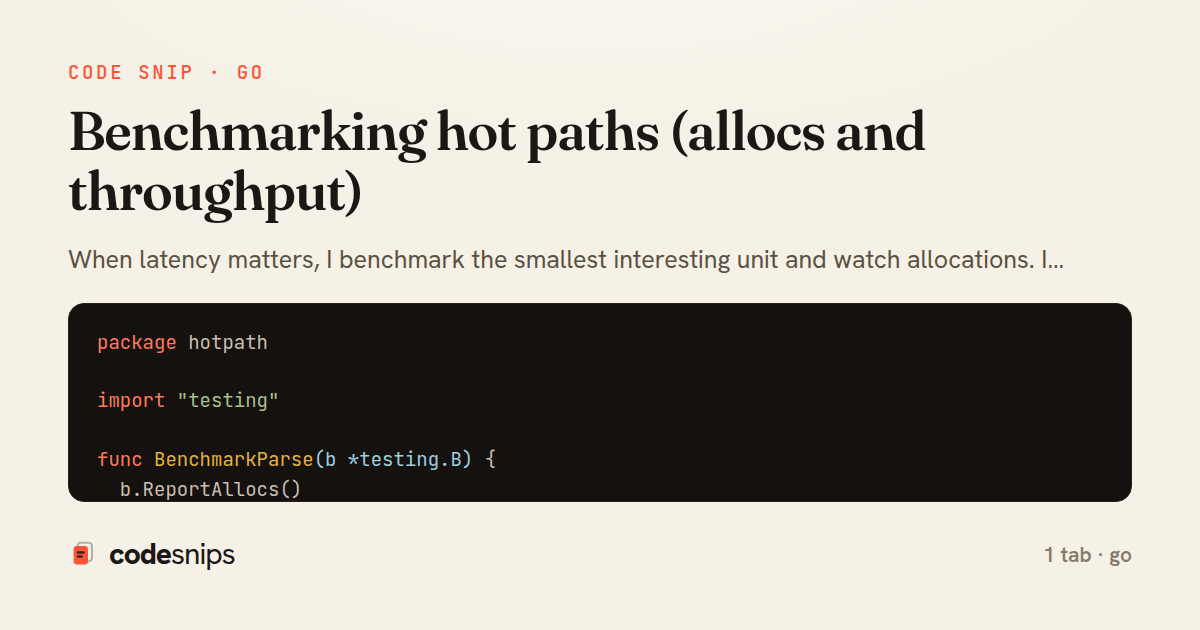
When latency matters, I benchmark the smallest interesting unit and watch allocations. In Go, a surprising number of regressions come from accidental heap churn: converting []byte to string, building lots of temporary maps, or using fmt.Sprintf in loops. A benchmark with b.ReportAllocs() and b.ResetTimer() gives you fast feedback. The other key is realism: seed representative payload sizes so the benchmark reflects production. Once a baseline exists, it’s easy to see whether a refactor made things worse. I also like to run benchmarks with -benchmem and keep an eye on allocs/op; it’s often a better leading indicator than raw ns/op. Benchmarks aren’t for micro-optimizing everything—just the paths you call millions of times.
Related snips
package api

import (
  "net/http"
  "runtime/debug"
)
Expose build metadata for debugging deploys
package dbutil

import (
  "context"

  "github.com/jackc/pgconn"
Retry Postgres serialization failures with bounded attempts
require "csv"

class PeopleCsvStream
  include Enumerable

  HEADERS = %w[id full_name email signed_up_at plan].freeze
Resilient CSV Export as a Streamed Response
Rails.application.configure do
  config.after_initialize do
    Bullet.enable = true
    Bullet.alert = false
    Bullet.bullet_logger = true
    Bullet.console = true
N+1 query detection with Bullet gem
json.array! @posts do |post|
  json.cache! ['v1', post], expires_in: 1.hour do
    json.id post.id
    json.title post.title
    json.excerpt post.excerpt
    json.published_at post.published_at
Fragment caching for expensive JSON serialization
package files

import (
  "context"
  "time"
Presigned S3 upload URLs (AWS SDK v2)
Share this code
Here's the card — post it anywhere.