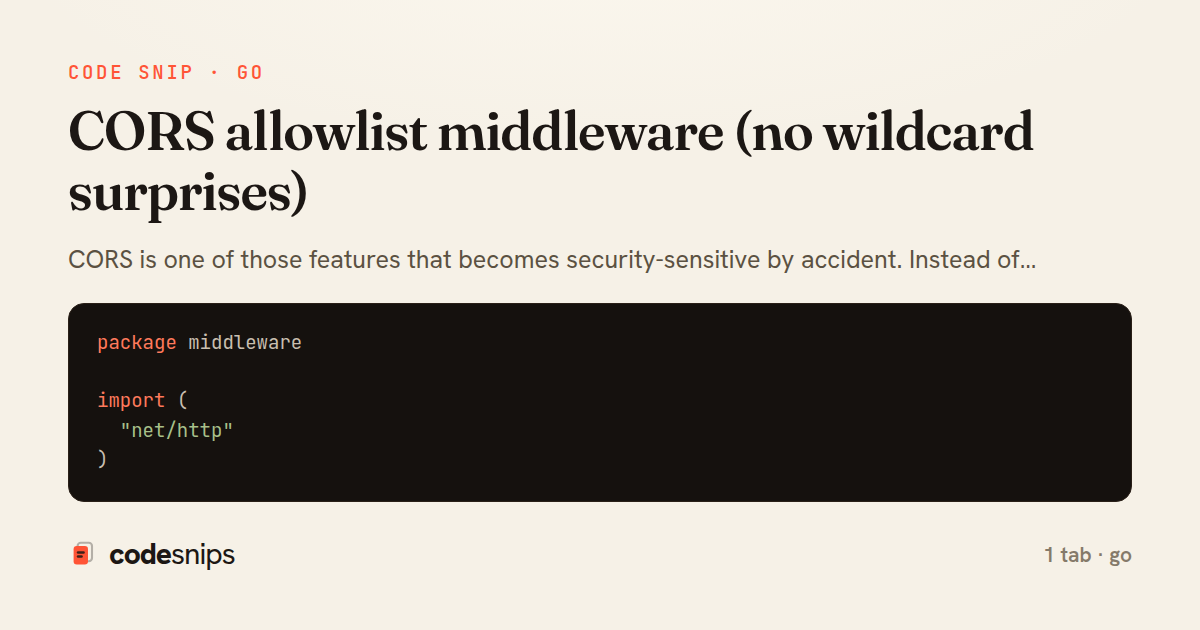
package middleware

import (
  "net/http"
)

func CORS(allowed map[string]struct{}) func(http.Handler) http.Handler {
  return func(next http.Handler) http.Handler {
    return http.HandlerFunc(func(w http.ResponseWriter, r *http.Request) {
      origin := r.Header.Get("Origin")
      if origin != "" {
        if _, ok := allowed[origin]; ok {
          w.Header().Set("Access-Control-Allow-Origin", origin)
          w.Header().Set("Access-Control-Allow-Methods", "GET,POST,PUT,PATCH,DELETE,OPTIONS")
          w.Header().Set("Access-Control-Allow-Headers", "Authorization,Content-Type,Idempotency-Key")
          w.Header().Set("Vary", "Origin")
        }
      }

      if r.Method == http.MethodOptions {
        w.WriteHeader(http.StatusNoContent)
        return
      }
      next.ServeHTTP(w, r)
    })
  }
}
CORS is one of those features that becomes security-sensitive by accident. Instead of Access-Control-Allow-Origin: *, I keep a strict allowlist and echo back the exact origin only when it’s approved. I also handle OPTIONS preflight requests explicitly and set Vary: Origin so caches don’t mix responses across origins. The important detail is credentials: if you ever set Access-Control-Allow-Credentials: true, you must never use wildcard origins. This middleware keeps the logic in one place and makes it easy to audit. In production, I treat the allowlist as configuration and include both local dev origins and the real domains. With this in place, frontend integration becomes predictable and you avoid accidental cross-site exposure.
Related snips
package api

import (
  "net/http"
  "runtime/debug"
)
Expose build metadata for debugging deploys
payload = {
  sub: user.id,
  iss: 'https://auth.example.com',
  aud: 'codesnips-api',
  exp: 15.minutes.from_now.to_i,
  iat: Time.now.to_i,
JWT issuance and verification without common footguns
export interface RetryOptions {
  retries: number;
  baseMs: number;
  maxMs: number;
  signal?: AbortSignal;
  onRetry?: (attempt: number, delay: number, err: unknown) => void;
Exponential backoff with jitter for retries
package dbutil

import (
  "context"

  "github.com/jackc/pgconn"
Retry Postgres serialization failures with bounded attempts
#!/usr/bin/env bash
set -euo pipefail

export VAULT_ADDR="https://vault.internal:8200"
export VAULT_TOKEN="${VAULT_TOKEN:?missing VAULT_TOKEN}"
Secrets management with environment isolation and Vault
import { randomBytes, createHash } from "crypto";
import jwt from "jsonwebtoken";
import { RefreshTokenStore } from "./store";

const ACCESS_SECRET = process.env.ACCESS_SECRET!;
const ACCESS_TTL = "15m";
JWT access + refresh token rotation (conceptual)
Share this code
Here's the card — post it anywhere.