go
26 lines · 1 tab
Leah Thompson
Jan 2026
1 tab
package admin

import (
  "net/http"
  "net/http/pprof"
)

func basicAuth(user, pass string, next http.Handler) http.Handler {
  return http.HandlerFunc(func(w http.ResponseWriter, r *http.Request) {
    u, p, ok := r.BasicAuth()
    if !ok || u != user || p != pass {
      w.Header().Set("WWW-Authenticate", `Basic realm="pprof"`)
      http.Error(w, "unauthorized", http.StatusUnauthorized)
      return
    }
    next.ServeHTTP(w, r)
  })
}

func Handler(user, pass string) http.Handler {
  mux := http.NewServeMux()
  mux.HandleFunc("/debug/pprof/", pprof.Index)
  mux.HandleFunc("/debug/pprof/profile", pprof.Profile)
  mux.HandleFunc("/debug/pprof/heap", pprof.Handler("heap").ServeHTTP)
  return basicAuth(user, pass, mux)
}
1 file · go
Explain with highlit
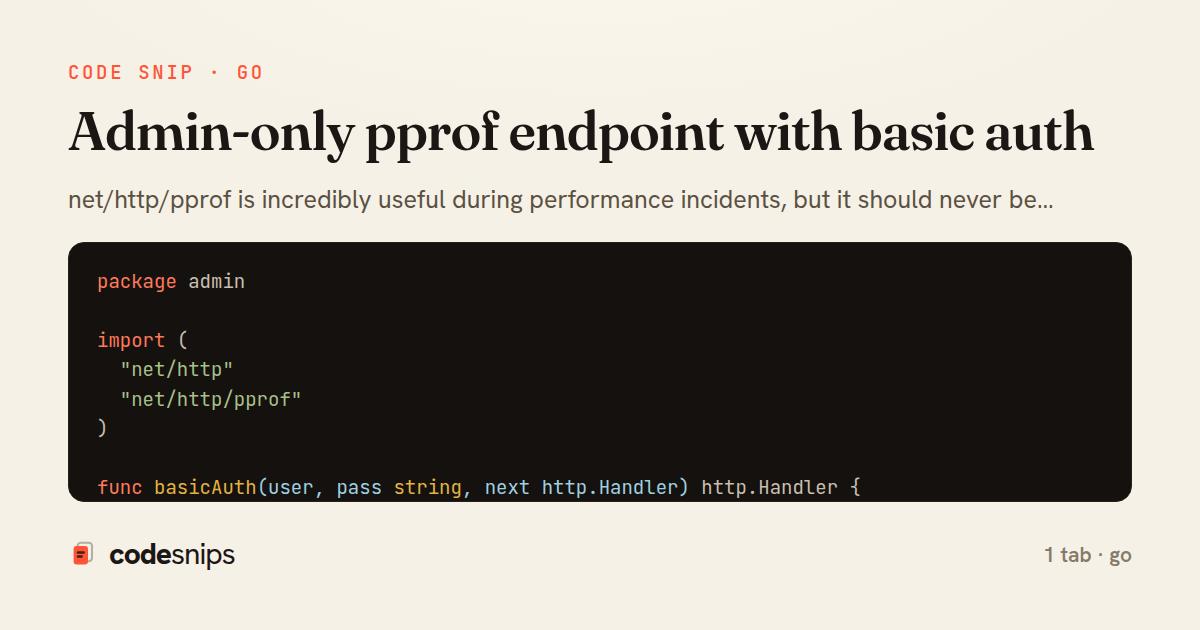
net/http/pprof is incredibly useful during performance incidents, but it should never be open to the public internet. I register the pprof handlers on a separate mux and wrap them with Basic Auth (or, better, your real auth middleware). The important practice is separation: run pprof on an internal port, bind it to 127.0.0.1 in non-container environments, and gate it in Kubernetes via an internal Service. The code below shows a minimal wrapper that checks credentials, then forwards to the pprof handler. In production, I also add a timeout and a rate limit because profiles can be expensive. With this in place, you can grab CPU/heap profiles safely without turning diagnostics into a security incident.
Related snips
go
package api

import (
  "net/http"
  "runtime/debug"
)
Expose build metadata for debugging deploys
go
observability
build
by Leah Thompson
1 tab
ruby
payload = {
  sub: user.id,
  iss: 'https://auth.example.com',
  aud: 'codesnips-api',
  exp: 15.minutes.from_now.to_i,
  iat: Time.now.to_i,
JWT issuance and verification without common footguns
jwt
authentication
api
by Kai Nakamura
2 tabs
go
package dbutil

import (
  "context"

  "github.com/jackc/pgconn"
Retry Postgres serialization failures with bounded attempts
go
postgres
transactions
by Leah Thompson
1 tab
rust
use tracing::{info, instrument};

#[instrument]
fn process_request(user_id: u64) {
    info!(user_id, "Processing request");
    // Work happens here
tracing for structured logging and distributed tracing
rust
observability
tracing
by Marcus Chen
1 tab
bash
#!/usr/bin/env bash
set -euo pipefail

export VAULT_ADDR="https://vault.internal:8200"
export VAULT_TOKEN="${VAULT_TOKEN:?missing VAULT_TOKEN}"
Secrets management with environment isolation and Vault
secrets-management
vault
environment-variables
by Kai Nakamura
1 tab
typescript
import { randomBytes, createHash } from "crypto";
import jwt from "jsonwebtoken";
import { RefreshTokenStore } from "./store";

const ACCESS_SECRET = process.env.ACCESS_SECRET!;
const ACCESS_TTL = "15m";
JWT access + refresh token rotation (conceptual)
security
node
jwt
by codesnips
3 tabs
Share this code
Here's the card — post it anywhere.