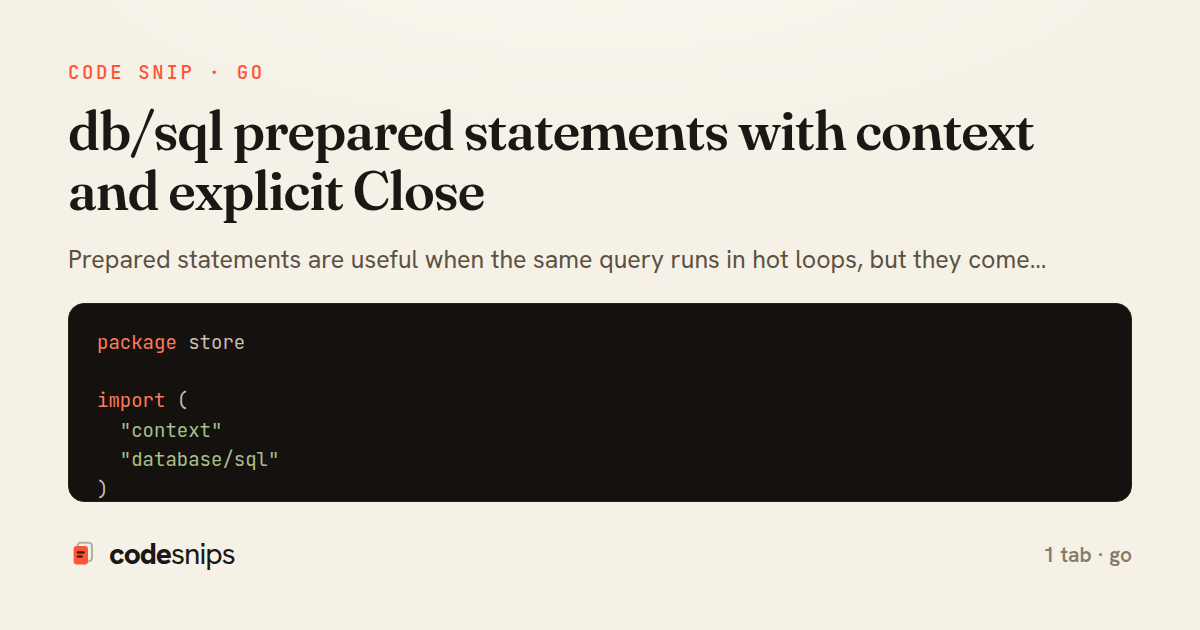
package store

import (
  "context"
  "database/sql"
)

type Queries struct {
  db         *sql.DB
  getByEmail *sql.Stmt
}

func New(db *sql.DB) (*Queries, error) {
  stmt, err := db.Prepare(`SELECT id FROM users WHERE email = $1`)
  if err != nil {
    return nil, err
  }
  return &Queries{db: db, getByEmail: stmt}, nil
}

func (q *Queries) Close() error {
  return q.getByEmail.Close()
}

func (q *Queries) UserIDByEmail(ctx context.Context, email string) (string, error) {
  var id string
  err := q.getByEmail.QueryRowContext(ctx, email).Scan(&id)
  return id, err
}
Prepared statements are useful when the same query runs in hot loops, but they come with lifecycle responsibilities. I prepare once (usually at startup), store the *sql.Stmt, and always close it on shutdown. The important detail is still using QueryRowContext so deadlines and cancellations work; prepared statements don’t magically inherit context. This pattern is also safer than building SQL strings in loops and it can reduce parse overhead on the database side. In production, I pair this with context.WithTimeout at the handler layer and with metrics for query latency so slow queries are obvious. The example below shows a small wrapper that provides a typed method around a prepared statement, keeping call sites clean and consistent.
Related snips
package api

import (
  "net/http"
  "runtime/debug"
)
Expose build metadata for debugging deploys
package dbutil

import (
  "context"

  "github.com/jackc/pgconn"
Retry Postgres serialization failures with bounded attempts
require "csv"

class PeopleCsvStream
  include Enumerable

  HEADERS = %w[id full_name email signed_up_at plan].freeze
Resilient CSV Export as a Streamed Response
Rails.application.configure do
  config.after_initialize do
    Bullet.enable = true
    Bullet.alert = false
    Bullet.bullet_logger = true
    Bullet.console = true
N+1 query detection with Bullet gem
json.array! @posts do |post|
  json.cache! ['v1', post], expires_in: 1.hour do
    json.id post.id
    json.title post.title
    json.excerpt post.excerpt
    json.published_at post.published_at
Fragment caching for expensive JSON serialization
# BAD: N+1 query problem
@users = User.all
@users.each do |user|
  puts user.posts.count  # Fires query for each user!
end
ActiveRecord query optimization and N+1 prevention
Share this code
Here's the card — post it anywhere.