package consumers

import (
  "context"

  "github.com/jackc/pgx/v5/pgxpool"
)

func TryMarkProcessed(ctx context.Context, db *pgxpool.Pool, eventID string) (bool, error) {
  ct, err := db.Exec(ctx, `INSERT INTO processed_events(event_id) VALUES($1) ON CONFLICT DO NOTHING`, eventID)
  if err != nil {
    return false, err
  }
  return ct.RowsAffected() == 1, nil
}
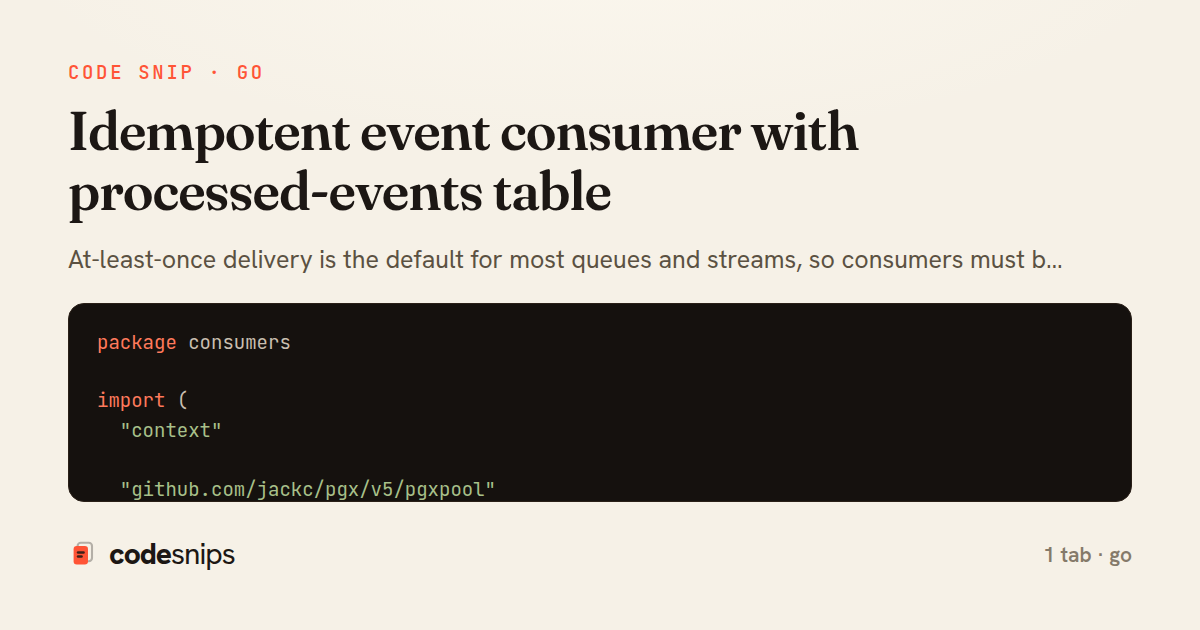
At-least-once delivery is the default for most queues and streams, so consumers must be idempotent. My go-to pattern is a processed_events table keyed by event_id with a unique constraint. When a message arrives, the consumer tries to insert event_id; if it’s already present, the message is a duplicate and can be safely skipped. The database uniqueness constraint is the real guarantee across instances and restarts. The rest of the handler can then assume “this event is new” and apply state changes. In production, I also store a processed_at timestamp and sometimes an event_type for debugging. This approach is simple, observable, and resilient to retries and rebalances, especially when combined with transactional writes (insert processed marker + domain update) so duplicates can’t slip through on partial failures.
Related snips
package api

import (
  "net/http"
  "runtime/debug"
)
Expose build metadata for debugging deploys
export interface RetryOptions {
  retries: number;
  baseMs: number;
  maxMs: number;
  signal?: AbortSignal;
  onRetry?: (attempt: number, delay: number, err: unknown) => void;
Exponential backoff with jitter for retries
package dbutil

import (
  "context"

  "github.com/jackc/pgconn"
Retry Postgres serialization failures with bounded attempts
require "csv"

class PeopleCsvStream
  include Enumerable

  HEADERS = %w[id full_name email signed_up_at plan].freeze
Resilient CSV Export as a Streamed Response
class AddSettingsToAccounts < ActiveRecord::Migration[7.1]
  disable_ddl_transaction!

  def change
    add_column :accounts, :settings, :jsonb, null: false, default: {}
Postgres JSONB Partial Index for Feature Flags
package files

import (
  "context"
  "time"
Presigned S3 upload URLs (AWS SDK v2)
Share this code
Here's the card — post it anywhere.