package api

import (
  "io"
  "net/http"
)

func DetectType(f io.Reader) (string, []byte, error) {
  buf := make([]byte, 512)
  n, err := io.ReadFull(f, buf)
  if err != nil && err != io.EOF && err != io.ErrUnexpectedEOF {
    return "", nil, err
  }
  buf = buf[:n]
  return http.DetectContentType(buf), buf, nil
}
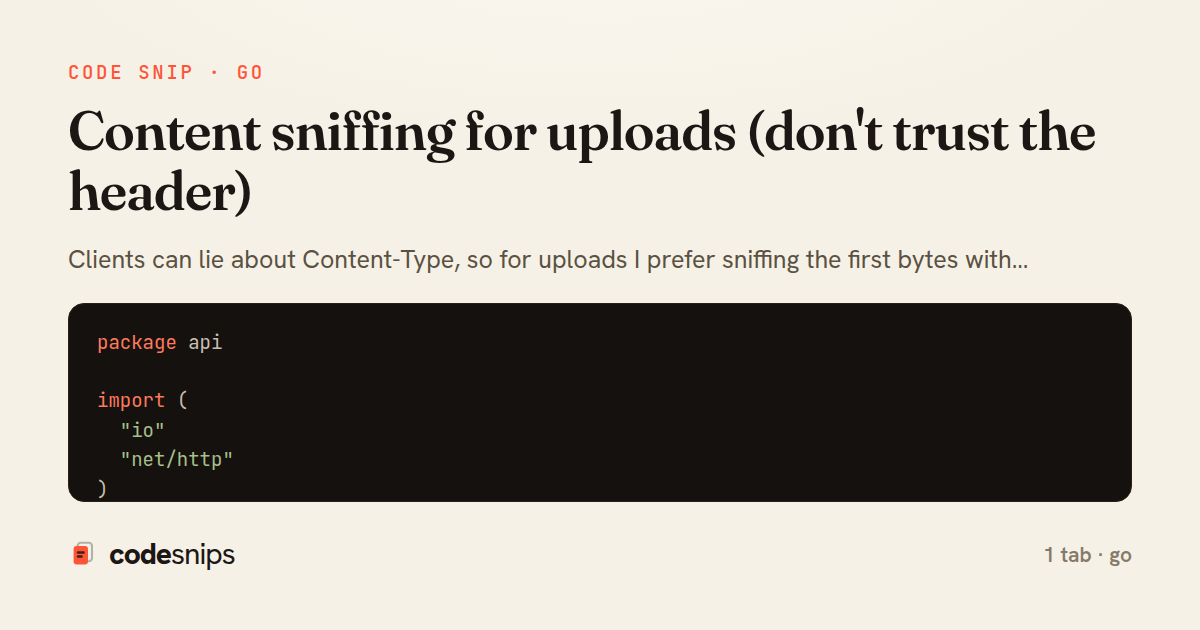
Clients can lie about Content-Type, so for uploads I prefer sniffing the first bytes with http.DetectContentType. The safe flow is: open the multipart file, read a small prefix, detect type, then rewind (or re-open) before writing to disk or object storage. This keeps you from accepting “image/png” that is actually an executable, and it reduces surprises in downstream processing. I also enforce a maximum size at the HTTP layer with MaxBytesReader and validate file extensions only as a secondary signal. In production, I keep an allowlist of MIME types per upload endpoint (avatars vs PDFs vs videos) and I log rejections with request IDs. This snippet demonstrates the minimal sniffing step that makes upload validation meaningfully safer.
Related snips
package api

import (
  "net/http"
  "runtime/debug"
)
Expose build metadata for debugging deploys
payload = {
  sub: user.id,
  iss: 'https://auth.example.com',
  aud: 'codesnips-api',
  exp: 15.minutes.from_now.to_i,
  iat: Time.now.to_i,
JWT issuance and verification without common footguns
export interface RetryOptions {
  retries: number;
  baseMs: number;
  maxMs: number;
  signal?: AbortSignal;
  onRetry?: (attempt: number, delay: number, err: unknown) => void;
Exponential backoff with jitter for retries
package dbutil

import (
  "context"

  "github.com/jackc/pgconn"
Retry Postgres serialization failures with bounded attempts
#!/usr/bin/env bash
set -euo pipefail

export VAULT_ADDR="https://vault.internal:8200"
export VAULT_TOKEN="${VAULT_TOKEN:?missing VAULT_TOKEN}"
Secrets management with environment isolation and Vault
import { randomBytes, createHash } from "crypto";
import jwt from "jsonwebtoken";
import { RefreshTokenStore } from "./store";

const ACCESS_SECRET = process.env.ACCESS_SECRET!;
const ACCESS_TTL = "15m";
JWT access + refresh token rotation (conceptual)
Share this code
Here's the card — post it anywhere.