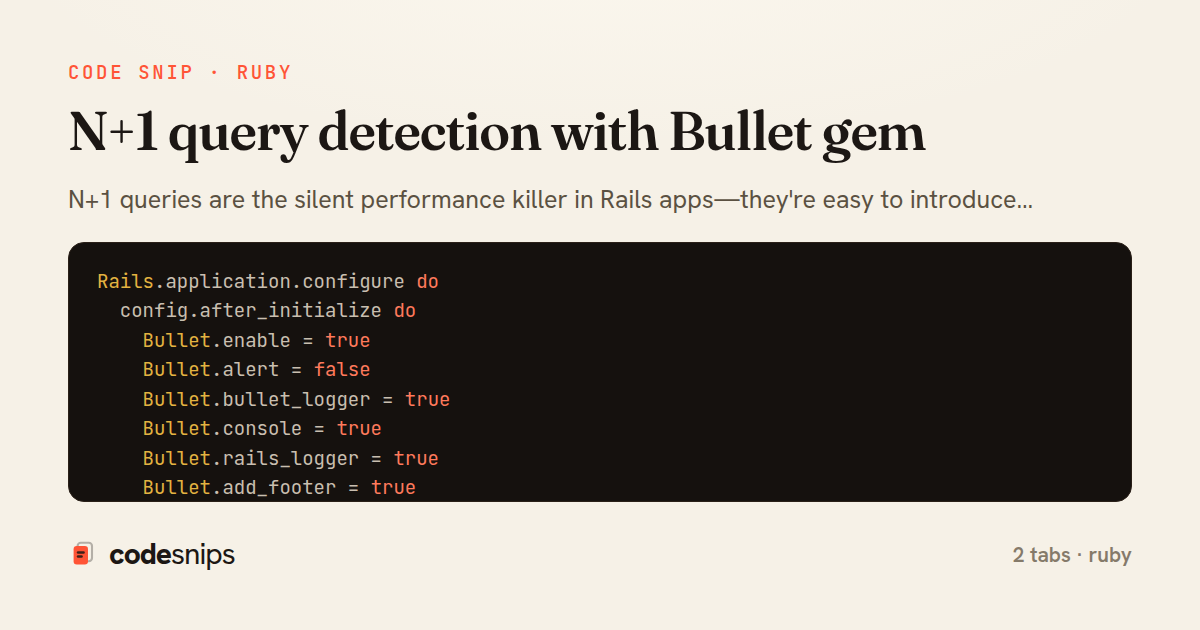
Rails.application.configure do
  config.after_initialize do
    Bullet.enable = true
    Bullet.alert = false
    Bullet.bullet_logger = true
    Bullet.console = true
    Bullet.rails_logger = true
    Bullet.add_footer = true
    Bullet.skip_html_injection = false
  end
end
Rails.application.configure do
  config.after_initialize do
    Bullet.enable = true
    Bullet.raise = true
    Bullet.bullet_logger = true
  end
end
N+1 queries are the silent performance killer in Rails apps—they're easy to introduce during rapid development and expensive to diagnose in production. The Bullet gem monitors queries during development and test runs, raising alerts when it detects missing eager_load, includes, or preload calls. I configure it to raise exceptions in test mode so the CI pipeline catches regressions before they reach production. The most valuable insight Bullet provides is distinguishing between true N+1 issues and acceptable single queries, which helps prioritize optimization efforts. Once Bullet is integrated, I can refactor with confidence knowing that I'm not accidentally removing necessary eager loading that prevents hundreds of roundtrips to the database.
Related snips
class CommentsController < ApplicationController
  before_action :set_post

  def create
    @comment = @post.comments.build(comment_params)
System test: asserting Turbo Stream responses
class Post < ApplicationRecord
  belongs_to :author, class_name: 'User'
  has_many :comments, dependent: :destroy

  scope :published, -> { where.not(published_at: nil).where('published_at <= ?', Time.current) }
  scope :draft, -> { where(published_at: nil) }
ActiveRecord scopes for reusable query logic
module Api
  module V1
    class UsersController < BaseController
      def show
        user = User.includes(:profile).find(params[:id])
ETags for conditional requests and caching
class PostsController < ApplicationController
  def index
    @posts = Post.includes(:author)
                 .order(created_at: :desc)
                 .page(params[:page])
                 .per(10)
Turbo Frames: infinite scroll with lazy-loading frame
require "csv"

class PeopleCsvStream
  include Enumerable

  HEADERS = %w[id full_name email signed_up_at plan].freeze
Resilient CSV Export as a Streamed Response
<form data-controller="query-sync" data-action="change->query-sync#apply">
  <select name="status" class="rounded border p-2">
    <option value="">Any</option>
    <option value="open">Open</option>
    <option value="closed">Closed</option>
  </select>
Filter UI that syncs query params via Stimulus (no front-end router)
Share this code
Here's the card — post it anywhere.