class HealthController < ApplicationController
  skip_before_action :verify_authenticity_token

  def liveness
    render json: { status: 'ok' }, status: :ok
  end

  def readiness
    checks = {
      database: check_database,
      redis: check_redis,
      sidekiq: check_sidekiq
    }

    all_healthy = checks.values.all? { |status| status == 'ok' }
    status_code = all_healthy ? :ok : :service_unavailable

    render json: { status: all_healthy ? 'ok' : 'degraded', checks: checks }, status: status_code
  end

  private

  def check_database
    ActiveRecord::Base.connection.execute('SELECT 1')
    'ok'
  rescue StandardError
    'failed'
  end

  def check_redis
    Redis.current.ping == 'PONG' ? 'ok' : 'failed'
  rescue StandardError
    'failed'
  end

  def check_sidekiq
    Sidekiq.redis(&:ping) == 'PONG' ? 'ok' : 'failed'
  rescue StandardError
    'failed'
  end
end
Rails.application.routes.draw do
  get 'health/liveness', to: 'health#liveness'
  get 'health/readiness', to: 'health#readiness'
end
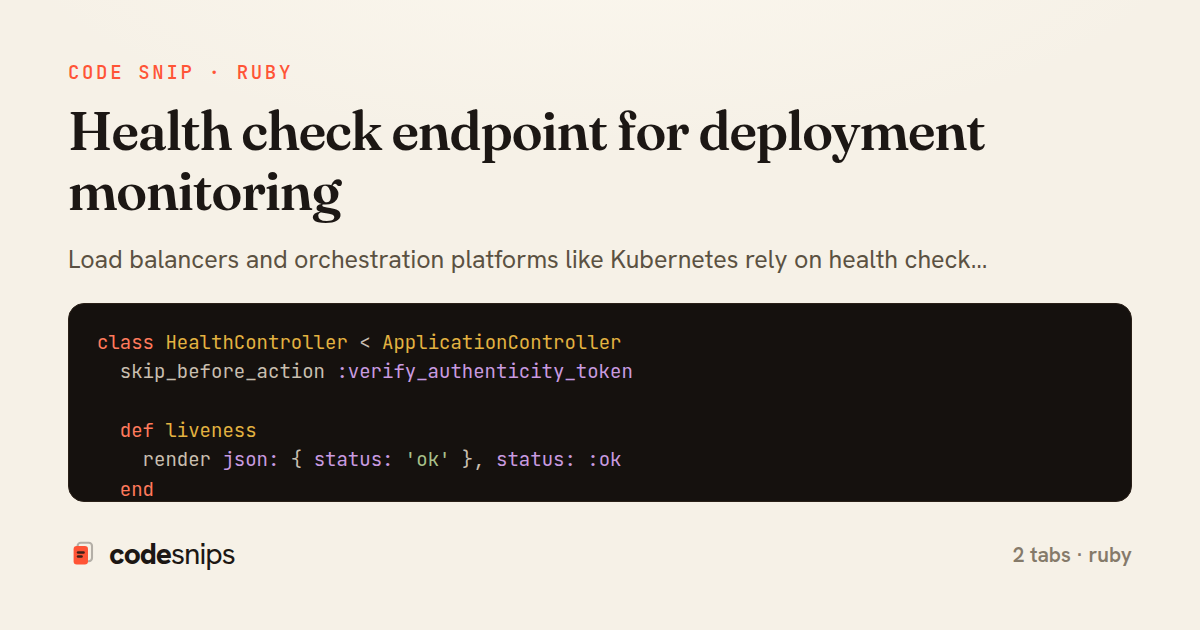
Load balancers and orchestration platforms like Kubernetes rely on health check endpoints to determine if an application instance is ready to serve traffic. A robust health check doesn't just return 200 OK—it verifies critical dependencies like database connectivity, Redis availability, and background job processing. I implement separate /health/liveness and /health/readiness endpoints: liveness checks if the app process is running, while readiness checks if all dependencies are available. This distinction allows orchestrators to restart unhealthy instances while giving newly deployed instances time to warm up before receiving traffic. Health checks should complete quickly (under 100ms) to avoid triggering false positives during traffic spikes.
Related snips
class CommentsController < ApplicationController
  before_action :set_post

  def create
    @comment = @post.comments.build(comment_params)
System test: asserting Turbo Stream responses
class Post < ApplicationRecord
  belongs_to :author, class_name: 'User'
  has_many :comments, dependent: :destroy

  scope :published, -> { where.not(published_at: nil).where('published_at <= ?', Time.current) }
  scope :draft, -> { where(published_at: nil) }
ActiveRecord scopes for reusable query logic
module Api
  module V1
    class UsersController < BaseController
      def show
        user = User.includes(:profile).find(params[:id])
ETags for conditional requests and caching
class PostsController < ApplicationController
  def index
    @posts = Post.includes(:author)
                 .order(created_at: :desc)
                 .page(params[:page])
                 .per(10)
Turbo Frames: infinite scroll with lazy-loading frame
require "csv"

class PeopleCsvStream
  include Enumerable

  HEADERS = %w[id full_name email signed_up_at plan].freeze
Resilient CSV Export as a Streamed Response
<form data-controller="query-sync" data-action="change->query-sync#apply">
  <select name="status" class="rounded border p-2">
    <option value="">Any</option>
    <option value="open">Open</option>
    <option value="closed">Closed</option>
  </select>
Filter UI that syncs query params via Stimulus (no front-end router)
Share this code
Here's the card — post it anywhere.