class TransferFundsService
  def initialize(from_account:, to_account:, amount:)
    @from_account = from_account
    @to_account = to_account
    @amount = amount
  end

  def call
    ActiveRecord::Base.transaction do
      # Lock rows to prevent concurrent modifications
      from = Account.lock.find(@from_account.id)
      to = Account.lock.find(@to_account.id)

      raise InsufficientFundsError if from.balance < @amount

      from.update!(balance: from.balance - @amount)
      to.update!(balance: to.balance + @amount)

      Transaction.create!(
        from_account: from,
        to_account: to,
        amount: @amount,
        status: 'completed'
      )
    end

    Result.success
  rescue InsufficientFundsError => e
    Result.failure(error: 'INSUFFICIENT_FUNDS')
  rescue StandardError => e
    Rails.logger.error("TransferFundsService failed: #{e.message}")
    Result.failure(error: 'TRANSFER_FAILED')
  end
end
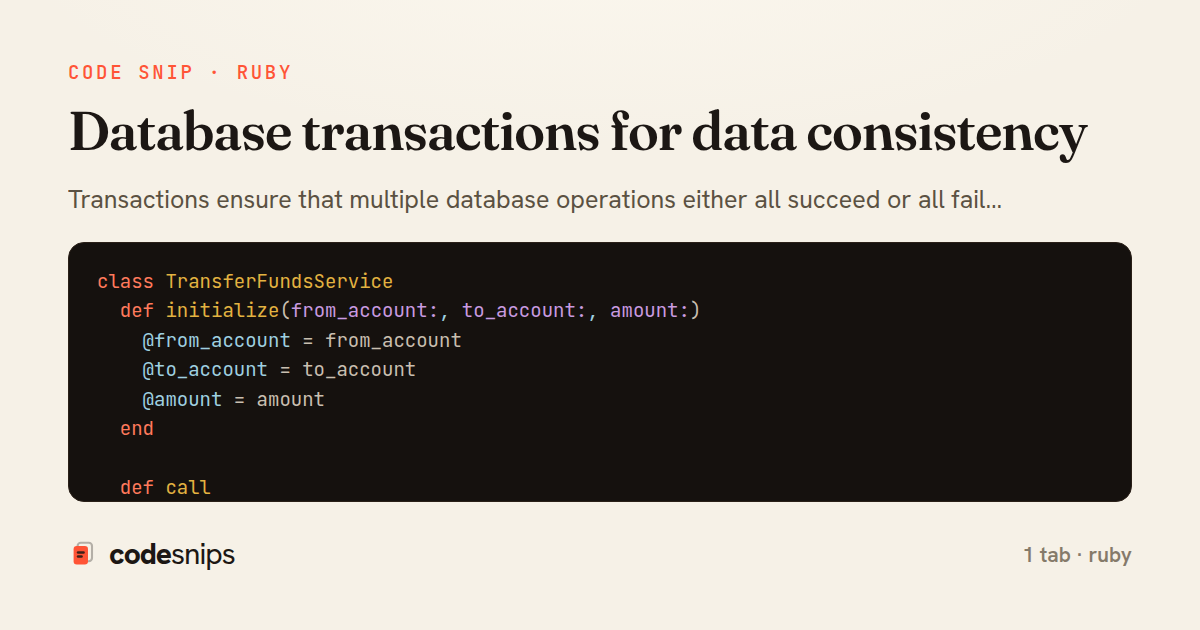
Transactions ensure that multiple database operations either all succeed or all fail together, preventing partial updates that leave data in inconsistent states. Rails provides ActiveRecord::Base.transaction which wraps a block of code in a database transaction. If any exception is raised within the block, all changes are rolled back automatically. This is critical for operations like transferring funds, creating orders with line items, or any workflow where related records must remain synchronized. I'm careful to keep transaction blocks focused and fast—long-running operations or external API calls inside transactions can cause lock contention and deadlocks. For complex workflows, I use database-level constraints as a second line of defense against invariant violations.
Related snips
class CommentsController < ApplicationController
  before_action :set_post

  def create
    @comment = @post.comments.build(comment_params)
System test: asserting Turbo Stream responses
class Post < ApplicationRecord
  belongs_to :author, class_name: 'User'
  has_many :comments, dependent: :destroy

  scope :published, -> { where.not(published_at: nil).where('published_at <= ?', Time.current) }
  scope :draft, -> { where(published_at: nil) }
ActiveRecord scopes for reusable query logic
module Api
  module V1
    class UsersController < BaseController
      def show
        user = User.includes(:profile).find(params[:id])
ETags for conditional requests and caching
class PostsController < ApplicationController
  def index
    @posts = Post.includes(:author)
                 .order(created_at: :desc)
                 .page(params[:page])
                 .per(10)
Turbo Frames: infinite scroll with lazy-loading frame
require "csv"

class PeopleCsvStream
  include Enumerable

  HEADERS = %w[id full_name email signed_up_at plan].freeze
Resilient CSV Export as a Streamed Response
<form data-controller="query-sync" data-action="change->query-sync#apply">
  <select name="status" class="rounded border p-2">
    <option value="">Any</option>
    <option value="open">Open</option>
    <option value="closed">Closed</option>
  </select>
Filter UI that syncs query params via Stimulus (no front-end router)
Share this code
Here's the card — post it anywhere.